. 2015 Jul 21;112(29):8914-21.
doi: 10.1073/pnas.1501713112.

Toward an evolutionary model of cancer: Considering the mechanisms that govern the fate of somatic mutations

Affiliations

Toward an evolutionary model of cancer: Considering the mechanisms that govern the fate of somatic mutations

Andrii I Rozhok et al. Proc Natl Acad Sci U S A. .

Abstract

Our understanding of cancer has greatly advanced since Nordling [Nordling CO (1953) Br J Cancer 7(1):68-72] and Armitage and Doll [Armitage P, Doll R (1954) Br J Cancer 8(1):1-12] put forth the multistage model of carcinogenesis. However, a number of observations remain poorly understood from the standpoint of this paradigm in its contemporary state. These observations include the similar age-dependent exponential rise in incidence of cancers originating from stem/progenitor pools differing drastically in size, age-dependent cell division profiles, and compartmentalization. This common incidence pattern is characteristic of cancers requiring different numbers of oncogenic mutations, and it scales to very divergent life spans of mammalian species. Also, bigger mammals with larger underlying stem cell pools are not proportionally more prone to cancer, an observation known as Peto's paradox. Here, we present a number of factors beyond the occurrence of oncogenic mutations that are unaccounted for in the current model of cancer development but should have significant impacts on cancer incidence. Furthermore, we propose a revision of the current understanding for how oncogenic and other functional somatic mutations affect cellular fitness. We present evidence, substantiated by evolutionary theory, demonstrating that fitness is a dynamic environment-dependent property of a phenotype and that oncogenic mutations should have vastly different fitness effects on somatic cells dependent on the tissue microenvironment in an age-dependent manner. Combined, this evidence provides a firm basis for understanding the age-dependent incidence of cancers as driven by age-altered systemic processes regulated above the cell level.

Keywords: aging; cancer; fitness; oncogenic mutations; somatic evolution.


Conflict of interest statement

The authors declare no conflict of interest.

Figures
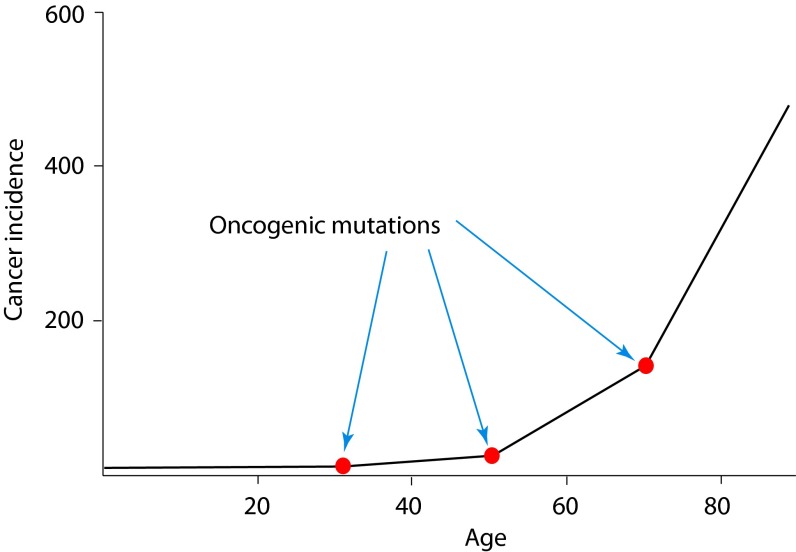
Fig. 1.
Fig. 1.
Armitage and Doll’s model of sequential oncogenic mutation accumulation over time (2). Each oncogenic mutation is thought to add a certain fitness advantage to the recipient cell, which is believed to explain the exponential increase in cancer incidence. General mutation accumulation probability over time is considered. The effect of tissue-specific clonal dynamics on the probability of sequential mutation accumulation in one cell (Fig. 4 and Eq. 3), necessary for multistage carcinogenesis, as opposed to the general probability of oncogenic mutations over time, is not accounted for. Dynamic, microenvironment-dependent fitness effects of mutations (Fig. 3), which should affect clonal dynamics of premalignant contexts in an age-dependent manner, are not considered.
Fig. 2.
Fig. 2.
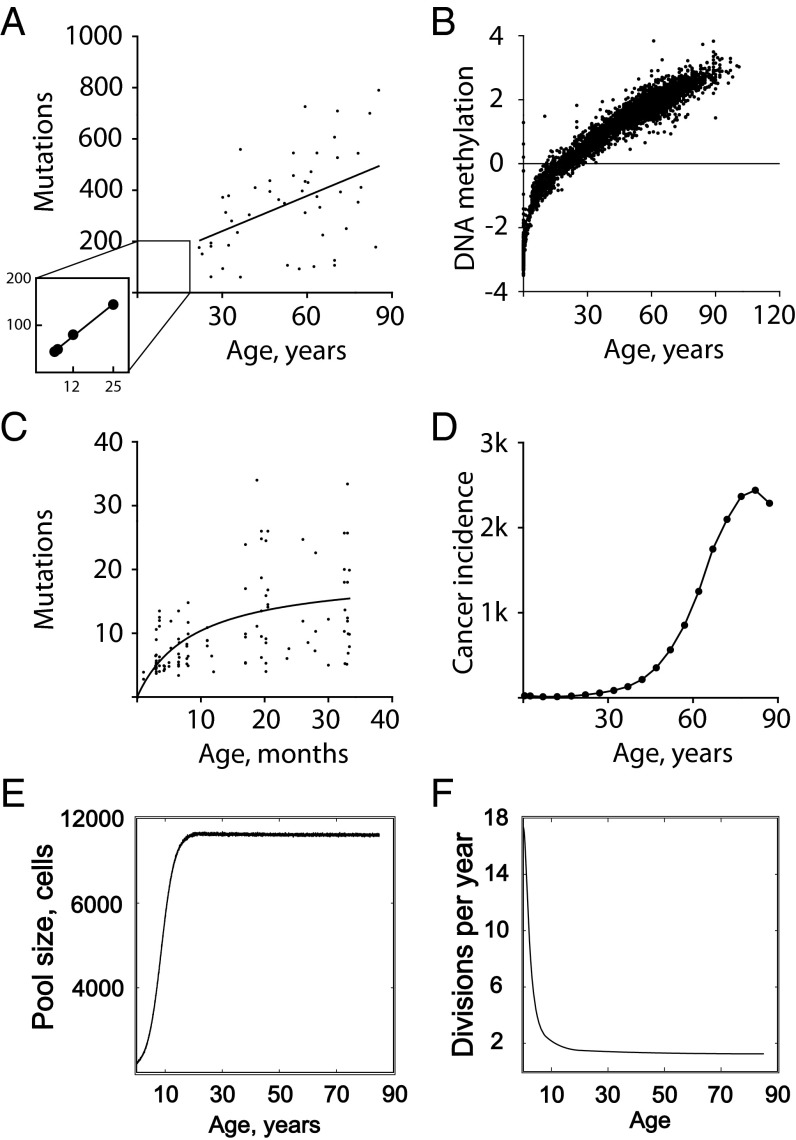
Nonlinear changes in genetic damage accumulation, cancer incidence, and SC dynamics with age. (A) Accumulation of neutral mutations (tier 3 genome) in acute megakaryoblastic leukemia (early postnatal phase) and acute myeloid leukemia (adult ages) genomes (15, 68). (B) Accumulation of DNA methylation in hematopoietic tissues (a similar pattern was found for other tissues as well) (14). (C) Accumulation of mutations in mouse tissues (combined data for spleen, intestine, heart, brain, and liver) (13, 61, 69). (D) Total cancer incidence in humans (www.seer.cancer.gov). (E) Rapid increase in the size of HSC pools during body growth in humans (21, 64). (F) HSC division rates slow down dramatically before body maturation in humans (17); a similar pattern has been found in mice (16).
Fig. 3.
Fig. 3.
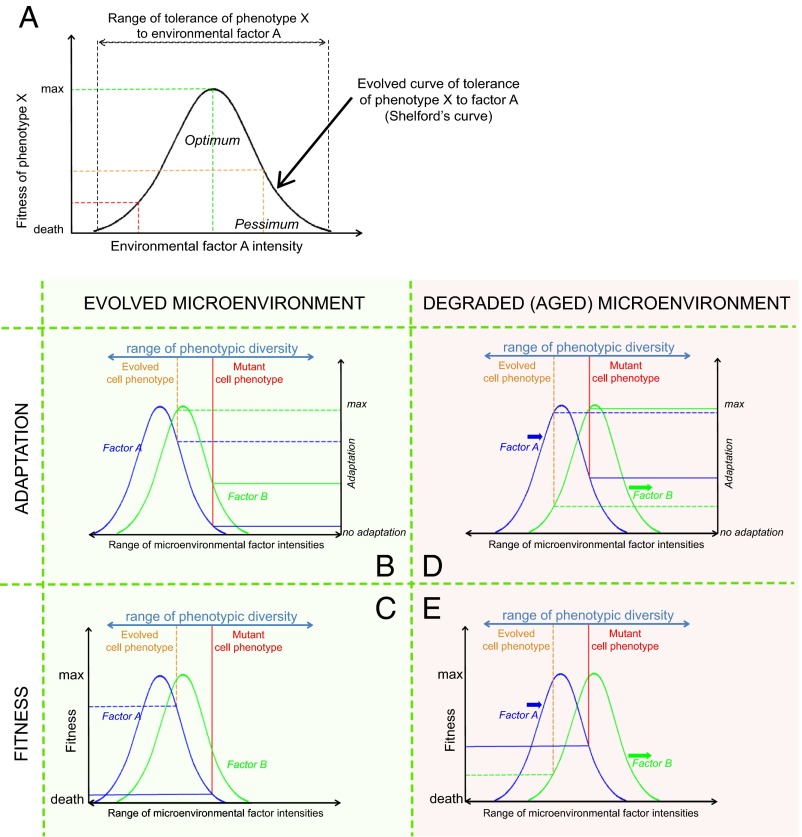
Definition of fitness in natural populations based on the Shelford’s law of tolerance and the Sprengel–Liebig law of the minimum. (A) Illustration of Shelford’s law of tolerance (70). Every factor in the environment has the optimum intensity that a species (or a phenotype) is best adapted to; the optimum intensity ensures highest fitness of the phenotype, and extreme intensities of the factor (also called pessima) lead to a decrease in the phenotype’s fitness within the range of the phenotypes’s tolerance to the factor. (B) Illustration of two phenotypes’ adaptation to environmental factors A and B based on Shelford’s law of tolerance. Evolution leads to higher adaptation (here called “evolved cell phenotype”), reducing the probability of a randomly mutated phenotype improving its adaptation relative to evolved phenotypes. (C) Following the Sprengel–Liebig law of the minimum, a phenotype’s fitness is limited by the environmental factor the phenotype is worst adapted to (phenotypes’ adaptations in this example are shown in B). (D) In an altered environment (degraded/aged tissue microenvironment in this example), environmental factor intensities change relative to the ones that the evolved phenotype is best adapted to, thus changing the adaptation of both phenotypes in this example to factors A and B. (E) Altered tissue microenvironment increases the probability that a randomly mutated phenotype will have higher fitness relative to the evolved phenotype. Note that in a normal microenvironment (C), the fitness of both phenotypes is limited by factor A; in an altered environment (E), the fitness of the evolved phenotype is now limited by factor B, whereas the fitness of the mutant phenotype still remains limited by factor A. Alteration of the environment a phenotype is adapted to may lead to changes in its fitness-limiting factors. The term “evolved microenvironment” signifies the tissue microenvironment during early and reproductive portions of the life span shaped by evolution at the germ-line level for optimal tissue performance.
Fig. 4.
Fig. 4.
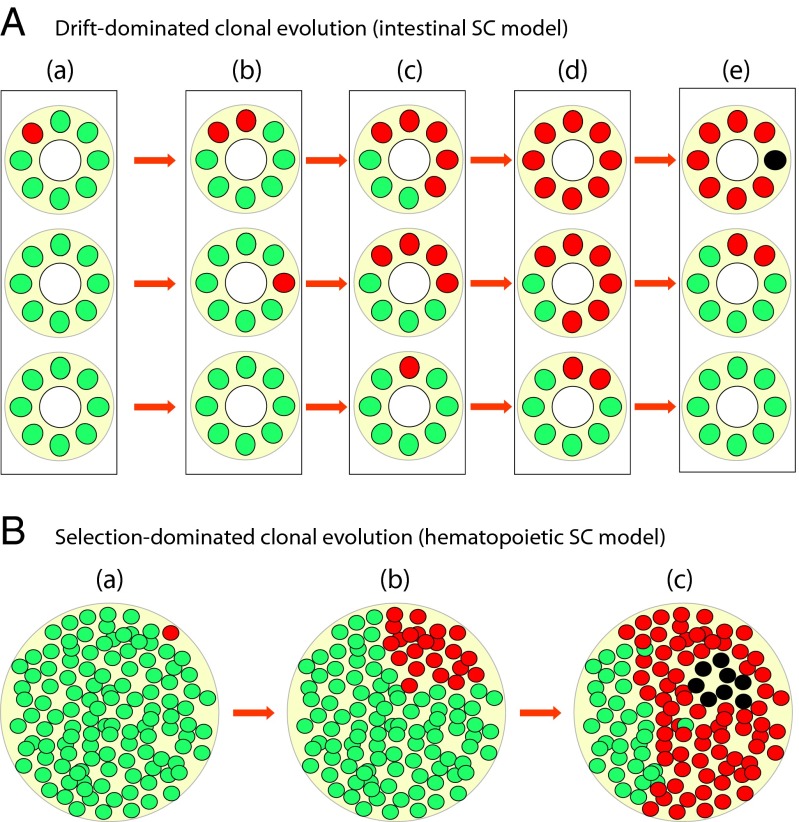
Illustration of the effect of tissue architecture on sequential oncogenic mutation accumulation in SC pools. (A) Schematic representation of fragmented SC pools, such as those fragmented SC pools in gut epithelia. (a) Schematic section of the gut epithelium with three crypts shown as circles containing green (nonmutated) cells and one red (mutant) cell. (be) Stages of somatic evolution within the three crypts. The power of random drift is increased in each crypt due to the small SC pool size in the crypts, leading to drift-driven clonal dynamics. The chances of mutation α (red cells) fixation in a crypt are heavily influenced by drift, and the total number of the mutation α-affected cells depends on the rate of mutation α fixation and the number of crypts in which mutation α independently occurred; the black cell in e represents a double mutant that bears mutation α and has acquired a second mutation β. (B) In large nonfragmented pools, such as HSCs, the power of drift is limited by the large population size and clonal dynamics are mostly governed by selection driven by fitness differences between normal cells (green cells) and cells bearing mutation α (red cells). Following Eq. 3, the selection-enriched pool of mutant α cells increases the chances that mutation β will occur in a cell already bearing mutation α; selection can further enrich the pool of αβ mutants (black cells in c) to promote the next selection rounds of multistage carcinogenesis.

References

    1. Armitage P. Multistage models of carcinogenesis. Environ Health Perspect. 1985;63:195–201. - PMC - PubMed
    1. Armitage P, Doll R. The age distribution of cancer and a multi-stage theory of carcinogenesis. Br J Cancer. 1954;8(1):1–12. - PMC - PubMed
    1. Nowell PC. The clonal evolution of tumor cell populations. Science. 1976;194(4260):23–28. - PubMed
    1. Reiter JG, Bozic I, Allen B, Chatterjee K, Nowak MA. The effect of one additional driver mutation on tumor progression. Evol Appl. 2013;6(1):34–45. - PMC - PubMed
    1. Vogelstein B, et al. Cancer genome landscapes. Science. 2013;339(6127):1546–1558. - PMC - PubMed

Publication types