


Planned caesarean section for term breech delivery
- PMID: 26196961
- PMCID: PMC6505736
- DOI: 10.1002/14651858.CD000166.pub2
Planned caesarean section for term breech delivery
Abstract
Background: Poor outcomes after breech birth might be the result of underlying conditions causing breech presentation or due to factors associated with the delivery.
Objectives: To assess the effects of planned caesarean section for singleton breech presentation at term on measures of pregnancy outcome.
Search methods: We searched the Cochrane Pregnancy and Childbirth Group's Trials Register (31 March 2015).
Selection criteria: Randomised trials comparing planned caesarean section for singleton breech presentation at term with planned vaginal birth.
Data collection and analysis: Two review authors independently assessed trials for inclusion and risk of bias, extracted data and checked them for accuracy.
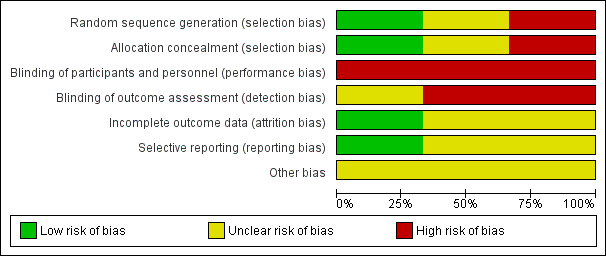
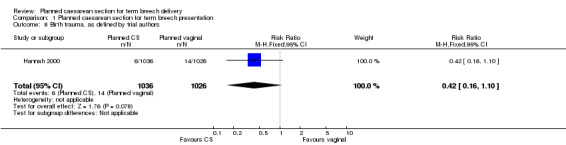
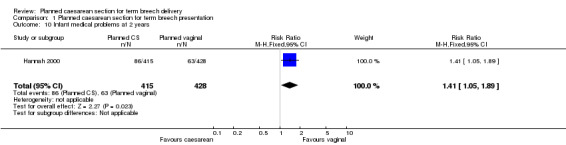
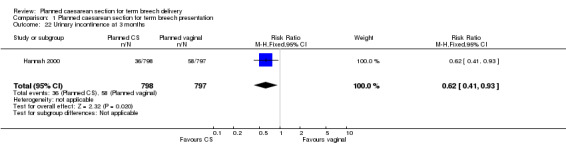
Main results: Three trials (2396 participants) were included in the review. Caesarean delivery occurred in 550/1227 (45%) of those women allocated to a vaginal delivery protocol and 1060/1169 (91%) of those women allocated to planned caesarean section (average risk ratio (RR) random-effects, 1.88, 95% confidence interval (CI) 1.60 to 2.20; three studies, 2396 women, evidence graded low quality). Perinatal or neonatal death (excluding fatal anomalies) or severe neonatal morbidity was reduced with a policy of planned caesarean section in settings with a low national perinatal mortality rate (RR 0.07, 95% CI 0.02 to 0.29, one study, 1025 women, evidence graded moderate quality), but not in settings with a high national perinatal mortality rate (RR 0.66, 95% CI 0.35 to 1.24, one study, 1053 women, evidence graded low quality). The difference between subgroups was significant (Test for subgroup differences: Chi² = 8.01, df = 1 (P = 0.005), I² = 87.5%). Due to this significant heterogeneity, a random-effects analysis was performed. The average overall effect was not statistically significant (RR 0.23, 95% CI 0.02 to 2.44, one study, 2078 infants). Perinatal or neonatal death (excluding fatal anomalies) was reduced with planned caesarean section (RR 0.29, 95% CI 0.10 to 0.86, three studies, 2388 women). The proportional reductions were similar for countries with low and high national perinatal mortality rates.The numbers studied were too small to satisfactorily address reductions in birth trauma and brachial plexus injury with planned caesarean section. Neither of these outcomes reached statistical significance (birth trauma: RR 0.42, 95% CI 0.16 to 1.10, one study, 2062 infants (20 events),evidence graded low quality; brachial plexus injury: RR 0.35, 95% CI 0.08 to 1.47, three studies, 2375 infants (nine events)).Planned caesarean section was associated with modestly increased short-term maternal morbidity (RR 1.29, 95% CI 1.03 to 1.61, three studies, 2396 women,low quality evidence). At three months after delivery, women allocated to the planned caesarean section group reported less urinary incontinence (RR 0.62, 95% CI 0.41 to 0.93, one study, 1595 women); no difference in 'any pain' (RR 1.09, 95% CI 0.93 to 1.29, one study, 1593 women,low quality evidence); more abdominal pain (RR 1.89, 95% CI 1.29 to 2.79, one study, 1593 women); and less perineal pain (RR 0.32, 95% CI 0.18 to 0.58, one study, 1593 women).At two years, there were no differences in the combined outcome 'death or neurodevelopmental delay' (RR 1.09, 95% CI 0.52 to 2.30, one study, 920 children,evidence graded low quality); more infants who had been allocated to planned caesarean delivery had medical problems at two years (RR 1.41, 95% CI 1.05 to 1.89, one study, 843 children). Maternal outcomes at two years were also similar. In countries with low perinatal mortality rates, the protocol of planned caesarean section was associated with lower healthcare costs, expressed in 2002 Canadian dollars (mean difference -$877.00, 95% CI -894.89 to -859.11, one study, 1027 women).All of the trials included in this review had design limitations, and the GRADE level of evidence was mostly low. No studies attempted to blind the intervention, and the process of random allocation was suboptimal in two studies. Two of the three trials had serious design limitations, however these studies contributed to fewer outcomes than the large multi-centre trial with lower risk of bias.
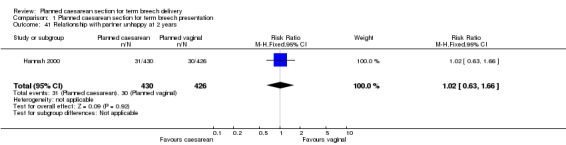
Authors' conclusions: Planned caesarean section compared with planned vaginal birth reduced perinatal or neonatal death as well as the composite outcome death or serious neonatal morbidity, at the expense of somewhat increased maternal morbidity. In a subset with 2-year follow up, infant medical problems were increased following planned caesarean section and no difference in long-term neurodevelopmental delay or the outcome "death or neurodevelopmental delay" was found, though the numbers were too small to exclude the possibility of an important difference in either direction.The benefits need to be weighed against factors such as the mother's preference for vaginal birth and risks such as future pregnancy complications in the woman's specific healthcare setting. The option of external cephalic version is dealt with in separate reviews. The data from this review cannot be generalised to settings where caesarean section is not readily available, or to methods of breech delivery that differ materially from the clinical delivery protocols used in the trials reviewed. The review will help to inform individualised decision-making regarding breech delivery. Research on strategies to improve the safety of breech delivery and to further investigate the possible association of caesarean section with infant medical problems is needed.
Conflict of interest statement
Mary Hannah is principal investigator and Justus Hofmeyr a collaborator of the Term Breech Trial (Hannah 2000), which is included in this review. Tess Lawrie undertook assessment and data extraction for this trial. Justus Hofmeyr receives royalties from UpToDate for chapters related to
Figures











Update of
-
Planned caesarean section for term breech delivery.Cochrane Database Syst Rev. 2003;(3):CD000166. doi: 10.1002/14651858.CD000166. Cochrane Database Syst Rev. 2003. Update in: Cochrane Database Syst Rev. 2015 Jul 21;(7):CD000166. doi: 10.1002/14651858.CD000166.pub2. PMID: 12917886 Updated.
References
References to studies included in this review
Collea 1980 {published data only}
-
- Collea JV, Chein C, Quilligan EJ. A randomized management of term frank breech presentation: a study of 208 cases. American Journal of Obstetrics and Gynecology 1980;137:235‐44. - PubMed
-
- Collea JV, Rabin SC, Weghorst GR, Quilligan EJ. The randomized management of term frank breech presentation: vaginal delivery vs caesarean section. American Journal of Obstetrics and Gynecology 1978;131:186‐95. - PubMed
Gimovsky 1983 {published data only}
-
- Gimovsky ML, Wallace RL, Schifrin BS, Paul RH. Randomized management of the nonfrank breech presentation at term: a preliminary report. American Journal of Obstetrics and Gynecology 1983;146:34‐40. - PubMed
Hannah 2000 {published data only}
-
- Hannah M, Amankwah K, Chalmers B, Cheng M, Foster G, Guselle P, et al. Term Breech Trial (TBT): a RCT of planned caesarean section vs planned vaginal birth for breech at term. 12th EAGO Conference; 1997 June 25‐28; Dublin, Ireland. 1997.
-
- Hannah M, Amankwah K, Chalmers B, Cheng M, Foster G, Guselle P, et al. Term Breech Trial (TBT): a RCT of planned caesarean section vs planned vaginal birth for breech at term. Society of Obstetricians and Gynaecologists of Canada; 1997; Halifax, Nova Scotia, Canada. 1997.
-
- Hannah M, Hannah W for the TBT Group. Term Breech Trial (TBT): a RCT of planned caesarean section vs planned vaginal birth for breech at term. XV FIGO World Congress; 1997 August 3‐8; Copenhagen, Denmark. 1997.
-
- Hannah M, Hannah W for the Term Breech Trial Group. Term Breech Trial: a RCT of planned CS vs planned vaginal birth for breech at term. XVI FIGO World Congress of Obstetrics & Gynecology (Book 1); 2000 Sept 3‐8; Washington DC, USA. 2000:51.
-
- Hannah M, Hannah W, Hodnett E, Chalmers B, Kung R, Willan A, et al. Outcomes at three months postpartum for women enrolled in the multicentre international term breech trial of planned caesarean section and planned vaginal birth for breech presentation at term [abstract]. American Journal of Obstetrics and Gynecology 2001;185(6 Suppl):S114.
References to studies excluded from this review
Confino 1985 {published data only}
-
- Confino E, Ismajovich B, Sherzer A, Peyser RM, David MP. Vaginal versus caesarean section oriented approaches in the management of breech delivery. International Journal of Gynaecology & Obstetrics 1985;23:1‐16. - PubMed
Stiglbauer 1989 {published data only}
-
- Stiglbauer M, Sevelda P, Vavra N, Weninger M, Sterniste W, Wagenbichler P. Cesarean section versus vaginal delivery of breech presentation in primiparous patients [Sectio versus vaginale Entbindung der Beckenendlage bei Primiparae]. Gynakologische Rundschau 1989;29 Suppl 2:319‐20. - PubMed
Additional references
Cheng 1993
-
- Cheng M, Hannah ME. Breech delivery at term ‐ a critical review of the literature. Obstetrics & Gynecology 1993;82:605‐18. - PubMed
Conde‐Agudelo 2000
-
- Conde‐Agudelo A, Belizan JM, Diaz‐Rossello JL. Epidemiology of fetal death in Latin America. Acta Obstetricia et Gynecologica Scandinavica 2000;79:371‐8. - PubMed
Danielian 1996
Gifford 1995
-
- Gifford DS, Morton SC, Kahn K. A meta‐analysis of infant outcomes after breech delivery. Obstetrics & Gynecology 1995;85:1047‐54. - PubMed
Goffinet 2006
-
- Goffinet F, Carayol M, Foidart JM, Alexander S, Uzan S, Subtil D, et al. Is planned vaginal delivery for breech presentation at term still an option? Results of an observational prospective survey in France and Belgium. American Journal of Obstetrics and Gynecology 2006;194(4):1002‐11. - PubMed
Grade 2014 [Computer program]
-
- McMaster University. GRADEpro. [Computer program on www.gradepro.org]. Version 2015. McMaster University, 2014.
Higgins 2011
-
- Higgins JPT, Green S, editors. Cochrane Handbook for Systematic Reviews of Interventions Version 5.1.0 [updated March 2011]. The Cochrane Collaboration, 2011. Available from www.cochrane‐handbook.org.
Hodnett 2005
-
- Hodnett ED, Hannah ME, Hewson S, Whyte H, Amankwah K, Cheng M, et al. Mothers' views of their childbirth experiences 2 years after planned caesarean versus planned vaginal birth for breech presentation at term, in the international randomized term breech trial. Journal of Obstetrics & Gynaecology Canada 2005;27(3):224‐31. - PubMed
Hofmeyr 1996
Hofmeyr 2001
-
- Hofmeyr GJ. Commentary on "caesarean delivery of breech babies is beneficial for infant health but has no impact on maternal health". Evidence‐Based Healthcare 2001;5:75‐6.
Hofmeyr 2004
Hofmeyr 2010
Hutton 2006
Lawson 2012
-
- Lawson GW. The Term Breech Trial ten years on: Primum non nocere?. Birth 2012;39(1):3‐9. - PubMed
Lyons 2015
-
- Lyons J, Pressey T, Bartholomew S, Liu S, Liston RM, Joseph KS, for the Canadian Perinatal Surveillance System (Public Health Agency of Canada. Delivery of Breech Presentation at Term Gestation in Canada, 2003‐2011. Obstet Gynecol. 2015;125(5):1153‐1161. - PubMed
Palencia 2005
-
- Palencia R, Gafni A, Ross S, Willan A, Hewson S, McKay D, et al. The costs of planned cesarean versus planned vaginal birth in the term breech trial. American Journal of Obstetrics and Gynecology 2005;193(6 Suppl):S124.
Palencia 2006
RevMan 2014 [Computer program]
-
- The Nordic Cochrane Centre, The Cochrane Collaboration. Review Manager (RevMan). Version 5.3. Copenhagen: The Nordic Cochrane Centre, The Cochrane Collaboration, 2014.
Schunemann 2009
-
- Schunemann HJ. GRADE: from grading the evidence to developing recommendations. A description of the system and a proposal regarding the transferability of the results of clinical research to clinical practice [GRADE: Von der Evidenz zur Empfehlung. Beschreibung des Systems und Losungsbeitrag zur Ubertragbarkeit von Studienergebnissen]. Zeitschrift fur Evidenz, Fortbildung und Qualitat im Gesundheitswesen 2009;103(6):391‐400. - PubMed
Su 2003
-
- Su M, McLeod L, Ross S, Willan A, Hannah WJ, Hutton E, et al. Factors associated with adverse perinatal outcome in the Term Breech Trial. American Journal of Obstetrics and Gynecology 2003;189:740‐5. - PubMed
Su 2007
-
- Su M, McLeod L, Ross S, Willan A, Hannah WJ, Hutton EK, et al. Factors associated with maternal morbidity in the term breech trial. Journal of Obstetrics & Gynaecology Canada: JOGC 2007;29(4):324‐30. - PubMed
Whyte 2004
-
- Whyte H, Hannah ME, Saigal S, Hannah WJ, Hewson S, Amankwah K, et al. Outcomes of children at 2 years after planned cesarean birth versus planned vaginal birth for breech presentation at term: the International Randomized Term Breech Trial. American Journal of Obstetrics and Gynecology 2004;191:864‐71. - PubMed
Wykes 2003
-
- Wykes CB, Johnston TA, Paterson‐Brown S, Johanson RB. Symphysiotomy: a life‐saving procedure. BJOG: an international journal of obstetrics and gynaecology 2003;110:219‐21. - PubMed
References to other published versions of this review
Hofmeyer 2001b
Publication types
MeSH terms
Grants and funding
LinkOut - more resources
Full Text Sources
Medical
Miscellaneous
