. 2015 Dec;93(12):1369-79.
doi: 10.1007/s00109-015-1322-y. Epub 2015 Jul 23.

Growth hormone replacement therapy regulates microRNA-29a and targets involved in insulin resistance

Affiliations

Growth hormone replacement therapy regulates microRNA-29a and targets involved in insulin resistance

Artur Galimov et al. J Mol Med (Berl). 2015 Dec.

Abstract

Replacement of growth hormone (GH) in patients suffering from GH deficiency (GHD) offers clinical benefits on body composition, exercise capacity, and skeletal integrity. However, GH replacement therapy (GHRT) is also associated with insulin resistance, but the mechanisms are incompletely understood. We demonstrate that in GH-deficient mice (growth hormone-releasing hormone receptor (Ghrhr)(lit/lit)), insulin resistance after GHRT involves the upregulation of the extracellular matrix (ECM) and the downregulation of microRNA miR-29a in skeletal muscle. Based on RNA deep sequencing of skeletal muscle from GH-treated Ghrhr(lit/lit) mice, we identified several upregulated genes as predicted miR-29a targets that are negative regulators of insulin signaling or profibrotic/proinflammatory components of the ECM. Using gain- and loss-of-function studies, five of these genes were confirmed as endogenous targets of miR-29a in human myotubes (PTEN, COL3A1, FSTL1, SERPINH1, SPARC). In addition, in human myotubes, IGF1, but not GH, downregulated miR-29a expression and upregulated COL3A1. These results were confirmed in a group of GH-deficient patients after 4 months of GHRT. Serum IGF1 increased, skeletal muscle miR-29a decreased, and miR-29a targets were upregulated in patients with a reduced insulin response (homeostatic model assessment of insulin resistance (HOMA-IR)) after GHRT. We conclude that miR-29a could contribute to the metabolic response of muscle tissue to GHRT by regulating ECM components and PTEN. miR-29a and its targets might be valuable biomarkers for muscle metabolism following GH replacement.

Key messages: GHRT most significantly affects the ECM cluster in skeletal muscle from mice. GHRT downregulates miR-29a and upregulates miR-29a targets in skeletal muscle from mice. PTEN, COL3A1, FSTL1, SERPINH1, and SPARC are endogenous miR-29a targets in human myotubes. IGF1 decreases miR-29a levels in human myotubes. miR-29a and its targets are regulated during GHRT in skeletal muscle from humans.

Keywords: GH; IGF1; Insulin resistance; Skeletal muscle; microRNA.


Figures
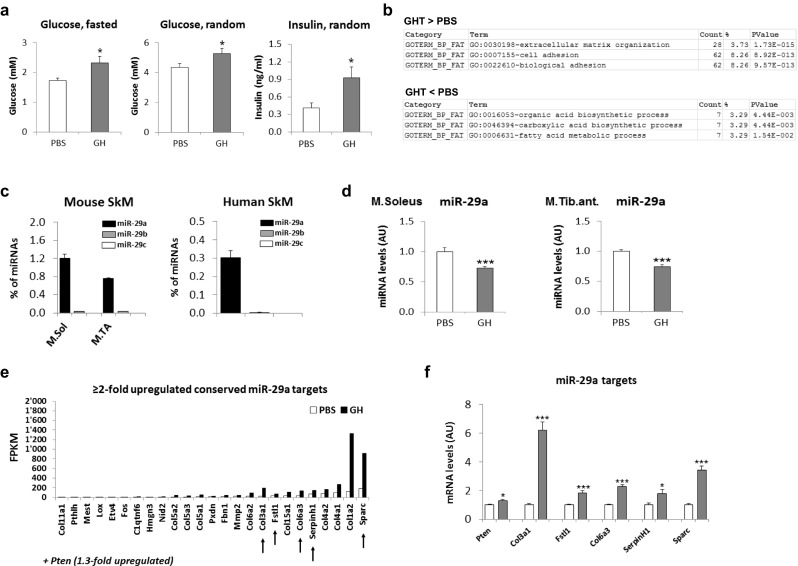
Fig. 1
Fig. 1
GHRT regulates miR-29a expression in skeletal muscle from GHD mice. GHD mice were treated with PBS or GH for 3 weeks and serum samples and tibialis anterior and soleus muscle harvested. a Blood glucose and serum insulin levels in GHD mice with (GH) or without (PBS) 3 weeks of GHRT. b Total RNA isolated from tibialis anterior muscle from GHD mice treated with PBS or GH was analyzed using RNA deep sequencing. The three most significantly regulated functional clusters are depicted for the group of genes that are increased after GHRT (GHT > PBS) or decreased (GHT < PBS). c RNA from mouse soleus muscle (M.Sol), tibialis anterior muscle (M.TA), or lower leg muscles from two healthy human subjects (M. rectus femoris and M. fibularis brevis, respectively) was analyzed using small RNA deep sequencing and results expressed as percent of all detected miRNA sequences. n = 2 for each muscle group. d qRT-PCR analysis of miR-29a in RNA from tibialis anterior muscle normalized to miR-let-7 and shown as arbitrary units (AU). Analysis was performed in the same mice as described in a. e All predicted miR-29a targets that are conserved between mice and humans and upregulated by GH in the RNA sequencing data described in b ≥2-fold shown as FPKM (fragments per kilobase of exons per million fragments mapped). Selected targets as described in the text are pointed out by arrows. f qRT-PCR analysis of gene expression in skeletal muscle after GH (gray) or PBS treatment (white). mRNA was normalized to 18S RNA and shown as AU. Results (a, d, f) show combined data for male and female mice (n = 7 for GH and n = 8 for PBS) and were analyzed using Student’s t test. *p < 0.05, ***p < 0.001
Fig. 2
Fig. 2
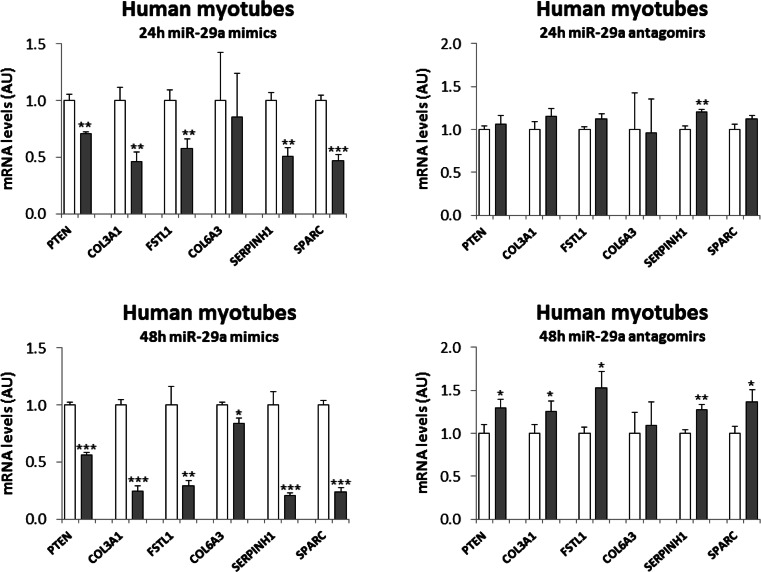
Target gene regulation in human myotubes by miR-29a. Human myotubes were transfected with miR-29a mimics or antagomirs or the respective scrambled controls. After the indicated time intervals, cells were harvested for RNA isolation. Results are shown for qRT-PCR analysis after miR-29a mimic transfection (gray) compared to control (white), n = 4, or after antagomir-29a transfection (gray) compared to control (white), n = 4–5. Results were normalized to 18S RNA and shown as arbitrary units (AU). Student’s t test was used to compare the two groups. *p < 0.05, **p < 0.01, ***p < 0.001
Fig. 3
Fig. 3
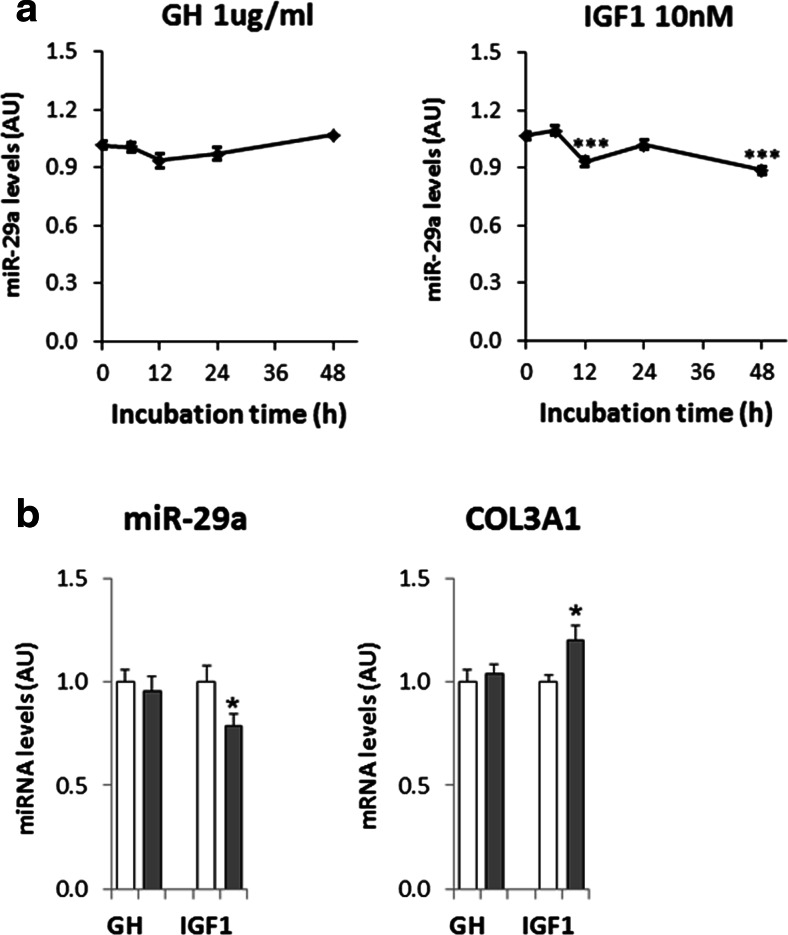
IGF1, but not GH, downregulates miR-29a levels in human myotubes. a Human myotubes were incubated for the indicated time intervals with 1 μg/ml GH or 76 ng/ml (10 nM) IGF1 before RNA was isolated. miR-29a levels were analyzed using qRT-PCR and normalized to miR-let-7. n = 4 for GH and n = 10 for IGF1. b Direct comparison of the effects of GH and IGF1 on miR-29a levels and COL3A1 expression after 48-h incubation in an independent set of experiments, n = 3–5. Results are shown as arbitrary units (AU). Changes in a were analyzed using ANOVA and Dunnett’s post test comparing all samples to the control samples (at 0 h). The effects of GH and IGF1 on miR-29a and COL3A1 levels (b) were analyzed using Student’s t test. *p < 0.05, ***p<0.001
Fig. 4
Fig. 4
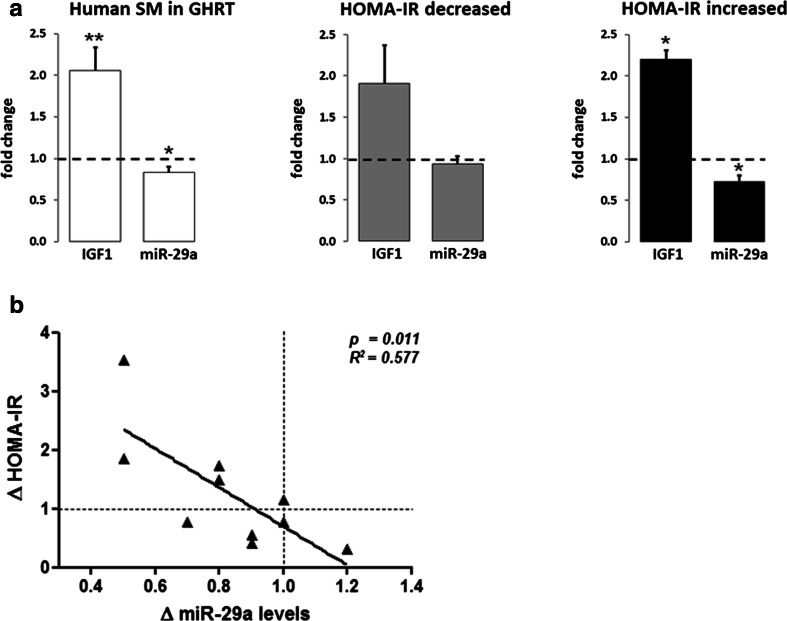
Increased serum IGF1 and decreased miR-29a levels in skeletal muscle from GHD patients with decreased insulin sensitivity after GHRT. Ten GHD patients were subjected to GHRT for 4 months. a Changes in serum IGF1 and miR-29a levels in biopsies from the tibialis anterior muscle in GHD patients after 4 months of GHRT. Values are shown for the whole cohort, n = 10, or separately analyzed for individuals with improved IS (HOMA-IR decreased), n = 5, or worsened IS (HOMA-IR increased), n = 5, after GHRT. b Relationship between the change in insulin sensitivity (ΔHOMA-IR) induced by 4 months of GHRT and the change in miR-29a levels in skeletal muscle biopsies. The dashed lines indicate the intercept points corresponding to a Δ value of 1, i.e., no change in HOMA-IR or miR-29a levels. miRNA levels were analyzed by qRT-PCR and normalized to miR-let-7. Results are shown as fold change of values after GHRT compared to values before GHRT. *p < 0.05, **p<0.01 (Student’s t test)
Fig. 5
Fig. 5
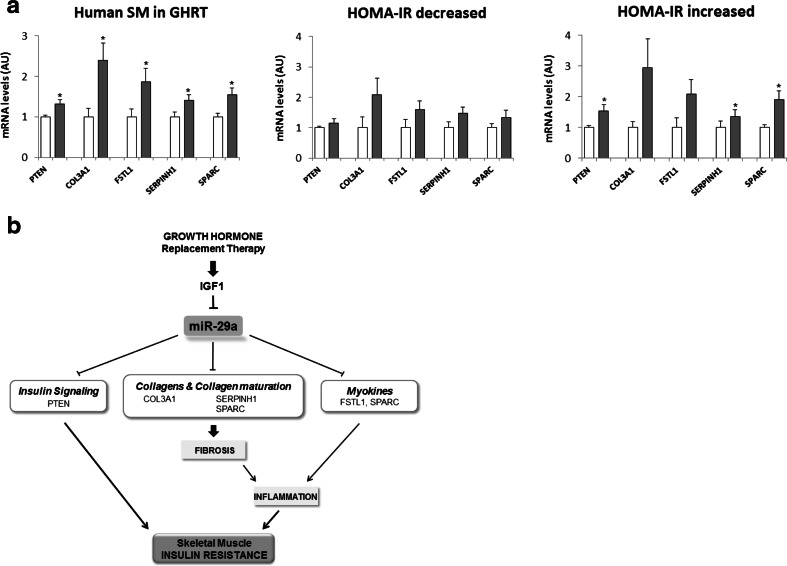
Regulation of miR-29a targets in human skeletal muscle after GHRT. RNA was isolated from biopsies of the tibialis anterior muscle obtained from the GHD patients described in Fig. 4. a qRT-PCR analysis in skeletal muscle biopsies before (white) or after (gray) 4 months of GHRT, n = 9, or separately analyzed for HOMA-IR decreased, n = 5, and HOMA-IR increased groups, n = 4. Results were normalized to 18S RNA and shown as arbitrary units (AU). Student’s t test was used to compare the two groups. *p < 0.05. b Hypothetical model demonstrating the role of GHRT for ECM remodeling and its association with insulin resistance in skeletal muscle. Decreased miR-29a levels and upregulation of its targets during GHRT could contribute to this regulation

References

    1. Carroll PV, Christ ER, Bengtsson BA, Carlsson L, Christiansen JS, Clemmons D, Hintz R, Ho K, Laron Z, Sizonenko P, et al. Growth hormone deficiency in adulthood and the effects of growth hormone replacement: a review. Growth Hormone Research Society Scientific Committee. J Clin Endocrinol Metab. 1998;83:382–395. doi: 10.1210/jcem.83.2.4594. - DOI - PubMed
    1. Moller N, Jorgensen JO. Effects of growth hormone on glucose, lipid, and protein metabolism in human subjects. Endocr Rev. 2009;30:152–177. doi: 10.1210/er.2008-0027. - DOI - PubMed
    1. Ghanaat F, Tayek JA. Growth hormone administration increases glucose production by preventing the expected decrease in glycogenolysis seen with fasting in healthy volunteers. Metabolism. 2005;54:604–609. doi: 10.1016/j.metabol.2004.12.003. - DOI - PubMed
    1. Moller N, Jorgensen JO, Abildgard N, Orskov L, Schmitz O, Christiansen JS. Effects of growth hormone on glucose metabolism. Horm Res. 1991;36(Suppl 1):32–35. - PubMed
    1. Kargi AY, Merriam GR. Diagnosis and treatment of growth hormone deficiency in adults. Nat Rev Endocrinol. 2013;9:335–345. doi: 10.1038/nrendo.2013.77. - DOI - PubMed

Publication types

MeSH terms