Review
. 2015 Jul 21;43(1):15-28.
doi: 10.1016/j.immuni.2015.07.001.

Interferon-λ: Immune Functions at Barrier Surfaces and Beyond

Affiliations
Review

Interferon-λ: Immune Functions at Barrier Surfaces and Beyond

Helen M Lazear et al. Immunity. .

Abstract

When type III interferon (IFN-λ; also known as interleukin-28 [IL-28] and IL-29) was discovered in 2003, its antiviral function was expected to be analogous to that of type I IFNs (IFN-α and IFN-β) via the induction of IFN-stimulated genes (ISGs). Although IFN-λ stimulates expression of antiviral ISGs preferentially in cells of epithelial origin, recent studies have defined additional antiviral mechanisms in other cell types and tissues. Viral infection models using mice lacking IFN-λ signaling and SNP associations with human disease have expanded our understanding of the contribution of IFN-λ to the antiviral response at anatomic barriers and the immune response beyond these barriers. In this review, we highlight recent insights into IFN-λ functions, including its ability to restrict virus spread into the brain and to clear chronic viral infections in the gastrointestinal tract. We also discuss how IFN-λ modulates innate and adaptive immunity, autoimmunity, and tumor progression and its possible therapeutic applications in human disease.


Figures

Figure 1
Figure 1
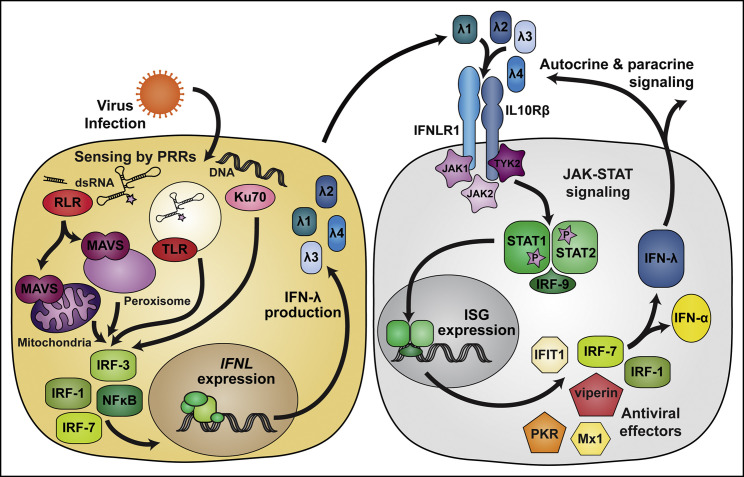
IFN-λ Induction and Signaling Pathways IFN-λ production is induced when viral infection is sensed by pattern recognition receptors (PRRs), including members of the RIG-I-like receptor (RLR) and Toll-like receptor (TLR) families, as well as the DNA sensor Ku70. Whereas IFN-λ is induced via many of the same signaling pathways that induce IFN-α/β, Ku70 and peroxisome-localized MAVS preferentially induce IFN-λ. IFN-λ signals through its heterodimeric receptor, IFNLR, which is composed of IFNLR1 and IL10Rβ subunits. Canonical signaling through IFNLR activates JAK1 and TYK2 kinases, which phosphorylate STAT1 and STAT2. However, IFNLR signaling also can activate JAK2 and other downstream signaling pathways (not depicted). JAK-STAT signaling induces expression of IFN-stimulated genes (ISGs) and the production of effector molecules that inhibit viral infection. Among the ISGs induced by IFN-λ are IRF1 and IRF7, encoding transcription factors IRF-1 and IRF-7, respectively, which amplify IFN production.
Figure 2
Figure 2
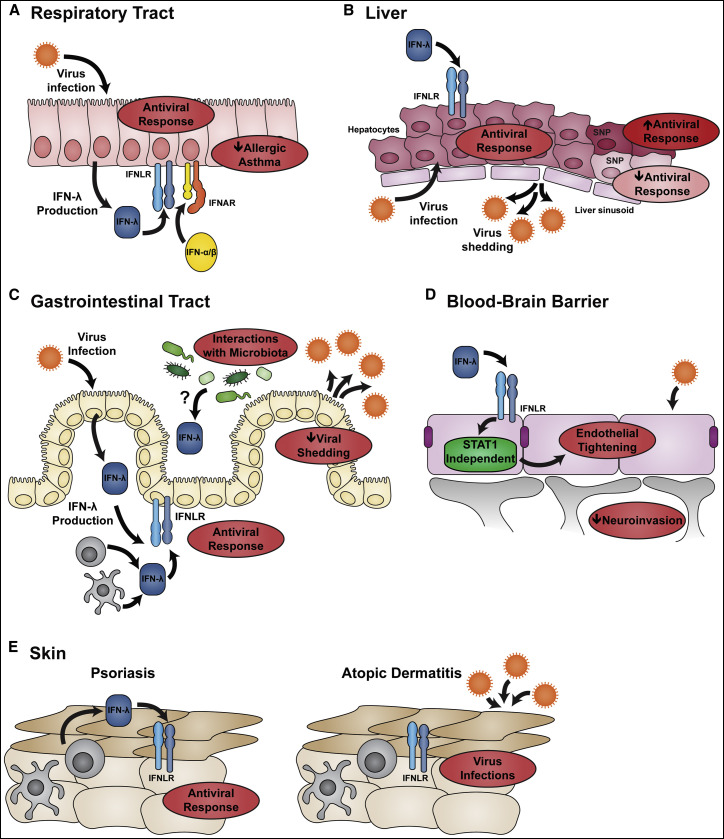
Antiviral Effects of IFN-λ at Barrier Surfaces (A) IFN-λ is a dominant IFN produced after viral infection in the respiratory tract. Respiratory epithelial cells can respond to both IFN-λ and IFN-α/β to activate an antiviral response. Th1 skewing induced by IFN-λ reduces the severity of allergic asthma. (B) The fenestrated endothelium of the liver creates a tissue architecture in which hepatocytes directly contact blood in liver sinusoids. Hepatocytes are the primary cellular targets for HBV and HCV and are highly responsive to IFN-λ. A role for IFN-λ in controlling HCV infection is suggested by the association between HCV clinical outcome and numerous SNPs within the IFNL locus. (C) IFN-λ has a key role in gastrointestinal tract immunity because unlike respiratory epithelial cells, gut epithelial cells do not respond to IFN-α/β and therefore rely upon IFN-λ to activate an antiviral response. The antiviral effects of IFN-λ could be especially important for restricting the shedding and transmission of enteric viruses. Immunity in the gastrointestinal tract is shaped by the bacterial microbiome; the ability of gut microbes to promote viral persistence requires IFN-λ signaling, although the mechanism of this interaction remains unclear. (D) IFN-λ signaling tightens the endothelial junctions of the BBB, which reduces viral neuroinvasion from the circulation. The tightening activity of IFN-λ is STAT1 independent, implicating a non-canonical signaling pathway. (E) Psoriasis and atopic dermatitis are chronic inflammatory skin conditions characterized by breakdown of the epithelial barrier. Compared to lesions from atopic dermatitis patients, psoriasis lesions exhibit elevated IFN-λ production and enhanced expression of ISGs. This might explain why disseminated viral skin infections are common in patients with atopic dermatitis but not psoriasis.

References

    1. Alexopoulou A., Karayiannis P. Interferon-based combination treatment for chronic hepatitis C in the era of direct acting antivirals. Ann. Gastroenterol. 2015;28:55–65. - PMC - PubMed
    1. Angel J., Franco M.A., Greenberg H.B., Bass D. Lack of a role for type I and type II interferons in the resolution of rotavirus-induced diarrhea and infection in mice. J. Interferon Cytokine Res. 1999;19:655–659. - PubMed
    1. Ank N., West H., Bartholdy C., Eriksson K., Thomsen A.R., Paludan S.R. Lambda interferon (IFN-lambda), a type III IFN, is induced by viruses and IFNs and displays potent antiviral activity against select virus infections in vivo. J. Virol. 2006;80:4501–4509. - PMC - PubMed
    1. Ank N., Iversen M.B., Bartholdy C., Staeheli P., Hartmann R., Jensen U.B., Dagnaes-Hansen F., Thomsen A.R., Chen Z., Haugen H. An important role for type III interferon (IFN-lambda/IL-28) in TLR-induced antiviral activity. J. Immunol. 2008;180:2474–2485. - PubMed
    1. Baker M.L., Schountz T., Wang L.F. Antiviral immune responses of bats: a review. Zoonoses Public Health. 2013;60:104–116. - PMC - PubMed

Publication types