


Tumor Budding in Colorectal Carcinoma: Confirmation of Prognostic Significance and Histologic Cutoff in a Population-based Cohort
- PMID: 26200097
- PMCID: PMC4567920
- DOI: 10.1097/PAS.0000000000000504
Tumor Budding in Colorectal Carcinoma: Confirmation of Prognostic Significance and Histologic Cutoff in a Population-based Cohort
Abstract
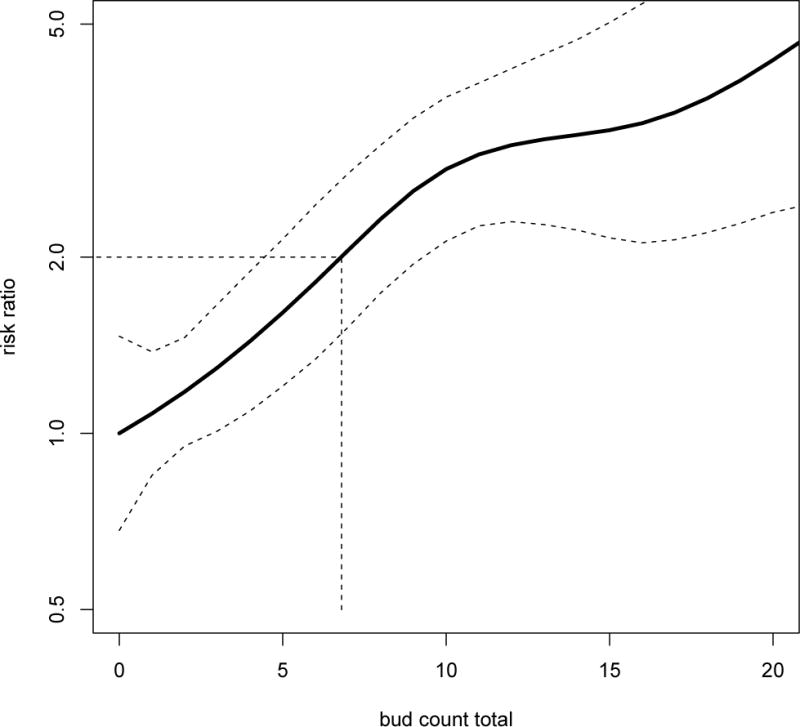
Tumor budding in colorectal carcinoma has been associated with poor outcome in multiple studies, but the absence of an established histologic cutoff for "high" tumor budding, heterogeneity in study populations, and varying methods for assessing tumor budding have hindered widespread incorporation of this parameter in clinical reports. We used an established scoring system in a population-based cohort to determine a histologic cutoff for "high" tumor budding and confirm its prognostic significance. We retrieved hematoxylin and eosin-stained sections from 553 incident colorectal carcinoma cases. Each case was previously characterized for select molecular alterations and survival data. Interobserver agreement was assessed between 2 gastrointestinal pathologists and a group of 4 general surgical pathologists. High budding (≥ 10 tumor buds in a ×20 objective field) was present in 32% of cases, low budding in 46%, and no budding in 22%. High tumor budding was associated with advanced pathologic stage (P < 0.001), microsatellite stability (P = 0.005), KRAS mutation (P = 0.010), and on multivariate analysis with a > 2 times risk of cancer-specific death (hazard ratio = 2.57 [1.27, 5.19]). After multivariate adjustment, by penalized smoothing splines, we found increasing tumor bud counts from 5 upward to be associated with an increasingly shortened cancer-specific survival. By this method, a tumor bud count of 10 corresponded to approximately 2.5 times risk of cancer-specific death. The interobserver agreement was good with weighted κ of 0.70 for 2 gastrointestinal pathologists over 121 random cases and 0.72 between all 6 pathologists for 20 random cases. Using an established method to assess budding on routine histologic stains, we have shown that a cutoff of 10 for high tumor budding is independently associated with a significantly worse prognosis. The reproducibility data provide support for the routine widespread implementation of tumor budding in clinical reports.
Conflict of interest statement
Daniel J. Weisenberger is a consultant for Zymo Research Corporation, which distributes commercially-available products for DNA methylation-based experiments. Zymo Research did not sponsor this report.
Figures

References
-
- Hase K, et al. Prognostic value of tumor “budding” in patients with colorectal cancer. Diseases of the colon and rectum. 1993;36(7):627–35. - PubMed
-
- Mitrovic B, et al. Tumor budding in colorectal carcinoma: time to take notice. Modern pathology : an official journal of the United States and Canadian Academy of Pathology, Inc. 2012;25(10):1315–25. - PubMed
-
- C C. Prognostic factors in Cancer. New York: Wiley-Liss; 2006.
Publication types
MeSH terms
Substances
Grants and funding
LinkOut - more resources
Full Text Sources
Other Literature Sources
Medical
Miscellaneous
