


Human Chorionic Gonadotropin Partially Mediates Phthalate Association With Male and Female Anogenital Distance
- PMID: 26200238
- PMCID: PMC4570159
- DOI: 10.1210/jc.2015-2370
Human Chorionic Gonadotropin Partially Mediates Phthalate Association With Male and Female Anogenital Distance
Abstract
Context: Prenatal exposure to phthalates disrupts male sex development in rodents. In humans, the placental glycoprotein hormone human chorionic gonadotropin (hCG) is required for male development, and may be a target of phthalate exposure.
Objective: This study aimed to test the hypothesis that phthalates disrupt placental hCG differentially in males and females with consequences for sexually dimorphic genital development.
Design: The Infant Development and Environment Study (TIDES) is a prospective birth cohort. Pregnant women were enrolled from 2010-2012 at four university hospitals.
Participants: Participants were TIDES subjects (n = 541) for whom genital and phthalate measurements were available and who underwent prenatal serum screening in the first or second trimester.
Main outcome measures: Outcomes included hCG levels in maternal serum in the first and second trimesters and anogenital distance (AGD), which is the distance from the anus to the genitals in male and female neonates.
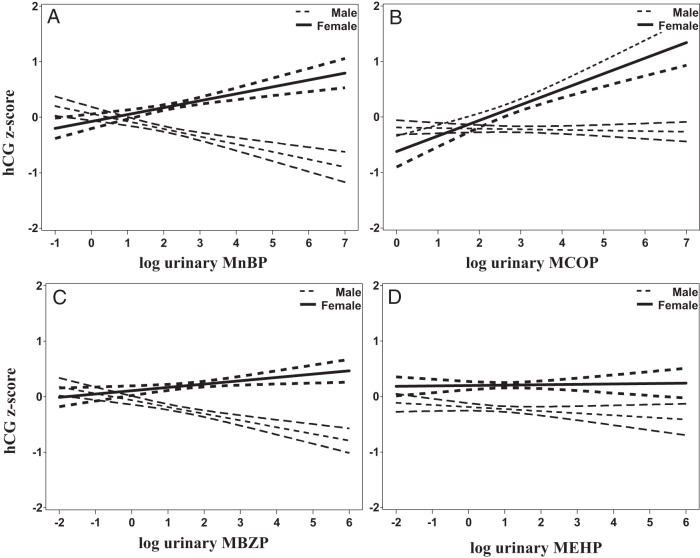
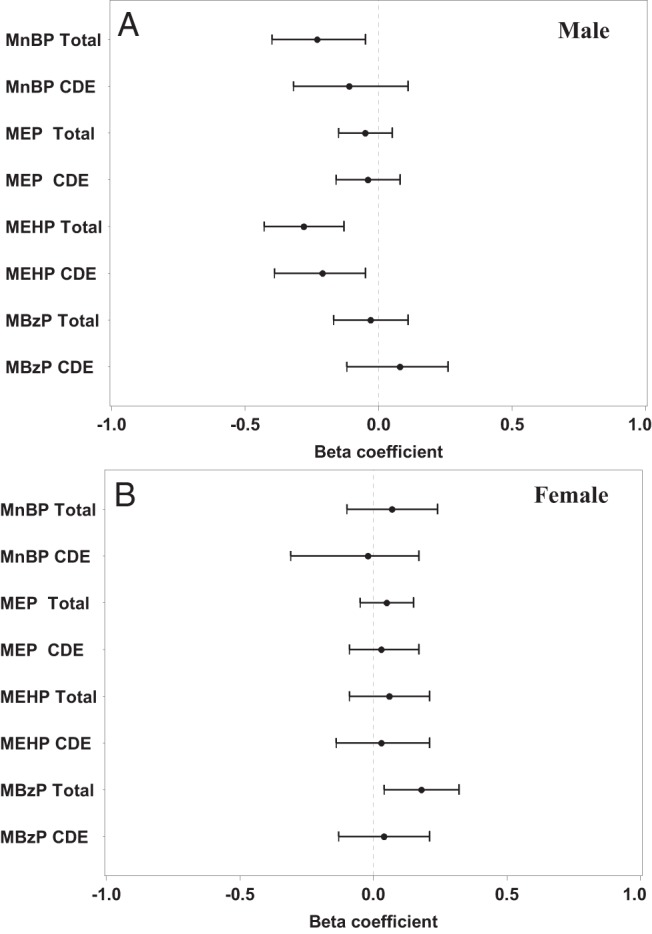
Results: Higher first-trimester urinary mono-n-butyl phthalate (MnBP; P = .01), monobenzyl phthalate (MBzP; P = .03), and mono-carboxy-isooctyl phthalate (P < .01) were associated with higher first-trimester hCG in women carrying female fetuses, and lower hCG in women carrying males. First-trimester hCG was positively correlated with the AGD z score in female neonates, and inversely correlated in males (P = 0.01). We measured significant associations of MnBP (P < .01), MBzP (P = .02), and mono-2-ethylhexyl phthalate (MEHP; P < .01) with AGD, after adjusting for sex differences. Approximately 52% (MnBP) and 25% (MEHP) of this association in males, and 78% in females (MBzP), could be attributed to the phthalate association with hCG.
Conclusions: First-trimester hCG levels, normalized by fetal sex, may reflect sexually dimorphic action of phthalates on placental function and on genital development.
Figures
References
-
- Gray LE, Ostby J, Furr J, Price M, Veeramachaneni DN, Parks L. Perinatal exposure to the phthalates DEHP, BBP, and DINP, but not DEP, DMP, or DOTP, alters sexual differentiation of the male rat. Toxicol Sci. 2000;58:350–365. - PubMed
-
- Mylchreest E, Cattley RC, Foster PM. Male reproductive tract malformations in rats following gestational and lactational exposure to Di(n-butyl) phthalate: An antiandrogenic mechanism? Toxicol Sci. 1998;43:47–60. - PubMed
-
- Parks LG, Ostby JS, Lambright CR, et al. The plasticizer diethylhexyl phthalate induces malformations by decreasing fetal testosterone synthesis during sexual differentiation in the male rat. Toxicol Sci. 2000;58:339–349. - PubMed
Publication types
MeSH terms
Substances
Grants and funding
LinkOut - more resources
Full Text Sources
Other Literature Sources
Medical
