


Pain in Community-Dwelling Older Adults with Dementia: Results from the National Health and Aging Trends Study
- PMID: 26200445
- PMCID: PMC4778418
- DOI: 10.1111/jgs.13536
Pain in Community-Dwelling Older Adults with Dementia: Results from the National Health and Aging Trends Study
Abstract
Objectives: To report prevalence, correlates, and medication management of pain in community-dwelling older adults with dementia.
Design: Cross-sectional.
Setting: In-person interviews with self- or proxy respondents living in private residences or non-nursing home residential care settings.
Participants: Nationally representative sample of community-dwelling Medicare beneficiaries aged 65 and older enrolled in the National Health and Aging Trends Study 2011 wave.
Measurements: Dementia status was determined using a modified previously validated algorithm. Participants were asked whether they had had bothersome and activity-limiting pain over the past month. A multivariable Poisson regression model was used to determine the relationship between bothersome pain and sociodemographic and clinical characteristics.
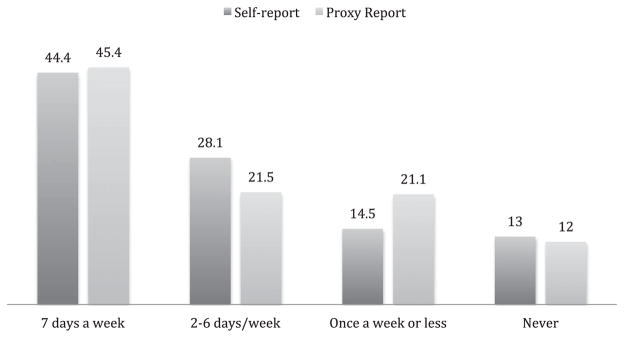
Results: Of the 7,609 participants with complete data on cognitive function, 802 had dementia (67.2% aged ≥80, 65.0% female, 67.9% white, 49.7% proxy response, 32.0% lived alone, 18.8% lived in residential care); 670 (63.5%) participants with dementia experienced bothersome pain, and 347 (43.3%) had pain that limited activities. These rates were significantly higher than in a propensity score-matched cohort without dementia (54.5% bothersome pain, P < .001, 27.2% pain that limited activity, P < .001). Proxies reported slightly higher rates of pain than self-respondents, but differences were statistically significant only for activity-limiting pain (46.6% proxy vs 40.1% self, P = .03). Correlates of bothersome pain included arthritis, heart and lung disease, less than high school education, activity of daily living disability, depressive and anxiety symptoms, and low energy. Of those reporting pain, 30.3% stated that they rarely or never took any medications for pain.
Conclusion: Community-living older adults with dementia are at high risk of having pain. Creative interventions and programs are needed to manage pain adequately in this vulnerable population.
Keywords: NHATS; community-dwelling; dementia; pain.
© 2015, Copyright the Authors Journal compilation © 2015, The American Geriatrics Society.
Conflict of interest statement
Figures
References
-
- Jones AL, Dwyer LL, Bercovitz AR, et al. The National Nursing Home Survey: 2004 overview. Vital Health Stat. 2009;13:167. - PubMed
-
- Magaziner J, German P, Zimmerman SI, et al. The prevalence of dementia in a statewide sample of new nursing home admissions aged 65 and older: Diagnosis by expert panel. Epidemiology of Dementia in Nursing Homes Research Group. Gerontologist. 2000;40:663–672. - PubMed
-
- Snow AL, Chandler JF, Kunik ME, et al. Self-reported pain in persons with dementia predicts subsequent decreased psychosocial functioning. Am J Geriatr Psychiatry. 2009;17:873–880. - PubMed
-
- Torvik K, Kaasa S, Kirkevold O, et al. Pain and quality of life among residents of Norwegian nursing homes. Pain Manag Nurs. 2010;11:35–44. - PubMed
Publication types
MeSH terms
Grants and funding
- 8 KL2 TR000143-08/TR/NCATS NIH HHS/United States
- P30 AG028741/AG/NIA NIH HHS/United States
- KL2 TR000143/TR/NCATS NIH HHS/United States
- U01 AG032947/AG/NIA NIH HHS/United States
- T32 NR007088/NR/NINR NIH HHS/United States
- K24 AG031155/AG/NIA NIH HHS/United States
- 1K23 AG040772/AG/NIA NIH HHS/United States
- K24 AG029812/AG/NIA NIH HHS/United States
- P30 AG044281/AG/NIA NIH HHS/United States
- 1 K24 AG041180/AG/NIA NIH HHS/United States
- P01 AG066605/AG/NIA NIH HHS/United States
- 2 K24 AG031155/AG/NIA NIH HHS/United States
- K23 AG040772/AG/NIA NIH HHS/United States
- T32-NR07088/NR/NINR NIH HHS/United States
- K24 AG041180/AG/NIA NIH HHS/United States
LinkOut - more resources
Full Text Sources
Other Literature Sources
Medical
Miscellaneous
