


Provider Board Certification Status and Practice Patterns in Total Knee Arthroplasty
- PMID: 26200572
- PMCID: PMC4826752
- DOI: 10.1097/ACM.0000000000000808
Provider Board Certification Status and Practice Patterns in Total Knee Arthroplasty
Abstract
Purpose: The presumption that board certification directly affects the quality of clinical care is a topic of ongoing discussion in medical literature. Recent studies have demonstrated disparities in patient outcomes associated with type of anesthesia provided for total knee arthroplasty (TKA); improved outcomes are associated with neuraxial (or regional) versus general anesthesia. Whether board-certified (BC) and non-board-certified (nBC) anesthesiologists make different choices in the anesthetic they administer is unknown. The authors sought to study potential associations of board certification status with anesthesia practice patterns for TKA.
Method: The authors accessed records of anesthetics provided from 2010 to 2013 from the National Anesthesia Clinical Outcomes Registry database. They identified TKA cases using Clinical Classifications Software and Current Procedural Terminology codes. The authors divided practitioners into two groups: those who were BC and those who were nBC. For each of these groups, the authors compared the following: their patient populations, the hospitals in which they worked, the nature of their practices, and the anesthetics they administered to their patients.
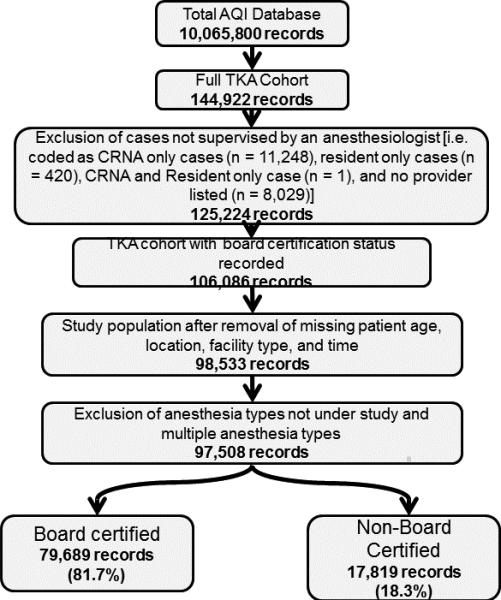
Results: BC anesthesiologists provided care for 81.7% of 97,508 patients having TKA; 18.3% were treated by nBC anesthesiologists. BC anesthesiologists administered neuraxial/regional anesthesia more frequently than nBC anesthesiologists (41.4% versus 21.2%; P < .001).
Conclusions: The rates at which regional/neuraxial anesthesia were administered for TKA were relatively low, and there were significant differences in practice patterns of BC and nBC anesthesiologists providing care for patients undergoing TKA. More research is necessary to understand the causes of these disparities.
Figures
References
-
- American Board of Medical Specialties . About ABMS. [May 20, 2015]. http://www.abms.org/about-abms/.
-
- Brennan TA, Horwitz RI, Duffy FD, Cassel CK, Goode LD, Lipner RS. The role of physician specialty board certification status in the quality movement. JAMA. 2004;292:1038–1043. - PubMed
-
- Dairiki Shortliffe LM. Certification, recertification, and maintenance: Continuing to learn. Urol Clin North Am. 2009;36:79–83. vii. - PubMed
-
- American Board of Anesthesiology [May 20, 2015];About the ABA. 2015 http://www.theaba.org/Home/About.
-
- Lowy J. Board certification as prerequisite for hospital staff privileges. Virtual Mentor. 2005:7. - PubMed
Publication types
MeSH terms
Grants and funding
LinkOut - more resources
Full Text Sources
Other Literature Sources
Medical
