


Coexistence of Anti-Glomerular Basement Membrane Antibodies and Anti-Neutrophil Cytoplasmic Antibodies in a Child With Human Leukocyte Antigen Susceptibility and Detailed Antibody Description: A Case Report
- PMID: 26200622
- PMCID: PMC4603008
- DOI: 10.1097/MD.0000000000001179
Coexistence of Anti-Glomerular Basement Membrane Antibodies and Anti-Neutrophil Cytoplasmic Antibodies in a Child With Human Leukocyte Antigen Susceptibility and Detailed Antibody Description: A Case Report
Abstract
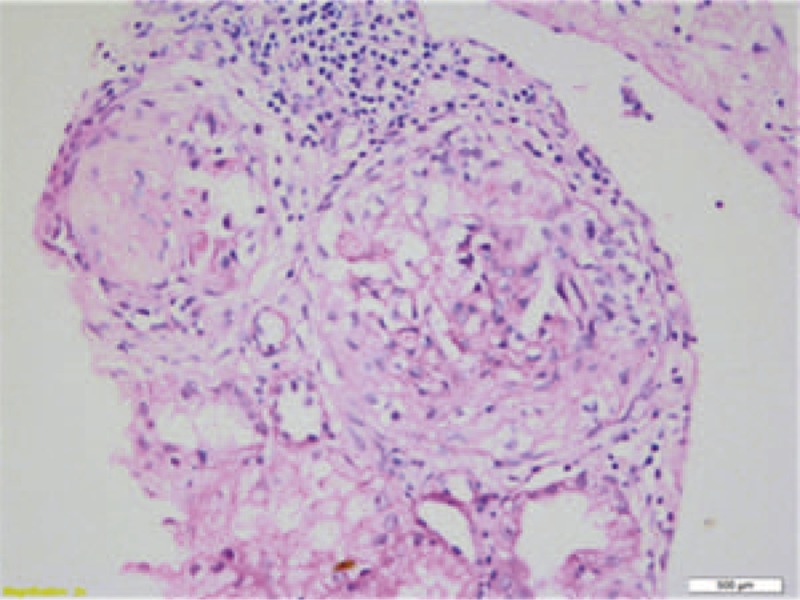
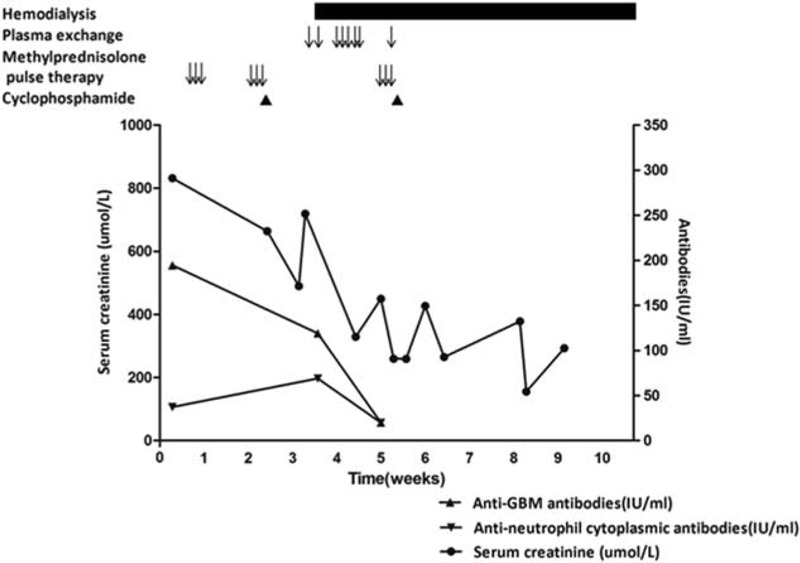
Anti-glomerular basement membrane (anti-GBM) disease and anti-neutrophil cytoplasmic antibody (ANCA)-associated vasculitis both could cause rapidly progressive glomerulonephritis. The coexistence of ANCAs and anti-GBM antibodies was known as "double positive," which was extremely rare in children. We report a pediatric case with coexistence of ANCAs and anti-GBM antibodies. A 6-year-old girl presented with acute renal failure, hematuria, proteinuria, and oliguria. She was double positive of ANCAs specific to myeloperoxidase, and anti-GBM antibodies. Kidney biopsy confirmed linear immunoglobulin (Ig)G deposit along GBM and 100% of crescent formation in glomeruli; among them 83.3% were cellular crescents. Human leukocyte antigen (HLA) gene typing showed DRB1*1501, an allele strongly associated with anti-GBM disease, and DRB1*0405, an independent risk factor for renal failure in patients with ANCA-associated vasculitis. The titer of anti-GBM antibodies was 1:800, and the predominant IgG subclass was IgG1, which was closely related with severe kidney injury and worse outcome. The target antigen of anti-GBM antibodies was restricted on the noncollagen domain 1 of the α3 chain of type IV collagen (α3[IV]NC1), with recognitions to both epitopes, EA (α317-31) and EB (α3127-141). This is the first reported pediatric case with coexistence of ANCAs and anti-GBM antibodies, in which the HLA typing and immunologic characters of autoantibodies were identified. The findings on this early-onset patient are meaningful for understanding the mechanisms of both anti-GBM disease and ANCA-associated vasculitis.
Conflict of interest statement
The authors declare no conflict of interest.
Figures
References
-
- Jayne DR, Marshall PD, Jones SJ, et al. Autoantibodies to GBM and neutrophil cytoplasm in rapidly progressive glomerulonephritis. Kidney Int 1999; 37:965–970. - PubMed
-
- Levy JB, Hammad T, Coulthart A, et al. Clinical features and outcome of patients with both ANCA and anti-GBM antibodies. Kidney Int 2004; 66:1535–1540. - PubMed
-
- Hellmark T, Niles JL, Collins B, et al. Comparison of anti-GBM antibodies in sera with or without ANCA. J Am Soc Nephrol 1997; 8:376–385. - PubMed
-
- Bosch X, Mirapeix E, Font J, et al. Anti-myeloperoxidase autoantibodies in patients with necrotizing glomerular and alveolar capillaritis. Am J Kidney Dis 1992; 20:231–239. - PubMed
-
- Weber MF, Nadrossy K, Pullig O, et al. Antineutrophil-cytoplasmic antibodies and anti-glomerular basement membrane antibodies in Goodpasture's syndrome and in Wegener's granulomatosis. J Am Soc Nephrol 1992; 2:1227–1234. - PubMed
Publication types
MeSH terms
Substances
LinkOut - more resources
Full Text Sources
Research Materials
