. 2015 Jul 24:15:540.
doi: 10.1186/s12885-015-1561-x.

Functional role of miR-10b in tamoxifen resistance of ER-positive breast cancer cells through down-regulation of HDAC4

Affiliations

Functional role of miR-10b in tamoxifen resistance of ER-positive breast cancer cells through down-regulation of HDAC4

Aamir Ahmad et al. BMC Cancer. .

Abstract

Background: For breast cancer patients diagnosed with estrogen receptor (ER)-positive tumors, treatment with tamoxifen is the gold standard. A significant number of patients, however, develop resistance to tamoxifen, and management of such tamoxifen-resistant patients is a major clinical challenge. With an eye to identify novel targets for the treatment of tamoxifen-resistant tumors, we observed that tamoxifen-resistant cells derived from ER-positive MCF-7 cells (MCF7TR) exhibit an increased expression of microRNA-10b (miR-10b). A role of miR-10b in drug-resistance of breast cancer cells has never been investigated, although its is very well known to influence invasion and metastasis.

Methods: To dileneate a role of miR-10b in tamoxifen-resistance, we over-expressed miR-10b in MCF-7 cells and down-regulated its levels in MCF7TR cells. The mechanistic role of HDAC4 in miR-10b-mediated tamoxifen resistance was studied using HDAC4 cDNA and HDAC4-specific siRNA in appropriate models.

Results: Over-expression of miR-10b in ER-positive MCF-7 and T47D cells led to increased resistance to tamoxifen and an attenuation of tamoxifen-mediated inhibition of migration, whereas down-regulation of miR-10b in MCF7TR cells resulted in increased sensitivity to tamoxifen. Luciferase assays identified HDAC4 as a direct target of miR-10b. In MCF7TR cells, we observed down-regulation of HDAC4 by miR-10b. HDAC4-specific siRNA-mediated inactivation of HDAC4 in MCF-7 cells led to acquisition of tamoxifen resistance, and, moreover, reduction of HDAC4 in MCF7TR cells by HDAC4-specific siRNA transfection resulted in further enhancement of tamoxifen-resistance.

Conclusions: We propose miR-10b-HDAC4 nexus as one of the molecular mechanism of tamoxifen resistance which can potentially be expolited as a novel targeted therapeutic approach for the clinical management of tamoxifen-resistant breast cancers.


Figures
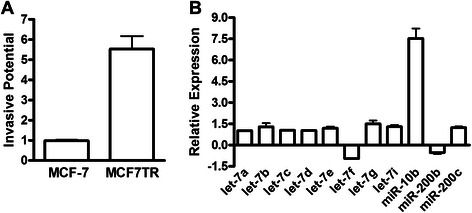
Fig. 1
Fig. 1
miR-10b in tamoxifen-resistant MCF-7 cells. a Tamoxifen-resistant MCF-7 cells (MCF7TR) showed significantly higher invasive potential, compared to parental MCF-7 cells. b Screening of miRNAs in MCF7TR cells, relative to the levels in MCF-7 cells, by real time RT-PCR. RNU48 was used as internal control for the real-time RT-PCR miRNA analysis.
Fig. 2
Fig. 2
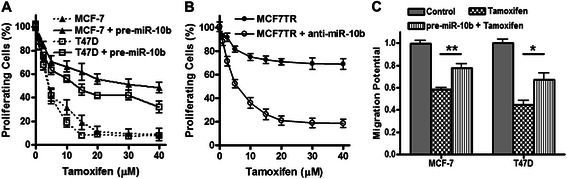
Effect of miR-10b levels on response to tamoxifen. a Ectopic over-expression of miR-10b in MCF-7 and T47D cells, through transfections with pre-miR-10b oligonucleotides, increased tamoxifen resistance, (b) silencing of miR-10b in MCF7TR cells, through transfections with anti-miR-10b oligonucleotides, decreased their tamoxifen resistance and (c) ectopic over-expression of miR-10b in MCF-7 and T47D cells significantly attenuated tamoxifen-induced inhibition of migration potential. Cells were treated with indicated doses of tamoxifen for 48 h. *p < 0.05, **p < 0.01
Fig. 3
Fig. 3
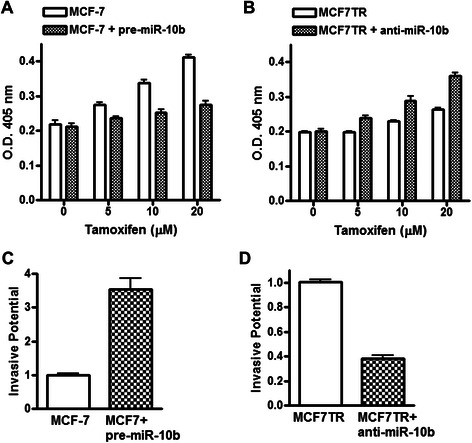
Effect of miR-10b levels on apoptosis-induction and invasion. Effect of miR-10b levels on apoptosis-induction in (a) MCF-7 and (b) MCF7TR cells. Induction of apoptosis was assessed by DNA Histone-ELISA assay. Invasion of (c) MCF-7 and (d) MCF7TR cells was assessed by plating cells in matrigel-coated plates MCF-7, non-specific pre-miRNAs transfected MCF-7 cells; MCF-7 + pre-miR-10b, pre-miR-10b transfected MCF-7 cells; MCF7TR, non-specific anti-miRNAs transfected MCF7TR cells; MCF7TR + anti-miR-10b, anti-miR-10b transfected MCF7TR cells.
Fig. 4
Fig. 4
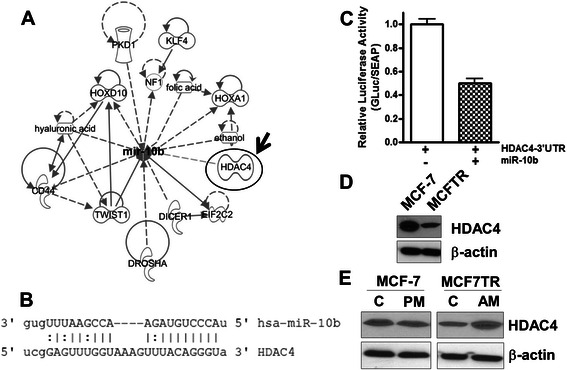
HDAC4 is a target of miR-10b. a Ingenuity Pathway Analysis for targets of miR-10b. HDAC4 is shown with an arrow. b Sequence complementarities of miR-10b and its target HDAC4. c Luciferase assay was conducted to confirm that HDAC4 is a direct target of miR-10b. MCF-7 cells were co-transfected with dual luciferase plasmid pEZX-MT05-HDAC4-3′UTR along with a control pre-miR or pre-miR-10b, and assayed for luciferase activity 48 h after transfection. d Levels of HDAC4 in parental (MCF-7) and tamoxifen-resistance MCF-7 (MCF7TR) cells. e Effect of altered miR-10b levels on HDAC4 levels. β-actin protein was used as protein loading control for Western blots and RNU48 was used as internal control for the real-time RT-PCR miRNA analysis. C, control; PM, pre-miR-10b; AM, anti-miR-10b
Fig. 5
Fig. 5
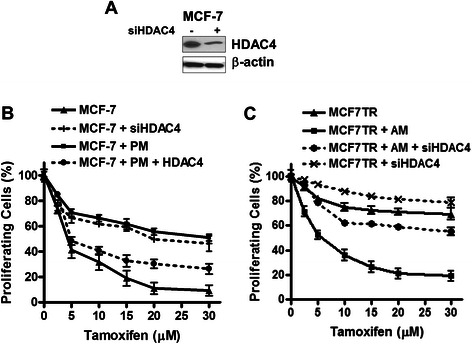
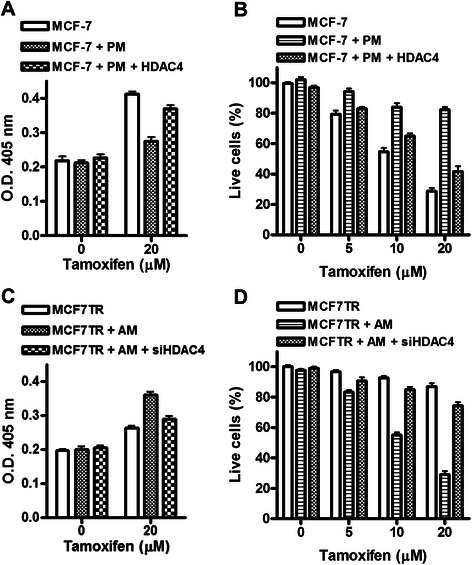
Effect of HDAC4 levels on tamoxifen-sensitivity. a siRNA against HDAC4 reduced its expression in MCF-7 cells. Functional role of HDAC4 and miR-10b on tamoxifen sensitivity in b MCF-7 and c MCF7TR cells. β-actin protein was used as protein loading control for Western blots. Tamoxifen treatment was done for 48 h at indicated doses. PM, pre-miR-10b; AM, anti-miR-10b; HDAC4, HDAC cDNA; siHDAC4, siRNA against HDAC4
Fig. 6
Fig. 6
miR-10b and its target HDAC4 influence tamoxifen-induced apoptosis and cell viability. Effect of ectopic expression of miR-10b and HDAC4 on (a) apoptosis-induction and (b) viability of MCF-7 cells, and the effect of silencing of miR-10b and HDAC4 on (c) apoptosis-induction and (d) viability of MCF7TR cells. Tamoxifen treatment was for 48 h. PM, pre-miR-10b; AM, anti-miR-10b; HDAC4, HDAC cDNA; siHDAC4, siRNA against HDAC4

References

    1. Osborne CK, Schiff R. Mechanisms of endocrine resistance in breast cancer. Annu Rev Med. 2011;62:233–47. doi: 10.1146/annurev-med-070909-182917. - DOI - PMC - PubMed
    1. Musgrove EA, Sutherland RL. Biological determinants of endocrine resistance in breast cancer. Nat Rev Cancer. 2009;9(9):631–43. doi: 10.1038/nrc2713. - DOI - PubMed
    1. Ramaswamy B, Lu YZ, Teng KY, Nuovo G, Li XB, Shapiro CL, et al. Hedgehog signaling is a novel therapeutic target in tamoxifen resistant breast cancer aberrantly activated by PI3K/AKT pathway. Cancer Res. 2012;72(19):5048–59. doi: 10.1158/0008-5472.CAN-12-1248. - DOI - PMC - PubMed
    1. Sarkar FH, Li Y, Wang Z, Kong D, Ali S. Implication of microRNAs in drug resistance for designing novel cancer therapy. Drug Resist Updat. 2010;13(3):57–66. doi: 10.1016/j.drup.2010.02.001. - DOI - PMC - PubMed
    1. Zhao JJ, Lin J, Yang H, Kong W, He L, Ma X, et al. MicroRNA-221/222 negatively regulates estrogen receptor alpha and is associated with tamoxifen resistance in breast cancer. J Biol Chem. 2008;283(45):31079–86. doi: 10.1074/jbc.M806041200. - DOI - PMC - PubMed