


The Minnesota Green Tea Trial (MGTT), a randomized controlled trial of the efficacy of green tea extract on biomarkers of breast cancer risk: study rationale, design, methods, and participant characteristics
- PMID: 26206423
- PMCID: PMC4567901
- DOI: 10.1007/s10552-015-0632-2
The Minnesota Green Tea Trial (MGTT), a randomized controlled trial of the efficacy of green tea extract on biomarkers of breast cancer risk: study rationale, design, methods, and participant characteristics
Abstract
Purpose: The Minnesota Green Tea Trial (MGTT) was a randomized, placebo-controlled, double-blinded trial investigating the effect of daily green tea extract consumption for 12 months on biomarkers of breast cancer risk.
Methods: Participants were healthy postmenopausal women at high risk of breast cancer due to dense breast tissue with differing catechol-O-methyltransferase (COMT) genotypes. The intervention was a green tea catechin extract containing 843.0 ± 44.0 mg/day epigallocatechin gallate or placebo capsules for 1 year. Annual digital screening mammograms were obtained at baseline and month 12, and fasting blood and 24-h urine samples were provided at baseline and at months 6 and 12. Primary endpoints included changes in percent mammographic density, circulating endogenous sex hormones, and insulin-like growth factor axis proteins; secondary endpoints were changes in urinary estrogens and estrogen metabolites and circulating F2-isoprostanes, a biomarker of oxidative stress.
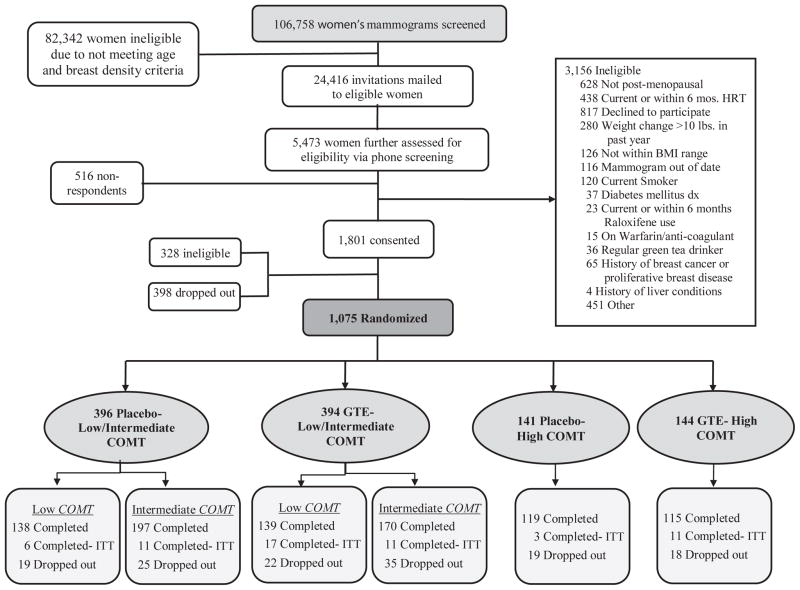
Results: The MGTT screened more than 100,000 mammograms and randomized 1,075 participants based on treatment (green tea extract vs. placebo), stratified by COMT genotype activity (high COMT vs. low/intermediate COMT genotype activity). A total of 937 women successfully completed the study and 138 dropped out (overall dropout rate = 12.8 %).
Conclusions: In this paper we report the rationale, design, recruitment, participant characteristics, and methods for biomarker and statistical analyses.
Keywords: Breast cancer; Green tea; Mammographic density; Postmenopausal women; Sex hormones.
Conflict of interest statement
Figures
References
-
- Siegel R, Ma J, Zou Z, Jemal A. Cancer statistics, 2014. CA Cancer J Clin. 2014;64:9–29. - PubMed
-
- Kushi LH, Doyle C, McCullough M, Rock CL, Demark-Wahnefried W, Bandera EV, Gapstur S, Patel AV, Andrews K, Gansler T, et al. American Cancer Society Guidelines on nutrition and physical activity for cancer prevention: reducing the risk of cancer with healthy food choices and physical activity. CA Cancer J Clin. 2012;62:30–67. - PubMed
-
- Thomson CA. Diet and breast cancer: understanding risks and benefits. Nutr Clin Pract. 2012;27:636–650. - PubMed
-
- Wang ZY, Huang MT, Lou YR, Xie JG, Reuhl KR, Newmark HL, Ho CT, Yang CS, Conney AH. Inhibitory effects of black tea, green tea, decaffeinated black tea, and decaffeinated green tea on ultraviolet B light-induced skin carcinogenesis in 7,12-dimethylbenz[a]anthracene-initiated SKH-1 mice. Cancer Res. 1994;54:3428–3435. - PubMed
Publication types
MeSH terms
Substances
Grants and funding
LinkOut - more resources
Full Text Sources
Other Literature Sources
Medical
Miscellaneous
