


Typical blood pressure response during dobutamine stress echocardiography of patients without known cardiovascular disease who have normal stress echocardiograms
- PMID: 26206464
- PMCID: PMC6279206
- DOI: 10.1093/ehjci/jev165
Typical blood pressure response during dobutamine stress echocardiography of patients without known cardiovascular disease who have normal stress echocardiograms
Abstract
Aims: Blood pressure (BP) responses during dobutamine stress echocardiography (DSE) have not been systematically studied. Consequently, it is not known what constitutes a normal or an abnormal BP response to dobutamine stress. We sought to define the typical BP response during DSE of patients not known to have cardiovascular disease.
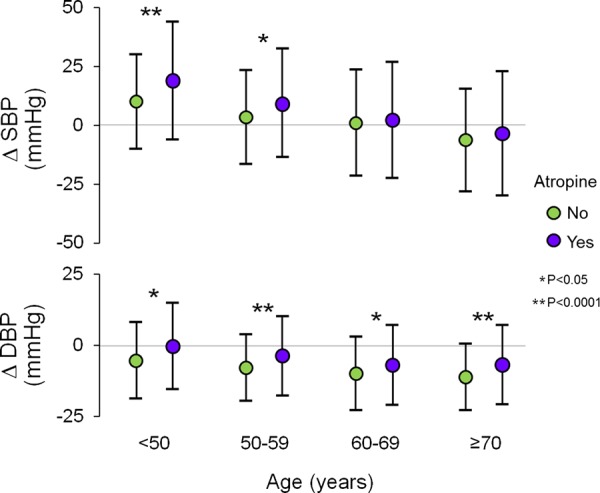
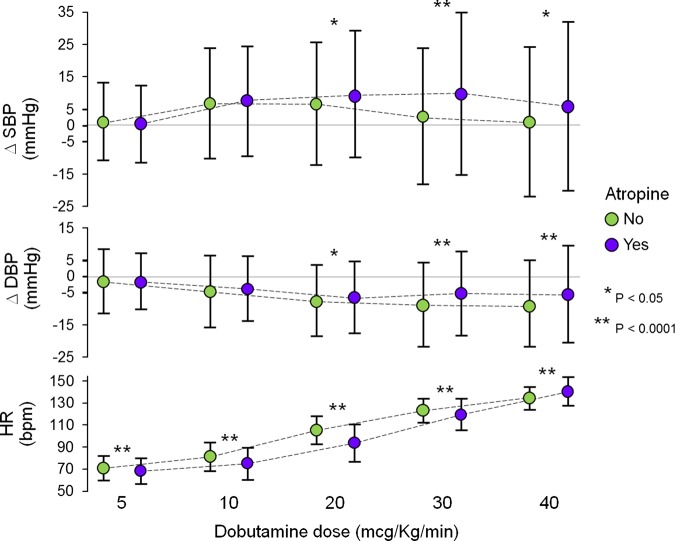
Methods and results: Of 24 134 patients who underwent DSE from November 2003 to December 2012 at Mayo Clinic, Rochester, MN, 2968 were selected for inclusion in this retrospective study. Excluded were patients with a history of hypertension, diabetes, or coronary artery disease, and those taking vasoactive medications. Patients who had baseline and/or stress-induced wall motion abnormalities were also excluded. The distribution of the study population's BP responses during DSE was Gaussian; we defined cut-point values for normative BP responses at 2 SD for each decade of age and for the whole study population. During DSE, systolic BP (SBP) increased from baseline to peak stress (Δ +2.9 ± 24 mmHg, P < 0.0001) and diastolic BP (DBP) decreased (Δ -7.4 ± 14 mmHg). BP changes were age and sex dependent; men and younger patients had greater ΔSBP and lesser ΔDBP, compared with women and older patients. Patients who received atropine had higher peak BP values than patients who did not receive atropine, due to greater ΔSBP (+7.4 ± 26 vs. -0.5 ± 22 mmHg, P < 0.0001) and lesser ΔDBP (-4 ± 14 vs. -9.7 ± 12 mmHg, P < 0.0001). This atropine effect was present in men and women, and was more pronounced in younger patients. The normative peak SBP values ranged from 82 to 182 mmHg.
Conclusion: BP responses during DSE vary and depend on patients' age, gender, and the use of atropine. We describe the typical BP responses seen during DSE and report normative reference values, which can be used for defining normal and abnormal BP responses to dobutamine stress.
Keywords: atropine; blood pressure; dobutamine stress echocardiography.
Published on behalf of the European Society of Cardiology. All rights reserved. © The Author 2015. For permissions please email: journals.permissions@oup.com.
Figures
References
-
- Pellikka PA, Nagueh SF, Elhendy AA, Kuehl CA, Sawada SG. American Society of Echocardiography recommendations for performance, interpretation, and application of stress echocardiography. J Am Soc Echocardiogr 2007;20:1021–41. - PubMed
-
- Sicari R, Nihoyannopoulos P, Evangelista A, Kasprzak J, Lancellotti P, Poldermans D et al. . Stress echocardiography expert consensus statement: European Association of Echocardiography (EAE) (a registered branch of the ESC). Eur J Echocardiogr 2008;9:415–37. - PubMed
-
- Biagini E, Elhendy A, Bax JJ, Rizzello V, Schinkel AF, van Domburg RT et al. . Seven-year follow-up after dobutamine stress echocardiography: impact of gender on prognosis. J Am Coll Cardiol 2005;45:93–7. - PubMed
-
- Sawada SG, Segar DS, Ryan T, Brown SE, Dohan AM, Williams R et al. . Echocardiographic detection of coronary artery disease during dobutamine infusion. Circulation 1991;83:1605–14. - PubMed
-
- Varga A, Garcia MA, Picano E. Safety of stress echocardiography (from the International Stress Echo Complication Registry). Am J Cardiol 2006;98:541–3. - PubMed
Publication types
MeSH terms
Substances
Grants and funding
LinkOut - more resources
Full Text Sources
Other Literature Sources
Medical
