. 2015 Aug;38(8):1402-11.
doi: 10.2337/dc15-0628.

Obesity and Gestational Diabetes Mellitus Pathways for Programming in Mouse, Monkey, and Man—Where Do We Go Next? The 2014 Norbert Freinkel Award Lecture

Affiliations

Obesity and Gestational Diabetes Mellitus Pathways for Programming in Mouse, Monkey, and Man—Where Do We Go Next? The 2014 Norbert Freinkel Award Lecture

Jacob E Friedman. Diabetes Care. 2015 Aug.

Abstract

Obesity and gestational diabetes mellitus continue to increase worldwide and span the spectrum of age, race, ethnicity, and socioeconomic status. Alarmingly, 1 in 10 infants and toddlers is obese, and 1 in 5 youths is both obese and at risk for metabolic syndrome prior to puberty. The mechanisms underlying how poor maternal health imparts risk for future metabolic disease in the offspring are beginning to emerge in deeply phenotyped human and nonhuman primate models. Maternal diet and obesity impact fuels, hormones, and inflammation with powerful effects on fetal metabolic systems. These are accompanied by persistent changes in the infant microbiome and epigenome and in offspring behavior. These results suggest that gestational and lactational dietary exposures are driving health risks in the next generation. Whether maternal diet can prevent changes in the womb to alter infant life-course disease risk is still unknown. Controlled, mechanistic studies to identify interventions are sorely needed for a healthier next generation.


Figures

Figure 1
Figure 1
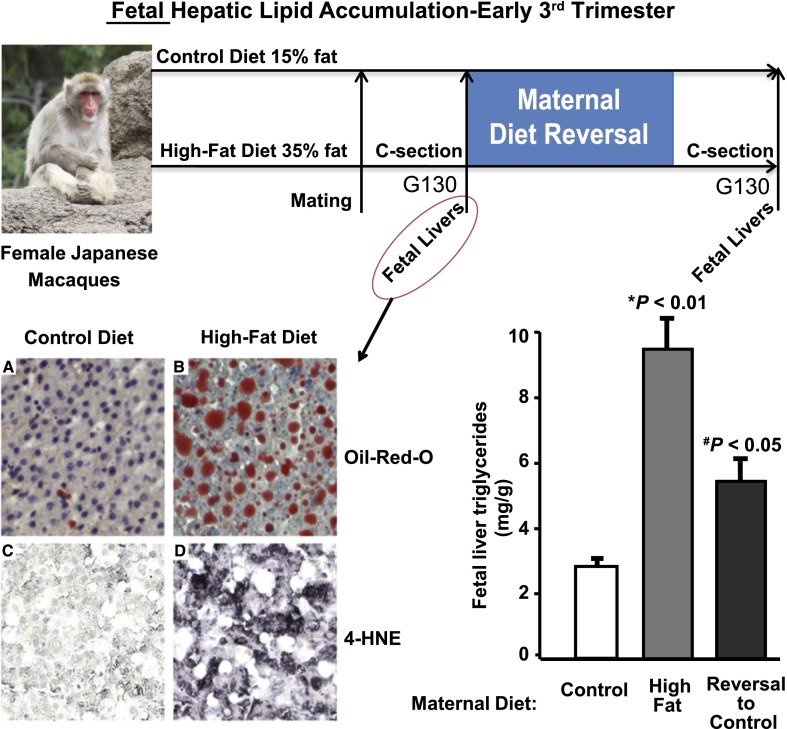
Liver steatosis in the fetal liver during the early third trimester of NPH on a high-fat diet. Female Japanese Macaques were maintained on high-fat or chow diet for a minimum of 2 years prior to mating. In a subsequent pregnancy, obese females were switched to a chow diet prior to mating and cesarean sections (C-section) were performed. Livers were stained for neutral lipid (Oil-Red-O) and 4-hydroxynonenal (4-HNE), a marker of oxidative stress (data are from McCurdy et al. [13]).
Figure 2
Figure 2
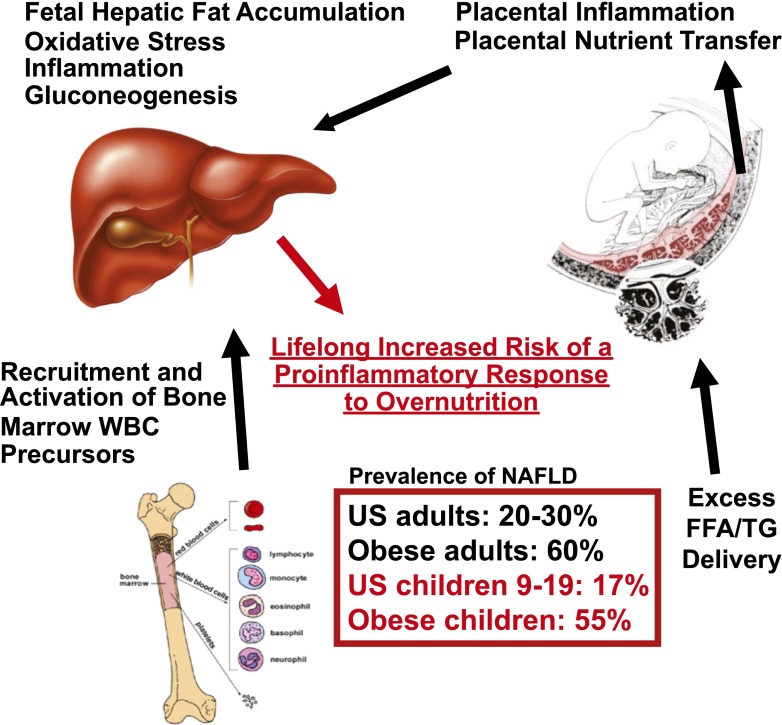
Consequences of maternal overfeeding on fetal liver and the evolution of NAFLD. Exposure to excess lipids triggers placental inflammation, oxidative stress, and liver steatosis prior to birth. After weaning, a combination of recruited hepatic macrophages and alternatively activated resident immune cells, together with IR and obesity, is a significant risk factor for inflammation and progression of NAFLD. Prevalence of NAFLD is shown. WBC, white blood cell.
Figure 3
Figure 3
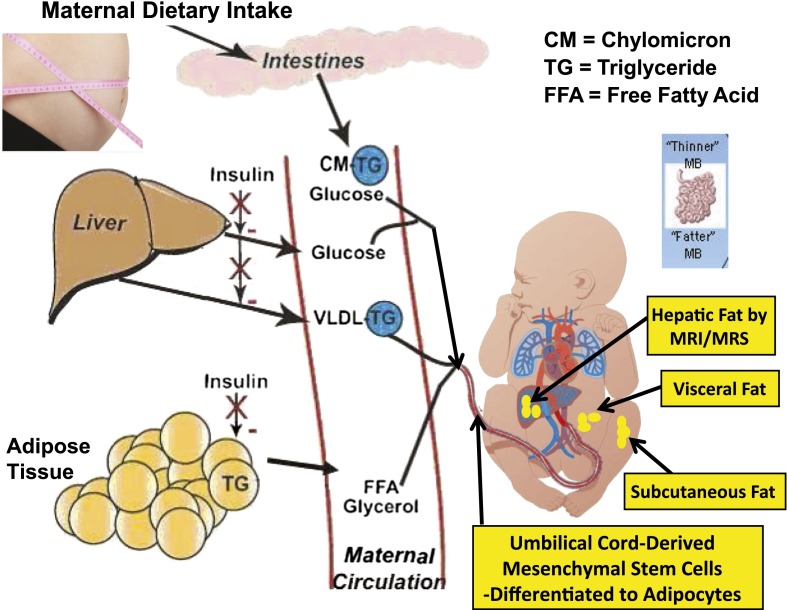
Fetal adaptations to maternal obesity and GDM. Maternal obesity, estimated to affect about one in four pregnant women, and GDM and type 2 diabetes in pregnancy, the rates of which are rapidly growing, increase circulating glucose and lipids due to increased lipolysis, hepatic glucose production, and dietary (chylomicron-derived) lipids. Newborns show increased hepatic lipids, subcutaneous fat, and adipogenesis in infant-derived umbilical cord MSCs. MB changes in infants born to obese and GDM mothers are under study. MRS, magnetic resonance spectroscopy.
Figure 4
Figure 4
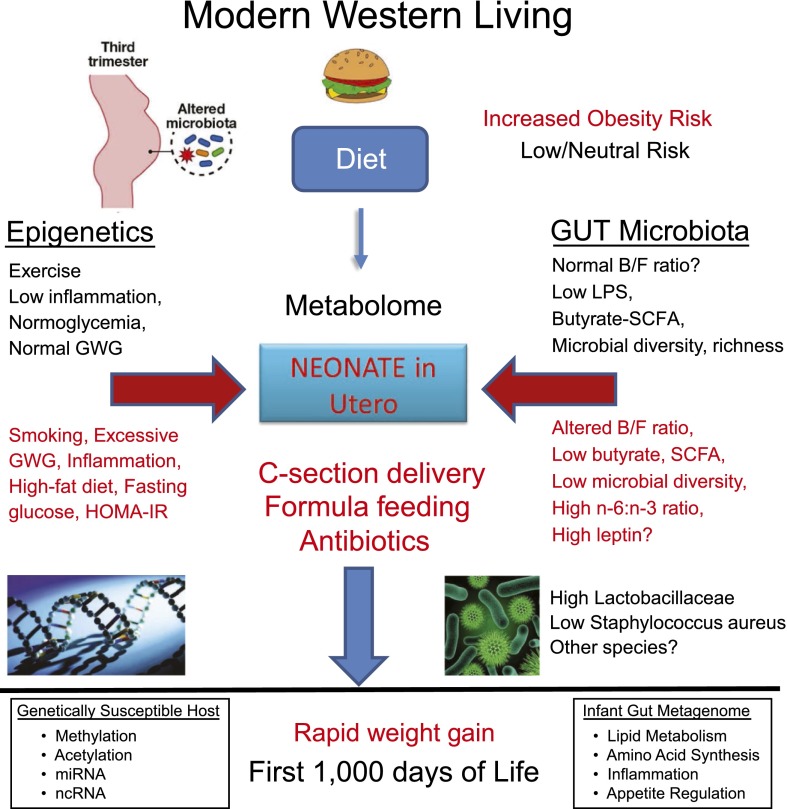
The impact of maternal diet on changes in obesity risk includes epigenetic and MB changes during the first 1,000 days of life. Metabolomic changes in mothers and babies may be associated with exposure to changes in gut microbes, dietary fatty acids, inflammation, excess insulin and leptin, along with antibiotics, and they may impact the host epigenome to increase infant weight gain. B/F, bacteroidetes/firmicutes; C-section, cesarean section; GWG, gestational weight gain; LPS, lipopolysaccharide; miRNA, microRNA; ncRNA, noncoding RNA.

References

    1. Barker DJ, Winter PD, Osmond C, Margetts B, Simmonds SJ. Weight in infancy and death from ischaemic heart disease. Lancet 1989;2:577–580 - PubMed
    1. Barker DJ. The origins of the developmental origins theory. J Intern Med 2007;261:412–417 - PubMed
    1. Bhargava SK, Sachdev HS, Fall CH, et al. . Relation of serial changes in childhood body-mass index to impaired glucose tolerance in young adulthood. N Engl J Med 2004;350:865–875 - PMC - PubMed
    1. Eriksson JG, Forsén T, Tuomilehto J, Osmond C, Barker DJ. Early growth and coronary heart disease in later life: longitudinal study. BMJ 2001;322:949–953 - PMC - PubMed
    1. Knight B, Shields BM, Hill A, Powell RJ, Wright D, Hattersley AT. The impact of maternal glycemia and obesity on early postnatal growth in a nondiabetic Caucasian population. Diabetes Care 2007;30:777–783 - PubMed

Publication types