


Genetic perspective on the role of the autophagy-lysosome pathway in Parkinson disease
- PMID: 26207393
- PMCID: PMC4590678
- DOI: 10.1080/15548627.2015.1067364
Genetic perspective on the role of the autophagy-lysosome pathway in Parkinson disease
Abstract
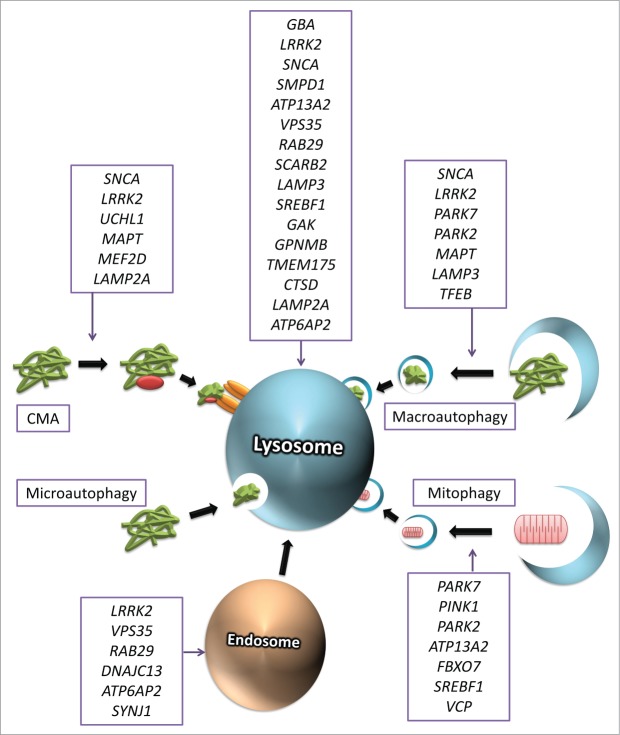
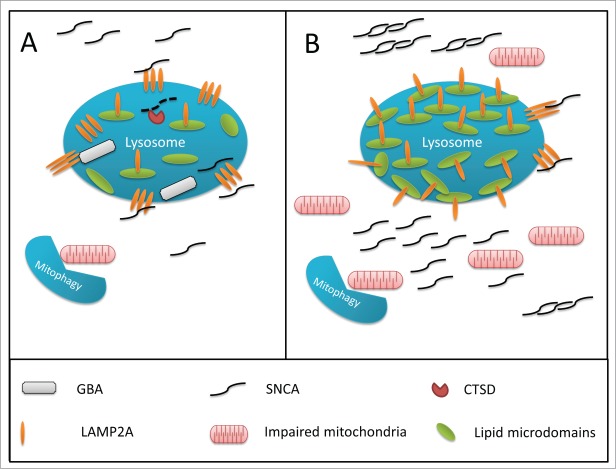
Parkinson disease (PD), once considered as a prototype of a sporadic disease, is now known to be considerably affected by various genetic factors, which interact with environmental factors and the normal process of aging, leading to PD. Large studies determined that the hereditary component of PD is at least 27%, and in some populations, single genetic factors are responsible for more than 33% of PD patients. Interestingly, many of these genetic factors, such as LRRK2, GBA, SMPD1, SNCA, PARK2, PINK1, PARK7, SCARB2, and others, are involved in the autophagy-lysosome pathway (ALP). Some of these genes encode lysosomal enzymes, whereas others correspond to proteins that are involved in transport to the lysosome, mitophagy, or other autophagic-related functions. Is it possible that all these factors converge into a single pathway that causes PD? In this review, we will discuss these genetic findings and the role of the ALP in the pathogenesis of PD and will try to answer this question. We will suggest a novel hypothesis for the pathogenic mechanism of PD that involves the lysosome and the different autophagy pathways.
Keywords: GBA; LAMP2A; LRRK2; Parkinson disease; SNCA; autophagy; genetics; lysosome; mitophagy.
Figures
References
-
- Lees AJ, Hardy J, Revesz T. Parkinson disease. Lancet 2009; 373:2055-66; PMID:19524782; http://dx.doi.org/ 10.1016/S0140-6736(09)60492-X - DOI - PubMed
-
- Elbaz A, Bower JH, Maraganore DM, McDonnell SK, Peterson BJ, Ahlskog JE, Schaid DJ, Rocca WA. Risk tables for parkinsonism and Parkinson disease. J Clin Epidemiol 2002; 55:25-31; PMID:11781119; http://dx.doi.org/ 10.1016/S0895-4356(01)00425-5 - DOI - PubMed
-
- Kopin IJ, Markey SP. MPTP toxicity: implications for research in Parkinson disease. Annu Rev Neurosci 1988; 11:81-96; PMID:3129982; http://dx.doi.org/ 10.1146/annurev.ne.11.030188.000501 - DOI - PubMed
-
- Do CB, Tung JY, Dorfman E, Kiefer AK, Drabant EM, Francke U, Mountain JL, Goldman SM, Tanner CM, Langston JW, et al.. Web-based genome-wide association study identifies two novel loci and a substantial genetic component for Parkinson disease. PLoS Genet 2011; 7:e1002141; PMID:21738487; http://dx.doi.org/ 10.1371/journal.pgen.1002141 - DOI - PMC - PubMed
-
- Hamza TH, Payami H. The heritability of risk and age at onset of Parkinson disease after accounting for known genetic risk factors. J Hum Genet 2010; 55:241-3; PMID:20203693; http://dx.doi.org/ 10.1038/jhg.2010.13 - DOI - PMC - PubMed
Publication types
MeSH terms
LinkOut - more resources
Full Text Sources
Other Literature Sources
Medical
Miscellaneous
