Multicenter Study
. 2015 Jul 24;10(7):e0131570.
doi: 10.1371/journal.pone.0131570. eCollection 2015.

ICD Shock, Not Ventricular Fibrillation, Causes Elevation of High Sensitive Troponin T after Defibrillation Threshold Testing--The Prospective, Randomized, Multicentre TropShock-Trial

Affiliations
Multicenter Study

ICD Shock, Not Ventricular Fibrillation, Causes Elevation of High Sensitive Troponin T after Defibrillation Threshold Testing--The Prospective, Randomized, Multicentre TropShock-Trial

Verena Semmler et al. PLoS One. .

Abstract

Background: The placement of an implantable cardioverter defibrillator (ICD) has become routine practice to protect high risk patients from sudden cardiac death. However, implantation-related myocardial micro-damage and its relation to different implantation strategies are poorly characterized.

Methods: A total of 194 ICD recipients (64±12 years, 83% male, 95% primary prevention of sudden cardiac death, 35% cardiac resynchronization therapy) were randomly assigned to one of three implantation strategies: (1) ICD implantation without any defibrillation threshold (DFT) testing, (2) estimation of the DFT without arrhythmia induction (modified "upper limit of vulnerability (ULV) testing") or (3) traditional safety margin testing including ventricular arrhythmia induction. High-sensitive Troponin T (hsTnT) levels were determined prior to the implantation and 6 hours after.

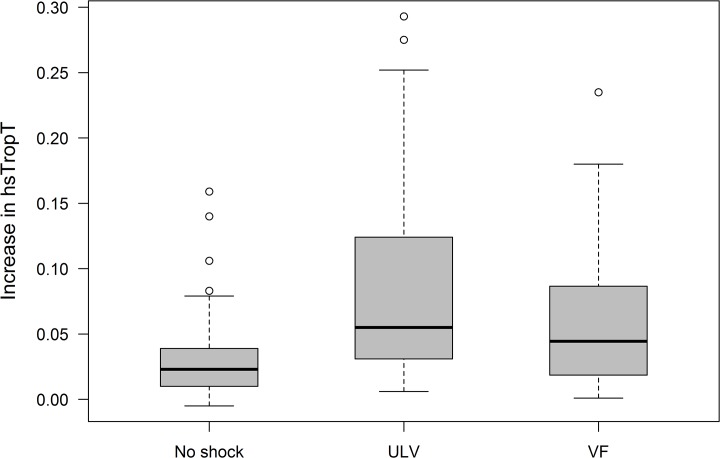
Results: All three groups showed a postoperative increase of hsTnT. The mean delta was 0.031±0.032 ng/ml for patients without DFT testing, 0.080±0.067 ng/ml for the modified ULV-testing and 0.064±0.056 ng/ml for patients with traditional safety margin testing. Delta hsTnT was significantly larger in both of the groups with intraoperative ICD testing compared to the non-testing strategy (p≤0.001 each). There was no statistical difference in delta hsTnT between the two groups with intraoperative ICD testing (p = 0.179).

Conclusion: High-sensitive Troponin T release during ICD implantation is significantly higher in patients with intraoperative ICD testing using shock applications compared to those without testing. Shock applications, with or without arrhythmia induction, did not result in a significantly different delta hsTnT. Hence, the ICD shock itself and not ventricular fibrillation seems to cause myocardial micro-damage.

Trial registration: ClinicalTrials.gov NCT01230086.


Conflict of interest statement

Competing Interests: Verena Semmler has received travel support from Sorin and St. Jude Medical. Jürgen Biermann has received lecture fees/travel support from Biotronik, Boston Scientific, Medtronic and St. Jude Medical. He performs or has performed clinical trials which were financially supported by Biotronik, Boston Scientific, Medtronic, Sorin and St. Jude Medical. Clemens Jilek has received travel support from St. Jude Medical. He has been an advisor to Medtronic. Nikolaus Sarafoff has received lecture fees/travel support from Biotronik, Boston Scientific and Medtronic. Carsten Lennerz has received lecture fees/travel support from Biotronik, Boston Scientific, Medtronic, Sorin and St. Jude Medical. Hrvoje Vražić has received lecture fees/travel support from Boston Scientific, Medtronic and Biotronik. He performs or has performed clinical trials which were financially supported by Biotronik. Bernhard Zrenner has received lecture fees/travel support from Boston Scientific, Medtronic and St. Jude Medical. He performs or has performed clinical trials which were financially supported by Biotronik and Boston Scientific. Stefan Asbach has received lecture fees/travel support from St. Jude Medical, Biotronik, Medtronic, Boston Scientific and Sorin. He performs or has performed clinical studies which were financially supported by Biotronik, St. Jude Medical, Medtronic, Boston Scientific and Sorin. Christof Kolb has received lecture fees/travel support from Biotronik, Boston Scientific, Medtronic, Sorin and St. Jude Medical. He is or has been an advisor to Biotronik and Sorin and he performs or has performed clinical trials which were financially supported by Biotronik, Boston Scientific, Medtronic, Sorin and St. Jude Medical. This does not alter the authors’ adherence to PLOS ONE policies on sharing data and materials.

Figures

Fig 1
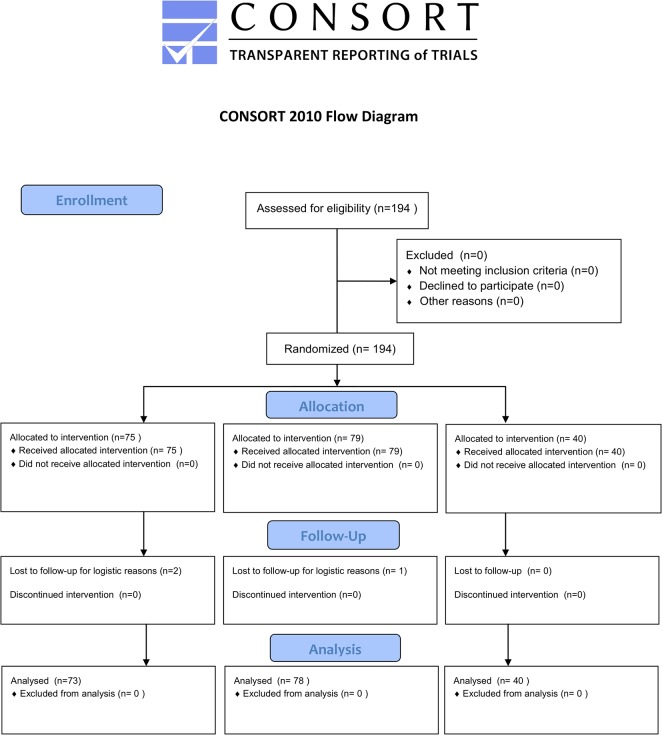
Fig 1. Consort Flow Diagram according to the CONSORT reporting guidelines.
Fig 2
Fig 2. Primary endpoint; increase in hsTnT[ng/ml] (intention-to-treat) for all randomization groups.
hsTnT = high sensitive Troponin T, No Shock = Implantation without ICD testing, ULV = Upper Limit of Vulnerability Testing, VF = Induction of Ventricular Fibrillation (traditional safety margin testing).
Fig 3
Fig 3. Secondary endpoint; increase in CK [U/l] (intention-to-treat) for all randomization groups.
CK = Creatinkinase, No Shock = Implantation without ICD testing, ULV = Upper Limit of Vulnerability Testing, VF = Induction of Ventricular Fibrillation (traditional safety margin testing).
Fig 4
Fig 4. Secondary endpoint; increase in CK-MB[U/l] (intention-to-treat) for all randomization groups.
CK-MB = Creatinkinase MB, No Shock = Implantation without ICD testing, ULV = Upper Limit of Vulnerability Testing, VF = Induction of Ventricular Fibrillation (traditional safety margin testing).

References

    1. Birnie D, Stanley T, Simpson C, Crystal E, Exner D, Ayala Paredes FA, et al. Complications associated with defibrillation threshold testing: The Canadian experience. Heart Rhythm 2008; 5:387–390 10.1016/j.hrthm.2007.11.018 - DOI - PubMed
    1. Healey JS, Hohnloser SH, Glikson M, Neuzner J, Viñolas X, Mabo P, et al. The rationale and design of the Shockless IMPLant Evaluation (SIMPLE) trial: A randomized, controlled trial of defibrillation testing at the time of defibrillator implantation. Am Heart J. 2012;164:146–52. 10.1016/j.ahj.2012.05.007 - DOI - PubMed
    1. Kolb C, Tzeis S, Zrenner B. Defibrillation Threshold Testing: Tradition or Necessity? PACE 2009; 32:570–572 10.1111/j.1540-8159.2009.02328.x - DOI - PubMed
    1. Calvi V, Dugo D, Capodanno D, Arancio R, Di Grazia A, Liotta C, et al. Intraoperative defibrillation threshold testing during implantable cardioverter defibrillator insertion: do we really need it? Am Heart J 2010; 159:98–102 10.1016/j.ahj.2009.10.031 - DOI - PubMed
    1. Blatt JA, Poole JE, Johnson GW, Callans DJ, Raitt MH, Reddy RK, et al. No Benefit From defibrillation Threshold Testing in the SCD-HeFT (Sudden Cardiac Death in Heart Failure Trial). J Am Coll Cardiol 2008; 52:551–6 10.1016/j.jacc.2008.04.051 - DOI - PubMed

Publication types

MeSH terms

Associated data