


Association between the Adherence to the International Guidelines for Cancer Prevention and Mammographic Density
- PMID: 26208331
- PMCID: PMC4514863
- DOI: 10.1371/journal.pone.0132684
Association between the Adherence to the International Guidelines for Cancer Prevention and Mammographic Density
Abstract
Introduction: Mammographic density (MD) is considered a strong predictor of Breast Cancer (BC). The objective of the present study is to explore the association between MD and the compliance with the World Cancer Research Fund and the American Institute for Cancer Research (WCRF/AICR) recommendations for cancer prevention.
Methods: Data of 3584 women attending screening from a population-based multicenter cross-sectional study (DDM-Spain) collected from October 7, 2007 through July 14, 2008, was used to calculate a score that measures the level of compliance with the WCRF/AICR recommendations: R1)Maintain adequate body weight; R2)Be physically active; 3R)Limit the intake of high density foods; R4)Eat mostly plant foods; R5)Limit the intake of animal foods; R6)Limit alcohol intake; R7)Limit salt and salt preserved food intake; R8)Meet nutritional needs through diet. The association between the score and MD (assessed by a single radiologist using a semi-quantitative scale) was evaluated using ordinal logistic models with random center-specific intercepts adjusted for the main determinants of MD. Stratified analyses by menopausal status and smoking status were also carried out.
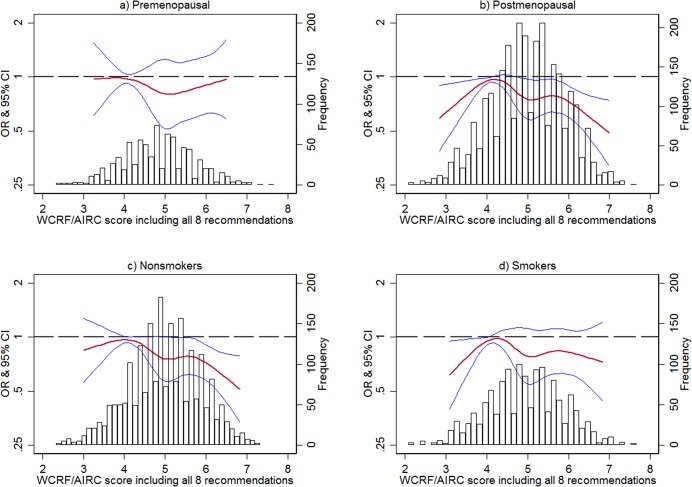
Results: A higher compliance with the WCRF/AICR recommendations was associated with lower MD (OR1-unit increase = 0.93 95%CI:0.86;0.99). The association was stronger in postmenopausal women (OR = 0.91 95%CI:0.84;0.99) and nonsmokers (OR = 0.87;95%CI:0.80;0.96 for nonsmokers, OR = 1.01 95%CI:0.91;1.12 for smokers, P-interaction = 0.042). Among nonsmokers, maintaining adequate body weight (OR = 0.81 95%CI:0.65;1.01), practicing physical activity (OR = 0.68 95%CI:0.48;0.96) and moderating the intake of high-density foods (OR = 0.58 95%CI:0.40;0.86) and alcoholic beverages (OR = 0.76 95%CI:0.55;1.05) were the recommendations showing the strongest associations with MD.
Conclusions: postmenopausal women and non-smokers with greater compliance with the WCRF/AICR guidelines have lower MD. These results may provide guidance to design specific recommendations for screening attendants with high MD and therefore at higher risk of developing BC.
Conflict of interest statement
Figures
References
-
- WCRF/AICR. World Cancer Research Fund / American Institute for Cancer Research. Policy and Action for Cancer Prevention. Food, Nutrition, and Physical Activity: a Global Perspective. Washington DC: AICR; 2009.
-
- WHO. Global health risks: mortality and burden of disease attributable to selected major risks Geneva, World Health Organization; 2009.
-
- WCRF/AICR. World Cancer Research Fund / American Institute for Cancer Research. Food, Nutrition, Physical Activity, and the Prevention of Cancer: a Global Perspective. Washington DC: AICR; 2007.
-
- WCRF/AICR. World Cancer Research Fund / American Institute for Cancer Research. Continuous Update Project Report. Food, Nutrition, Physical Activity, and the Prevention of Breast Cancer. 2010.
-
- Hastert TA, Beresford SA, Patterson RE, Kristal AR, White E. Adherence to WCRF/AICR cancer prevention recommendations and risk of postmenopausal breast cancer. Cancer epidemiology, biomarkers & prevention: a publication of the American Association for Cancer Research, cosponsored by the American Society of Preventive Oncology. 2013;22(9):1498–508. 10.1158/1055-9965.EPI-13-0210 - DOI - PMC - PubMed
Publication types
MeSH terms
LinkOut - more resources
Full Text Sources
Other Literature Sources
Medical
