


Can self-report instruments of shoulder function capture functional differences in older adults with and without a rotator cuff tear?
- PMID: 26208428
- PMCID: PMC4706820
- DOI: 10.1016/j.jelekin.2015.06.009
Can self-report instruments of shoulder function capture functional differences in older adults with and without a rotator cuff tear?
Abstract
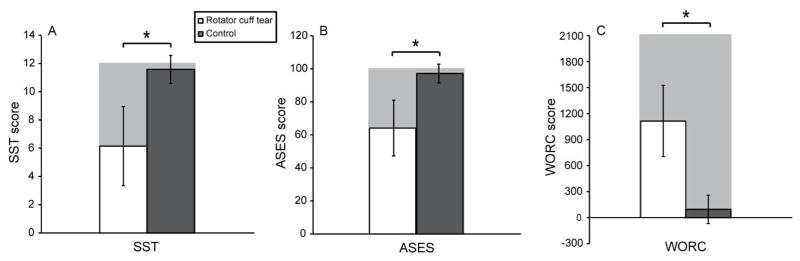
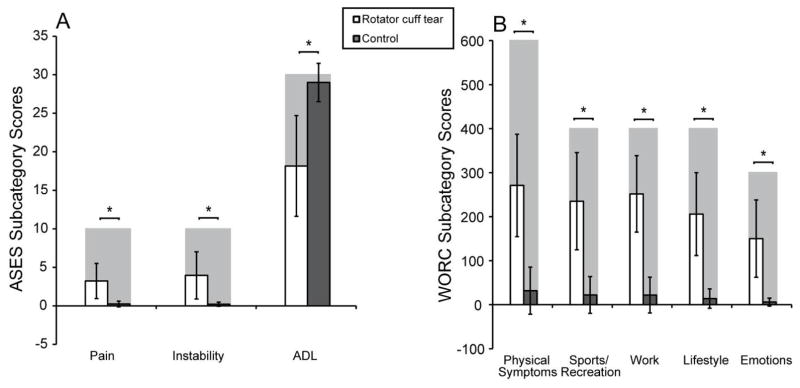
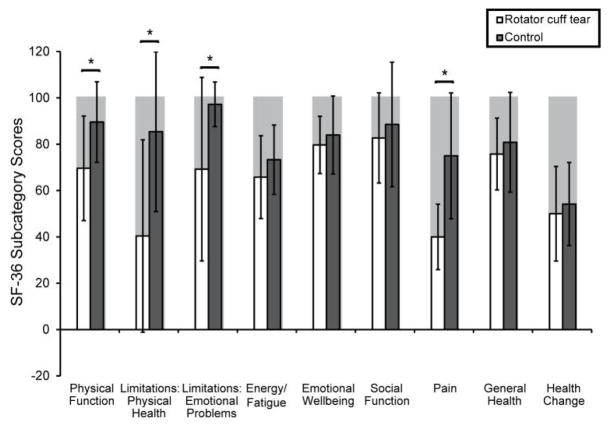
Rotator cuff tears (RCT) are prevalent in older individuals and may compound age-associated functional declines. Our purpose was to determine whether self-report measures of perceived functional ability are valid for older patients with RCT. Twenty five subjects participated (12M/13F; age=63.9±3.0years); 13 with RCT and 12 controls (CON). Participants completed self-report measures of shoulder function (SST, ASES, WORC) and health-related quality of life (SF-36). Isometric joint moment and range of motion (ROM) were measured at the shoulder. Relationships among functional self-reports, and between these measures and joint moment and ROM were assessed; group differences for total and subcategory scores were evaluated. There were significant correlations among self-reports (rs=0.62-0.71, p⩽0.02). For RCT subjects, ASES was associated with all joint moments except adduction (p⩽0.02); SST, ASES, and WORC were associated with abduction and external rotation ROM (p⩽0.04). For RCT subjects, SST and WORC were associated with SF-36 physical function subcategory scores (p⩽0.05). The RCT group scored worse than CON on all functional self-reports (p<0.01) and WORC and ASES subcategories (p<0.01). In conclusion, SST, ASES, and WORC demonstrate utility and discriminant validity for older individuals by distinguishing those with RCT, but this work suggests prioritizing ASES given its stronger association with functional group strength.
Keywords: Activities of daily living; Aged; Range of motion; Rotator cuff; Self report; Strength; Upper extremity.
Copyright © 2015 Elsevier Ltd. All rights reserved.
Conflict of interest statement
MTF serves as a consultant for Smith and Nephew, although no financial remuneration was received related to the information from this study. CJT has an ownership interest in a medical device used for measuring tension in rotator cuff tendon repairs with research applications, however, development and testing of this device is outside the scope of the work presented in this manuscript. None of the other authors have any conflicts of interest to disclose related to the content of this article.
Figures
References
-
- Amstutz HC, Sew Hoy AL, Clarke IC. UCLA anatomic total shoulder arthroplasty. Clin Orthop Relat Res. 1981 Mar-Apr;(155):7–20. - PubMed
-
- Beaton DE, Richards RR. Measuring function of the shoulder. A cross-sectional comparison of five questionnaires. J Bone Joint Surg Am. 1996;78(6):882–90. - PubMed
-
- Brophy RH, Beauvais RL, Jones EC, Cordasco FA, Marx RG. Measurement of shoulder activity level. Clin Orthop Relat Res. 2005 Oct;(439):101–8. - PubMed
-
- Bytomski JR, Black D. Conservative treatment of rotator cuff injuries. J Surg Orthop Adv. 2006;15(3):126–31. - PubMed
Publication types
MeSH terms
Grants and funding
LinkOut - more resources
Full Text Sources
Other Literature Sources
Medical
