


The region-dependent biomechanical and biochemical properties of bovine cartilaginous endplate
- PMID: 26209084
- PMCID: PMC4592809
- DOI: 10.1016/j.jbiomech.2015.07.005
The region-dependent biomechanical and biochemical properties of bovine cartilaginous endplate
Abstract
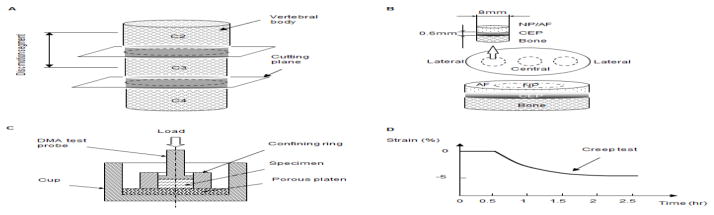
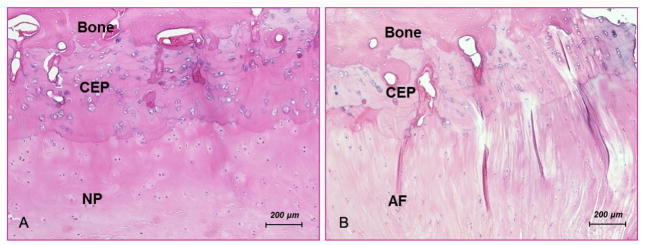
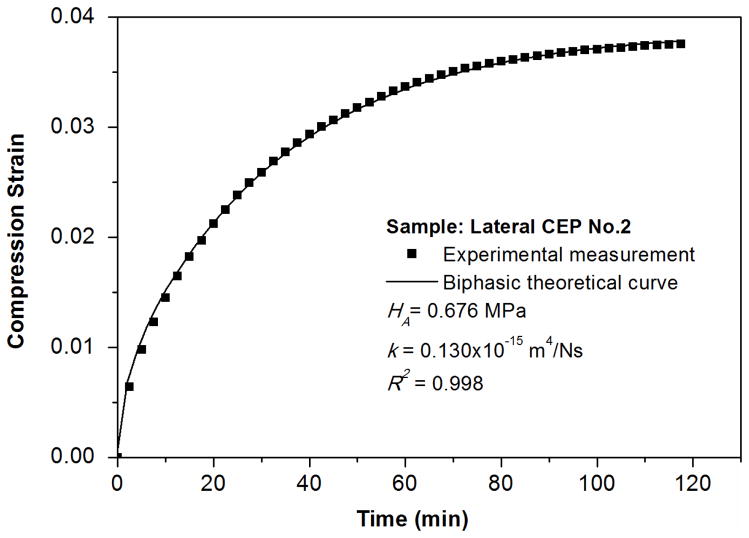
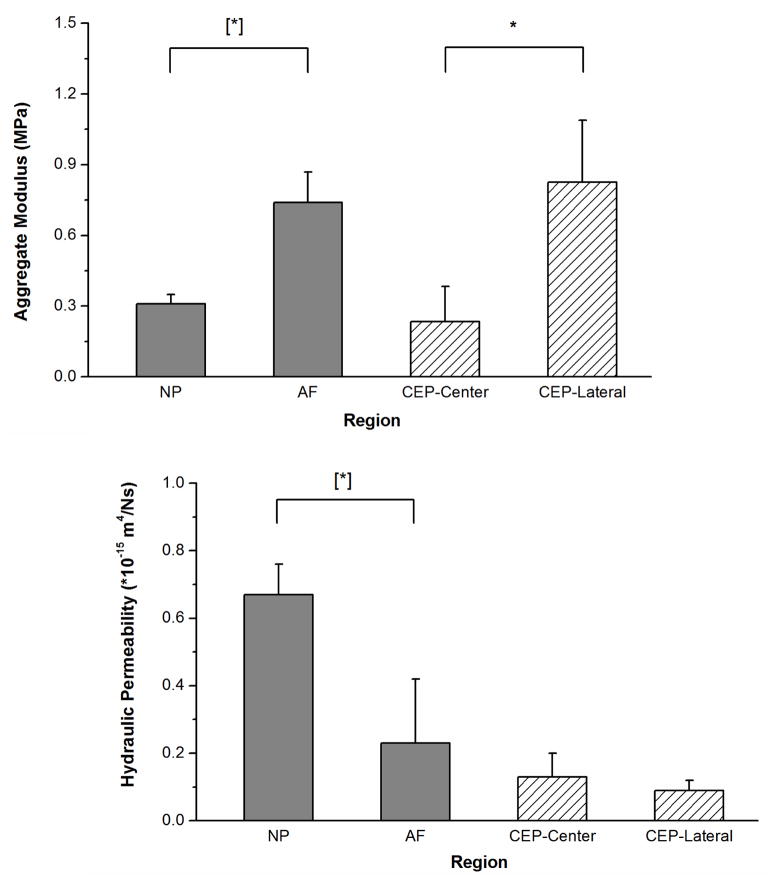
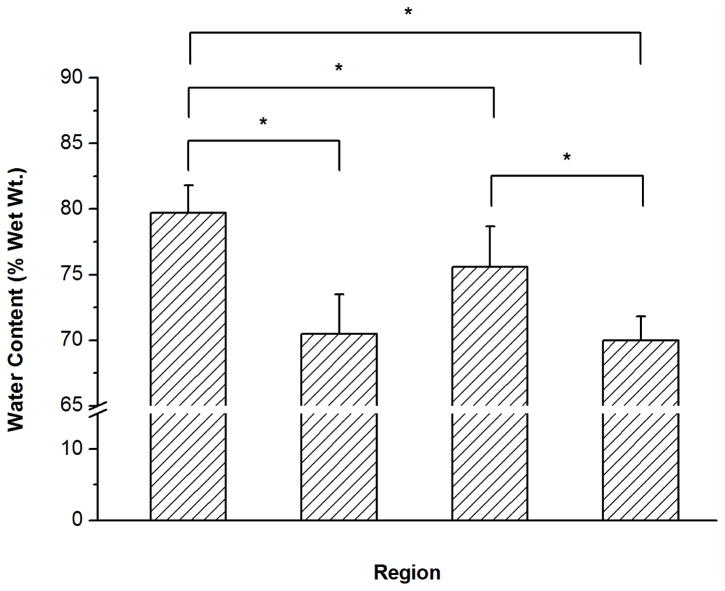
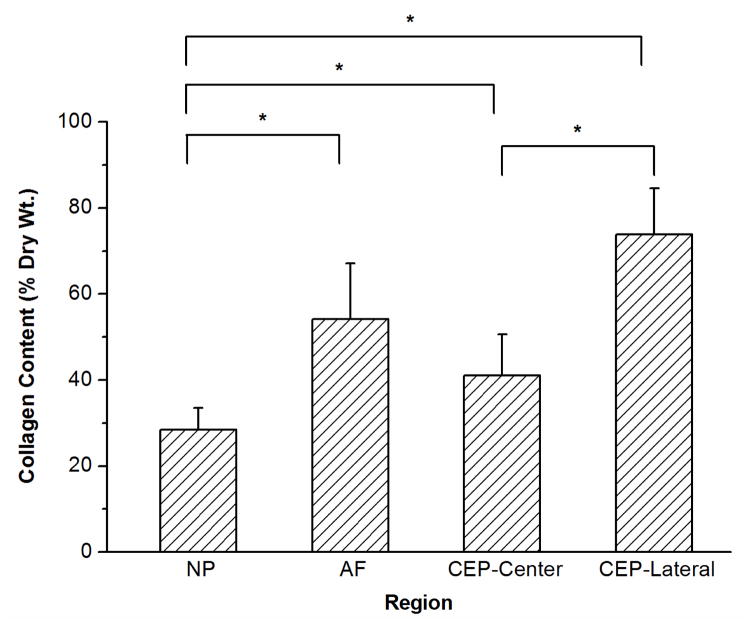
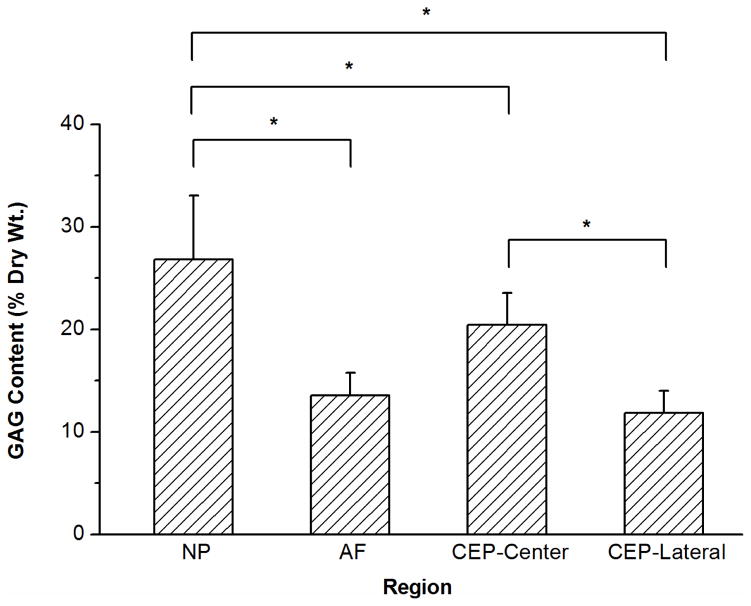
Regional biomechanical and biochemical properties of bovine cartilaginous endplate (CEP) and its role in disc mechanics and nutrition were determined. The equilibrium aggregate modulus and hydraulic permeability between the central and lateral regions were examined by confined compression testing. Biochemical assays were conducted to quantify the amount of water, collagen, and glycosaminoglycan (GAG). The equilibrium aggregate modulus of the CEP in the central region (0.23 ± 0.15 MPa) was significantly lower than for the lateral region (0.83 ± 0. 26 MPa). No significant regional difference was found for the permeability of the CEP (central region: 0.13 ± 0.07×10(-15)m(4)/Ns and lateral region: 0.09 ± 0.03 × 10(-15)m(4)/Ns). CEPs were an average of 75.6% water by wet weight, 41.1% collagen, and 20.4% GAG by dry weight in the central region, as well as an average of 70.2% water by wet weight, 73.8% collagen, and 11.7% GAG by dry weight in the lateral region. Regional differences observed for the equilibrium aggregate modulus were likely due to the regional variation in biochemical composition. The lateral bovine endplate is much stiffer and may share a greater portion of the load. Compared with the nucleus pulposus (NP) and annulus fibrosus (AF), a smaller hydraulic permeability was found for the CEP in both the central and lateral regions, which could be due to its lower water content and higher collagen content. Our results suggest that the CEP may block rapid fluid exchange and solute convection, allow pressurization of the interstitial fluid, and play a significant role in nutrient supply in response to loading.
Keywords: Aggregate modulus; Cartilaginous endplate; Hydraulic permeability; Intervertebral disc; Soft tissue mechanics.
Copyright © 2015 Elsevier Ltd. All rights reserved.
Conflict of interest statement
None of the authors of this paper have a conflict of interest that might be construed as affecting the conduct or reporting of the work presented.
Figures
References
-
- Adams MA, Hutton WC. Prolapsed intervertebral disc. A hyperflexion injury. Spine. 1982;7:184–191. - PubMed
-
- Aguiar DJ, Johnson SL, Oegema TR. Notochordal cells interact with nucleus pulposus cells: regulation of proteoglycan synthesis. Experimental Cell Research. 1999;246:129–137. - PubMed
-
- Ateshian GA, Warden WH, Kim JJ, Grelsamer RP, Mow VC. Finite deformation biphasic material properties of bovine articular cartilage from confined compression experiments. Journal of Biomechanics. 1997;30:1157–1164. - PubMed
-
- Athanasiou KA, Agarwal A, Dzida FJ. Comparative study of the intrinsic mechanical properties of the human acetabular and femoral head cartilage. Journal of Orthopaedic Research. 1994;12:340–349. - PubMed
-
- Callaghan JP, McGill SM. Intervertebral disc herniation: studies on a porcine model exposed to highly repetitive flexion/extension motion with compressive force. Clinical Biomechanics. 2001;16:28–37. - PubMed
Publication types
MeSH terms
Substances
Grants and funding
LinkOut - more resources
Full Text Sources
Other Literature Sources
Miscellaneous
