


Assessment of dipyridamole stress echocardiography for risk stratification of diabetic patients
- PMID: 26209102
- PMCID: PMC4515011
- DOI: 10.1186/s12947-015-0030-7
Assessment of dipyridamole stress echocardiography for risk stratification of diabetic patients
Abstract
Background: Despite advances in medical therapy, cardiovascular disease, mainly coronary artery disease (CAD), remains the leading cause of mortality among patients with diabetes mellitus (DM). The objective of the present study was to assess the effectiveness of dipyridamole stress echocardiography in identify diabetic patients at high risk for cardiovascular events.
Methods: Dipyridamole stress echocardiography was administered to 483 diabetic patients (294 women; mean age 63.41 ± 11.28 years) between July 2006 and December 2012.
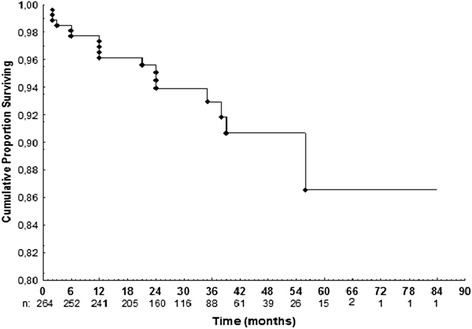
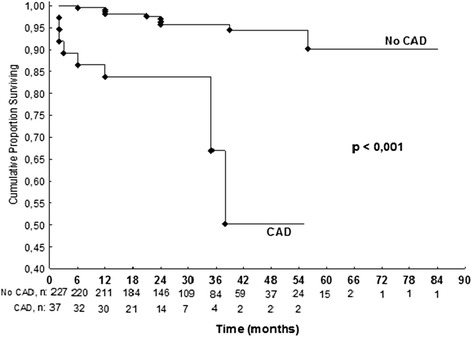
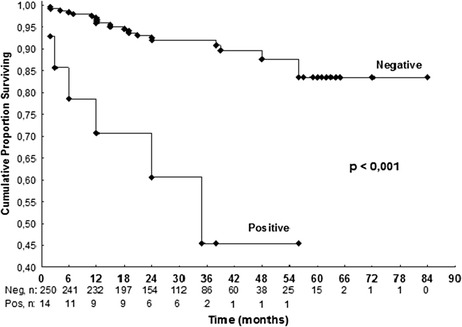
Results: Follow-up data were available for 264 patients (163 women; mean age 64.3 ± 10.5 years): 250 with a negative stress echocardiography and 14 with a positive stress echo. During a mean follow-up time of 18 ± 14 months, a cardiovascular event occurred in 18 (6.8%) patients, 12 (4.8%) in patients with a negative stress echo (n = 250) during a mean follow-up period of 20 ± 16 months and 6 (42%) in patients with positive stress echo (n = 14) during a mean follow-up of 13 ± 13 months. The positive and negative predictive values of stress echocardiography were 42% and 96% respectively. The accuracy value was 92%. A Cox regression model showed that CAD (hazard ratio [HR] 5.4, 95% confidence interval [CI] 1.9-15.4; p = 0.002) and positive stress echocardiography (HR 7.1, 95% CI 2.5-20.5; p < 0.001) were significant predictors of cardiovascular events.
Conclusions: For patients with diabetes, a negative dipyridamole stress echocardiogram predicts favorable outcome during the first year of follow-up. A new stress imaging test should be done after 12 months in diabetic patients.
Figures
References
MeSH terms
Substances
LinkOut - more resources
Full Text Sources
Other Literature Sources
Medical
Miscellaneous
