


Red Blood Cell Transfusions Impact Pneumonia Rates After Coronary Artery Bypass Grafting
- PMID: 26209489
- PMCID: PMC4904229
- DOI: 10.1016/j.athoracsur.2015.03.089
Red Blood Cell Transfusions Impact Pneumonia Rates After Coronary Artery Bypass Grafting
Abstract
Background: Pneumonia, a known complication of coronary artery bypass grafting (CABG), significantly increases a patient's risk of morbidity and mortality. Although not well characterized, red blood cell (RBC) transfusions may increase a patient's risk of pneumonia. We describe the relationship between RBC transfusion and postoperative pneumonia after CABG.
Methods: A total of 16,182 consecutive patients underwent isolated CABG between 2011 and 2013 at 1 of 33 hospitals in the state of Michigan. We used multivariable logistic regression to estimate the relative odds of pneumonia associated with the use or number of RBC units (0, 1, 2, 3, 4, 5, and ≥ 6). We adjusted for predicted risk of mortality, preoperative hematocrit values, history of pneumonia, cardiopulmonary bypass duration, and medical center. We confirmed the strength and direction of these relationships among selected clinical subgroups in a secondary analysis.
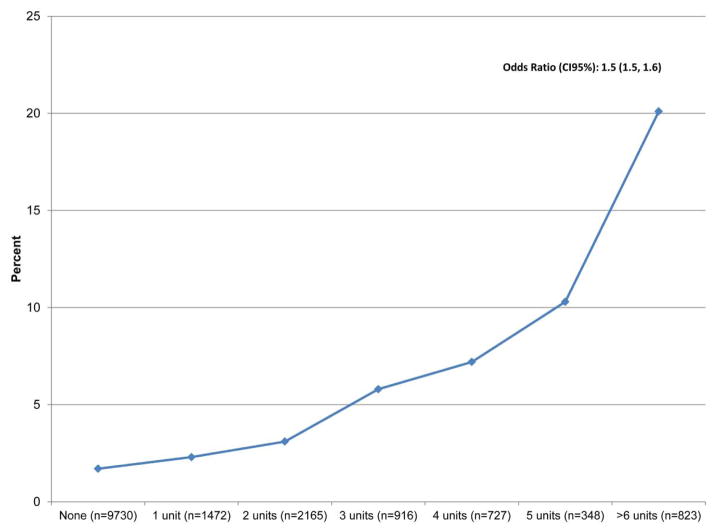
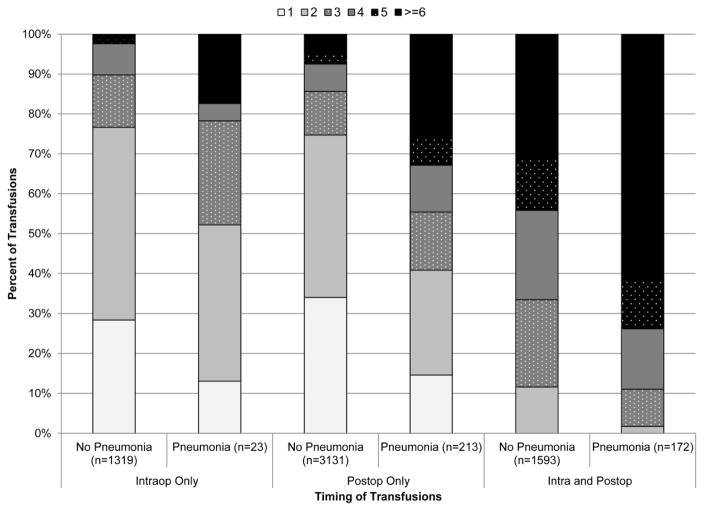
Results: Five hundred seventy-six (3.6%) patients had pneumonia and 6,451 (39.9%) received RBC transfusions. There was a significant association between any RBC transfusion and pneumonia (adjusted odds ratio [ORadj], 3.4; p < 0.001). There was a dose response between number of units and odds of pneumonia, with a ptrend less than 0.001. Patients receiving only 2 units of RBCs had a 2-fold (ORadj, 2.1; p < 0.001) increased odds of developing pneumonia. These findings were consistent across clinical subgroups.
Conclusions: We found a significant volume-dependent association between an increasing number of RBCs and the odds of pneumonia, which persisted after risk adjustment. Clinical teams should explore opportunities for preventing a patient's risk of RBC transfusions, including reducing hemodilution or adopting a lower transfusion threshold in a stable patient.
Copyright © 2015 The Society of Thoracic Surgeons. Published by Elsevier Inc. All rights reserved.
Figures
References
-
- Surgenor SD, DeFoe GR, Fillinger MP, et al. Intraoperative red blood cell transfusion during coronary artery bypass graft surgery increases the risk of postoperative low-output heart failure. Circulation. 2006;114:I43–48. - PubMed
-
- Prager RL, Armenti FR, Bassett JS, et al. Cardiac surgeons and the quality movement: The michigan experience. Seminars in thoracic and cardiovascular surgery. 2009;21:20–27. - PubMed
Publication types
MeSH terms
Grants and funding
LinkOut - more resources
Full Text Sources
Other Literature Sources
Medical
