


Timing of Cortico-Muscle Transmission During Active Movement
- PMID: 26209849
- PMCID: PMC4961012
- DOI: 10.1093/cercor/bhv151
Timing of Cortico-Muscle Transmission During Active Movement
Abstract
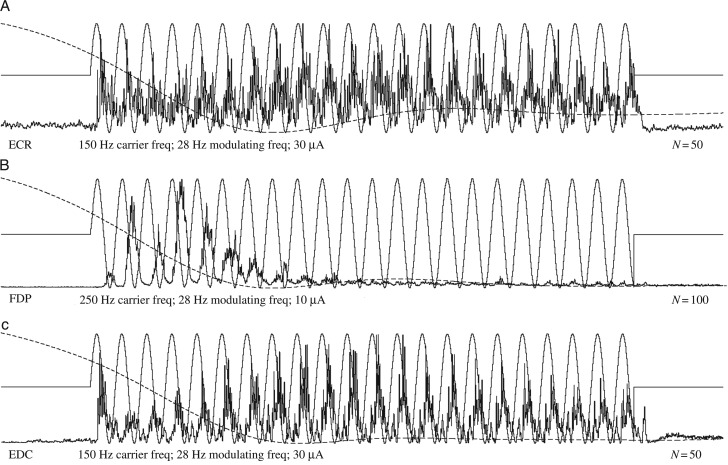
Numerous studies have reported large disparities between short cortico-muscle conduction latencies and long recorded delays between cortical firing and evoked muscle activity. Using methods such as spike- and stimulus-triggered averaging of electromyographic (EMG) activity, previous studies have shown that the time delay between corticomotoneuronal (CM) cell firing and onset of facilitation of forelimb muscle activity ranges from 6.7 to 9.8 ms, depending on the muscle group tested. In contrast, numerous studies have reported delays of 60-122 ms between cortical cell firing onset and either EMG or movement onset during motor tasks. To further investigate this disparity, we simulated rapid active movement by applying frequency-modulated stimulus trains to M1 cortical sites in a rhesus macaque performing a movement task. This yielded corresponding EMG modulations, the latency of which could be measured relative to the stimulus modulations. The overall mean delay from stimulus frequency modulation to EMG modulation was 11.5 ± 5.6 ms, matching closely the conduction time through the cortico-muscle pathway (12.6 ± 2.0 ms) derived from poststimulus facilitation peaks computed at the same sites. We conclude that, during active movement, the delay between modulated M1 cortical output and its impact on muscle activity approaches the physical cortico-muscle conduction time.
Keywords: EMG; cortico-muscle delay; forelimb; motor control; primary motor cortex.
Published by Oxford University Press 2015. This work is written by (a) US Government employee(s) and is in the public domain in the US.
Figures
References
-
- Baker SN, Lemon RN. 1998. Computer simulation of post-spike facilitation in spike-triggered averages of rectified EMG. J Neurophysiol. 80:1391–1406. - PubMed
-
- Binder MD, Heckman CJ, Powers RK. 2011. The physiological control of motoneuron activity. In: Rowell LB, Shepherd JT, editors. Handbook of Physiology. New York, NY: Oxford University Press. p. 3–53.
-
- Cheney PD, Fetz EE. 1980. Functional classes of primate corticomotoneuronal cells and their relation to active force. J Neurophysiol. 44:773–791. - PubMed
MeSH terms
LinkOut - more resources
Full Text Sources
Other Literature Sources
