


The long-term impact of early life pain on adult responses to anxiety and stress: Historical perspectives and empirical evidence
- PMID: 26210872
- PMCID: PMC4977201
- DOI: 10.1016/j.expneurol.2015.07.017
The long-term impact of early life pain on adult responses to anxiety and stress: Historical perspectives and empirical evidence
Abstract
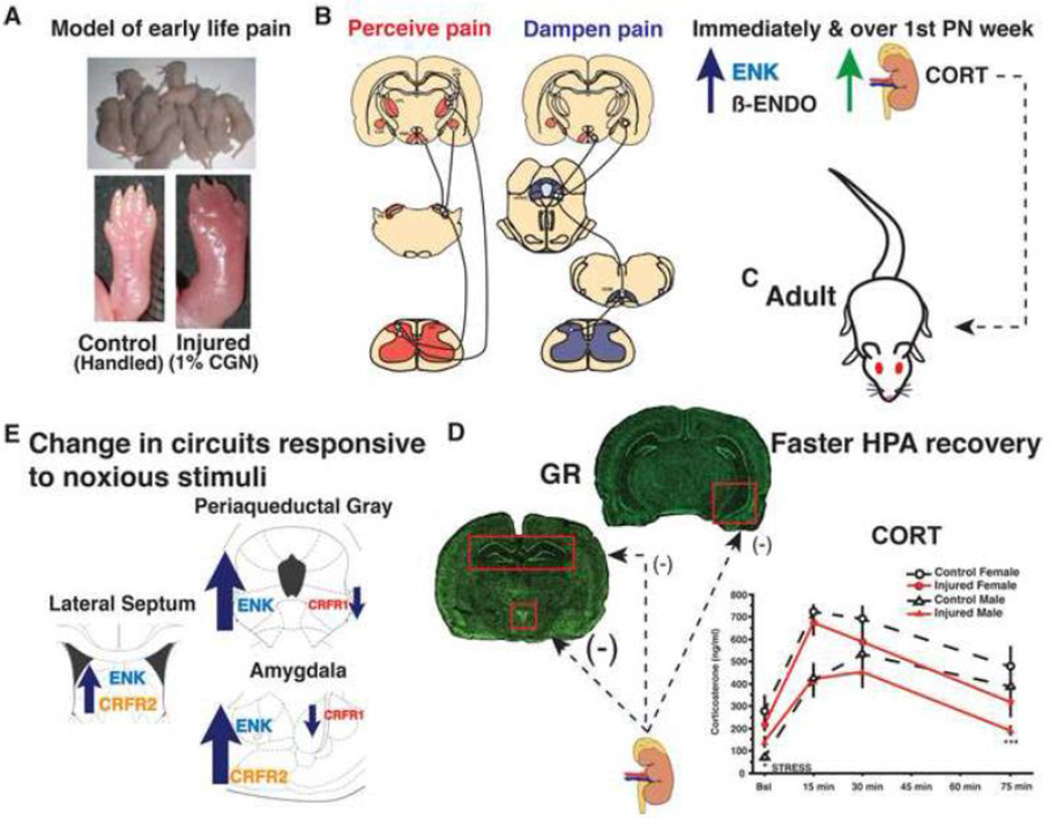
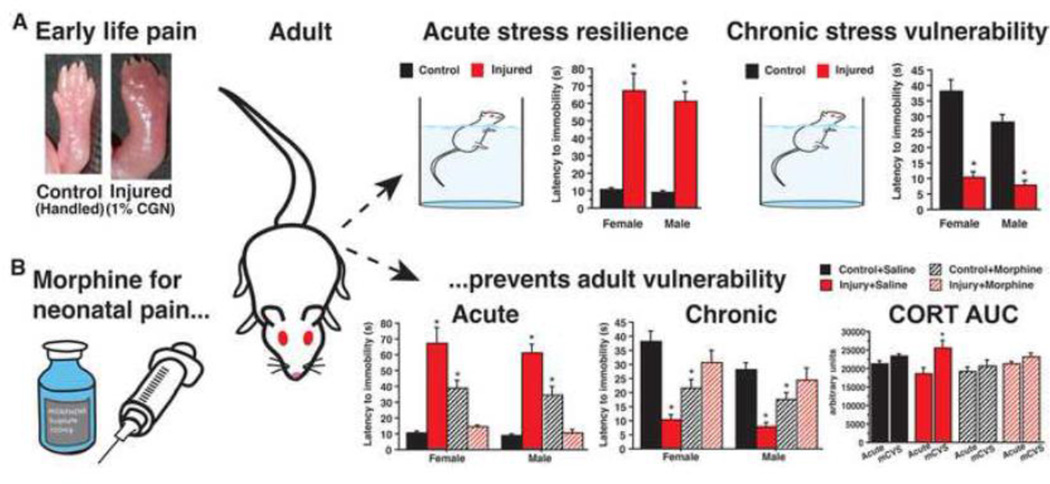
Approximately 1 in 6 infants are born prematurely each year. Typically, these infants spend 25 days in the Neonatal Intensive Care Unit (NICU) where they experience 10-18 painful and inflammatory procedures each day. Remarkably, pre-emptive analgesics and/or anesthesia are administered less than 25% of the time. Unalleviated pain during the perinatal period is associated with permanent decreases in pain sensitivity, blunted cortisol responses and high rates of neuropsychiatric disorders. To date, the mechanism(s) by which these long-term changes in stress and pain behavior occur, and whether such alterations can be prevented by appropriate analgesia at the time of insult, remains unclear. Work in our lab using a rodent model of early life pain suggests that inflammatory pain experienced on the day of birth blunts adult responses to stress- and pain-provoking stimuli, and dysregulates the hypothalamic pituitary adrenal (HPA) axis in part through a permanent upregulation in central endogenous opioid tone. This review focuses on the long-term impact of neonatal inflammatory pain on adult anxiety- and stress-related responses, and underlying neuroanatomical changes in the context of endogenous pain control and the HPA axis. These two systems are in a state of exaggerated developmental plasticity early in postnatal life, and work in concert to respond to noxious or aversive stimuli. We present empirical evidence from animal and clinical studies, and discuss historical perspectives underlying the lack of analgesia/anesthetic use for early life pain in the modern NICU.
Keywords: Amygdala; Corticosterone; Corticotrophin releasing factor receptors; Endogenous opioids; Endorphin; Enkephalin; Glucocorticoid receptor; Hypothalamic pituitary adrenal axis; Morphine; Periaqueductal gray.
Copyright © 2015 Elsevier Inc. All rights reserved.
Figures
References
-
- Aarnoudse-Moens CS, Weisglas-Kuperus N, van Goudoever JB, Oosterlaan J. Meta-analysis of neurobehavioral outcomes in very preterm and/or very low birth weight children. Pediatrics. 2009;124:717–728. - PubMed
-
- Akil H, Watson SJ, Young E, Lewis ME, Khachaturian H, Walker JM. Endogenous opioids: biology and function. Annu Rev Neurosci. 1984;7:223–255. - PubMed
-
- al’Absi M, Wittmers LE, Ellestad D, Nordehn G, Kim SW, Kirschbaum C, Grant JE. Sex differences in pain and hypothalamic-pituitary-adrenocortical responses to opioid blockade. Psychosom Med. 2004;66:198–206. - PubMed
-
- Anand KJ. Pain, plasticity, and premature birth: a prescription for permanent suffering? Nat Med. 2000;6:971–973. - PubMed
-
- Anand KJ, Aranda JV, Berde CB, Buckman S, Capparelli EV, Carlo WA, Hummel P, Lantos J, Johnston CC, Lehr VT, Lynn AM, Maxwell LG, Oberlander TF, Raju TN, Soriano SG, Taddio A, Walco GA. Analgesia and anesthesia for neonates: study design and ethical issues. Clin Ther. 2005a;27:814–843. - PubMed
Publication types
MeSH terms
Grants and funding
LinkOut - more resources
Full Text Sources
Other Literature Sources
Medical
Miscellaneous
