


Testing the 'toxin hypothesis of allergy': mast cells, IgE, and innate and acquired immune responses to venoms
- PMID: 26210895
- PMCID: PMC4593748
- DOI: 10.1016/j.coi.2015.07.001
Testing the 'toxin hypothesis of allergy': mast cells, IgE, and innate and acquired immune responses to venoms
Abstract
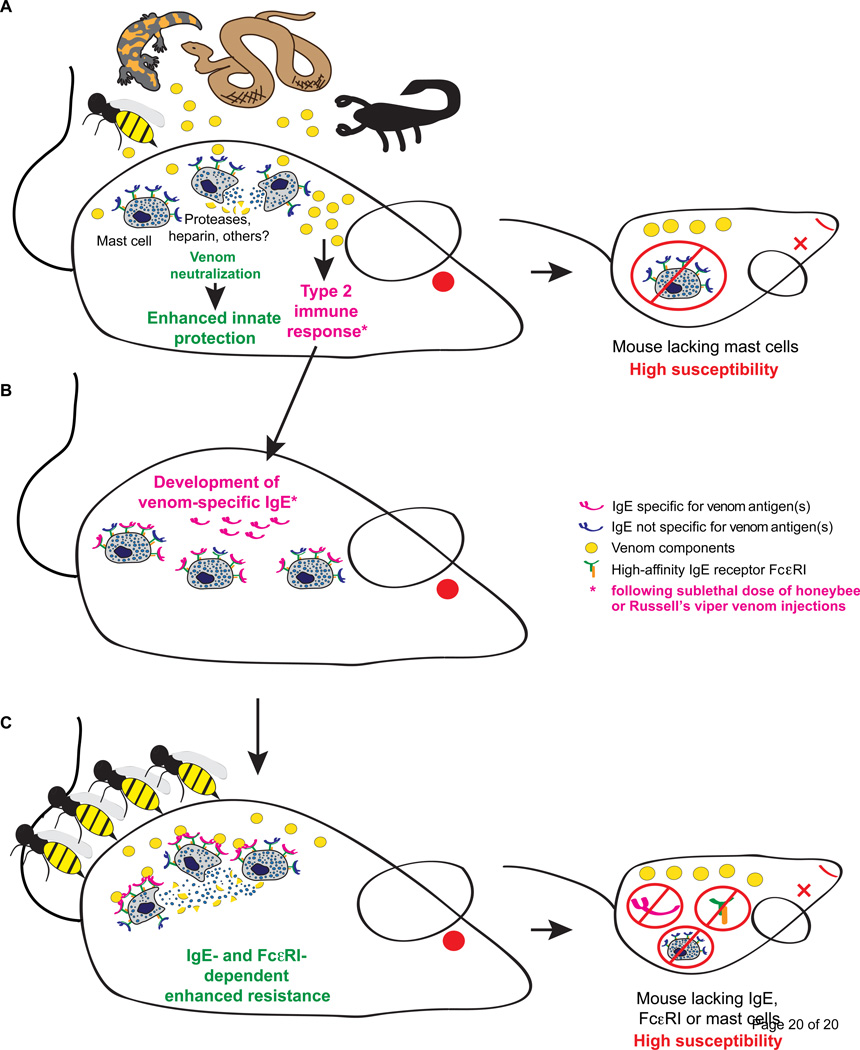
Work in mice indicates that innate functions of mast cells, particularly degradation of venom toxins by mast cell-derived proteases, can enhance resistance to certain arthropod or reptile venoms. Recent reports indicate that acquired Th2 immune responses associated with the production of IgE antibodies, induced by Russell's viper venom or honeybee venom, or by a component of honeybee venom, bee venom phospholipase 2 (bvPLA2), can increase the resistance of mice to challenge with potentially lethal doses of either of the venoms or bvPLA2. These findings support the conclusion that, in contrast to the detrimental effects associated with allergic type 2 (Th2) immune responses, mast cells and IgE-dependent immune responses to venoms can contribute to innate and adaptive resistance to venom-induced pathology and mortality.
Copyright © 2015 Elsevier Ltd. All rights reserved.
Conflict of interest statement
An annotated bibliography with comments about some of the same articles which are cited and commented on in this review is scheduled to appear in the October, 2015 issue of
Figures
References
-
-
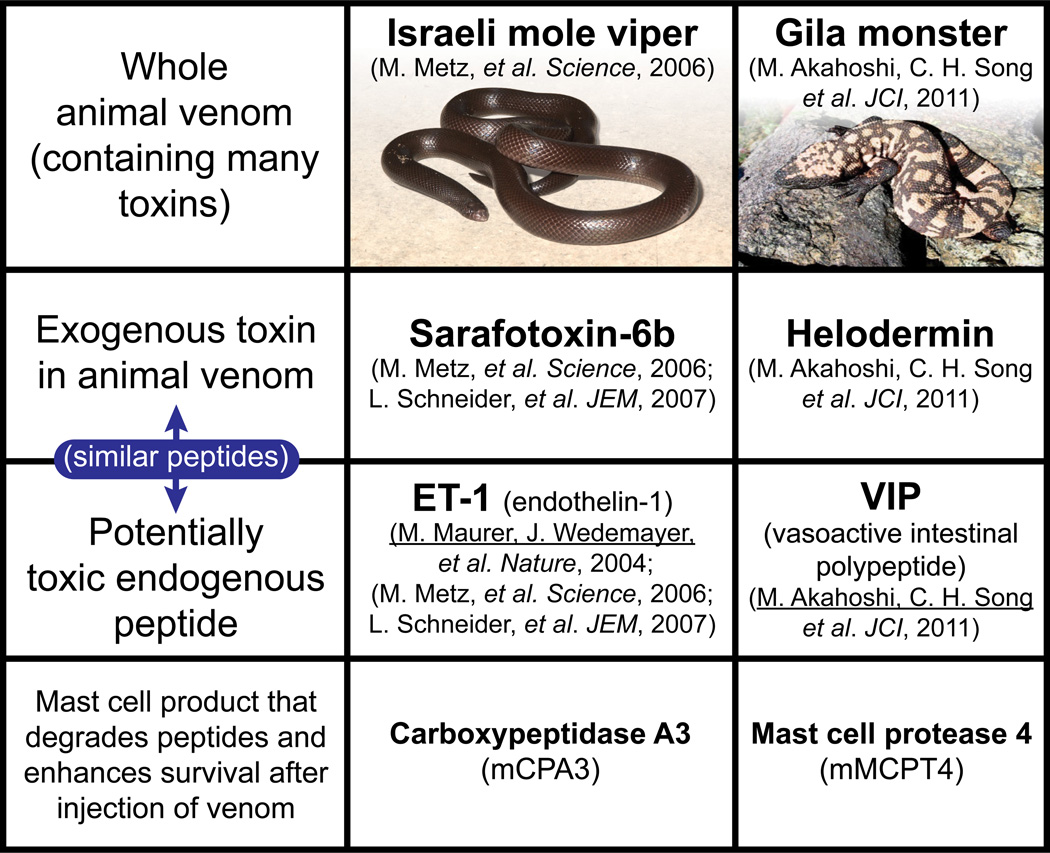
Akahoshi M, Song CH, Piliponsky AM, Metz M, Guzzetta A, Abrink M, Schlenner SM, Feyerabend TB, Rodewald HR, Pejler G, et al. Mast cell chymase reduces the toxicity of Gila monster venom, scorpion venom, and vasoactive intestinal polypeptide in mice. J Clin Invest. 2011;121:4180–4191. ** Studies employing MC-engrafted genetically MC-deficient WBB6F1-KitW/W-v and C57BL/6-KitW-sh/W-sh mice, as well as mice lacking either the MC chymase, MC protease-4 (MCPT4) or CPA3 enzymatic activity, showed that MCs and MCPT4 (which can degrade helodermin, a peptide in Gila monster [Heloderma suspectum] venom that is structurally similar to mammalian VIP), but not CPA3, can enhance host resistance to the toxicity of Gila monster venom. MCs and MCPT4 also limited the toxicity associated with high concentrations of VIP, and reduced the morbidity and mortality induced by the venoms of the Deathstalker (Yellow) scorpion (Leiurus quinquestriatus hebraeus) and the Arizona bark scorpion (Centruroides exilicauda).
-
-
- Higginbotham RD, Karnella S. The significance of the mast cell response to bee venom. J Immunol. 1971;106:233–240. - PubMed
-
- Metz M, Grimbaldeston MA, Nakae S, Piliponsky AM, Tsai M, Galli SJ. Mast cells in the promotion and limitation of chronic inflammation. Immunol Rev. 2007;217:304–328. - PubMed
-
-
Metz M, Piliponsky AM, Chen CC, Lammel V, Abrink M, Pejler G, Tsai M, Galli SJ. Mast cells can enhance resistance to snake and honeybee venoms. Science. 2006;313:526–530. **In studies employing MC knock-in kit mutant mice (i.e., MC-engrafted genetically MC-deficient WBB6F1-KitW/W-v and C57BL/6-KitW-sh/W-sh mice), the authors provided strong experimental evidence in mice that, as suggested by Higginbotham (see refs. and 14), MCs can enhance resistance to the toxicity of whole venoms, in this case the venoms of three snakes and the honeybee, as well as to the toxicity of a component of the venom of the Israeli mole viper (Atractaspis engaddensis), sarafotoxin 6b. By using a phramacological approach, and by employing shRNA to markedly diminish the content of carboxypeptidase A3 (CPA3) in MCs prior to their transfer into genetically MC-deficient mice, this study provided evidence that CPA3 is a MC-associated protease that importantly contributes to the MC’s ability to enhance resistance to the toxicity of whole venom from A. engaddensis and to sarafotoxin 6b.
-
-
- Metcalfe DD, Baram D, Mekori YA. Mast cells. Physiol Rev. 1997;77:1033–1079. - PubMed
Publication types
MeSH terms
Substances
Grants and funding
LinkOut - more resources
Full Text Sources
Other Literature Sources
