


Chemerin: A comprehensive review elucidating the need for cardiovascular research
- PMID: 26211950
- PMCID: PMC4859430
- DOI: 10.1016/j.phrs.2015.07.018
Chemerin: A comprehensive review elucidating the need for cardiovascular research
Abstract
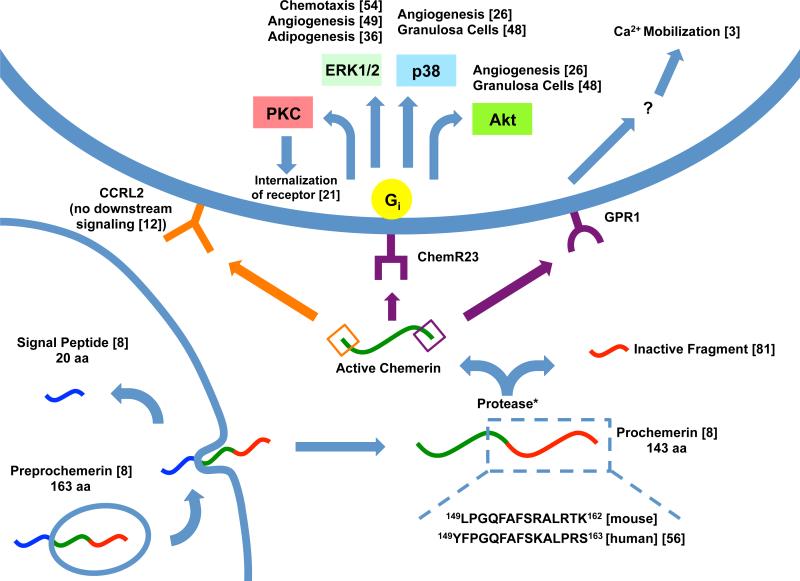
When chemerin was discovered in 1997, it was relegated to being a protein associated with the normal skin function contrasting the setting of psoriasis. However, with the discovery of multiple receptors for the chemerin protein and a vast collection of associations with various pathologies, chemerin has global influence capable of regulating chemotactic, adipokine, autocrine/paracrine, adipogenic, angiogenic, and reproductive functions. These individual abilities of chemerin are important for understanding its basic pharmacology and physiology, but application of these principles to human pathology relies on the ability of scientists and physicians to view this protein from a much wider, all-encompassing angle. A global participant in the action of chemerin is the cardiovascular system (CVS). Although the CVS may not have as many direct interactions (e.g. smooth muscle in endothelium) with chemerin as it does indirect (e.g. chemerin activation in the lumen by proteases), our basic understanding of the CVS and its relation to chemerin is necessary to form a proper grasp of its individual actions and make the applications to pathology. This review provides a fundamental, yet comprehensive review of chemerin that inherently identifies the CVS as a necessary link between chemerin and its associated pathologies, but also calls for basic cardiovascular research as the solution to this chasm between knowledge and application.
Keywords: Cardiovascular system; Chemerin; Pathology; Pharmacology; Physiology.
Copyright © 2015 Elsevier Ltd. All rights reserved.
Figures
References
-
- Nagpal S, Patel S, Jacobe H, DiSepio D, Ghosn C, Malhotra M, Teng M, Duvic M, Chandraratna RAS. Tazarotene-induced gene 2 (tig2), a novel retinoid-responsive gene in skin. Journal of Investigative Dermatology. 1997;109:91–95. - PubMed
-
- Marchese A, Docherty JM, Nguyen T, Heiber M, Cheng R, Heng HH, Tsui LC, Shi X, George SR, O'Dowd BF. Cloning of human genes encoding novel g protein- coupled receptors. Genomics. 1994;23:609–618. - PubMed
-
- Gantz I, Konda Y, Yang YK, Miller DE, Dierick HA, Yamada T. Molecular cloning of a novel receptor (cmklr1) with homology to the chemotactic factor receptors. Cytogenet Cell Genet. 1996;74:286–290. - PubMed
-
- Samson M, Edinger AL, Stordeur P, Rucker J, Verhasselt V, Sharron M, Govaerts C, Mollereau C, Vassart G, Doms RW, Parmentier M. Chemr23, a putative chemoattractant receptor, is expressed in monocyte-derived dendritic cells and macrophages and is a coreceptor for siv and some primary hiv-1 strains. European Journal of Immunology. 1998;28:1689–1700. - PubMed
Publication types
MeSH terms
Substances
Grants and funding
LinkOut - more resources
Full Text Sources
Other Literature Sources
