The Diagnosis and Treatment of Bronchopulmonary Carcinoid
- PMID: 26214234
- PMCID: PMC4524963
- DOI: 10.3238/arztebl.2015.0479
The Diagnosis and Treatment of Bronchopulmonary Carcinoid
Abstract
Background: The spectrum of primary neuroendocrine tumors of the lungs ranges from typical carcinoid tumors, which are relatively benign, to highly aggressive small-cell carcinoma. In this review, we summarize the treatment of bronchopulmonary carcinoid, a disease with an incidence of 0.5 per 100,000 persons per year in Western countries.
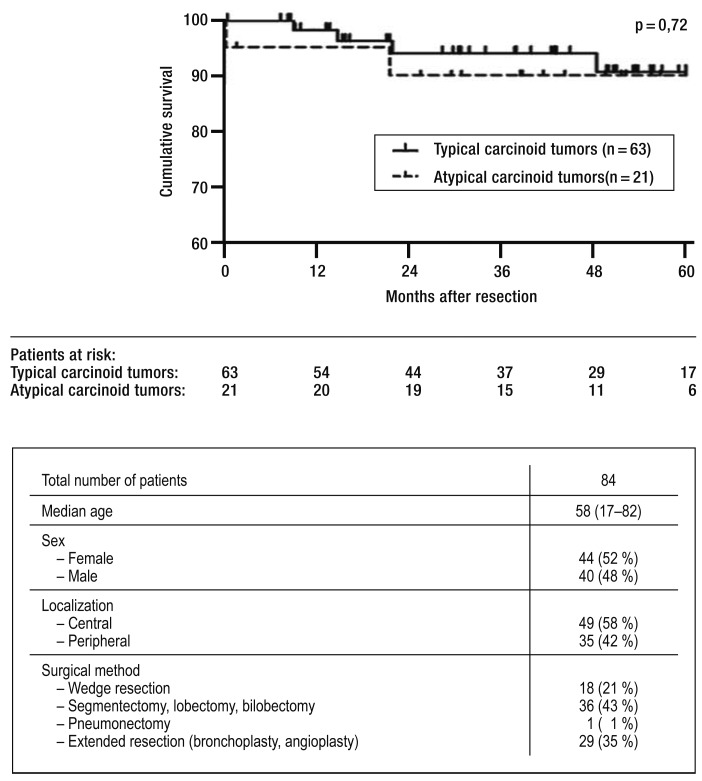
Method: We selectively searched the PubMed database for scientific evidence on the treatment of bronchopulmonary carcinoid, considering only articles published up to February 2015. We also performed a survival analysis of 84 patients with this disease who underwent interdisciplinary treatment at the University of Freiburg Medical Center.
Results: Carcinoid tumors account for less than 1% of all lung tumors. They manifest themselves clinically with cough (35%), hemoptysis (25%), and/or bronchial obstruction (40%), depending on their location, size, and pattern of growth. 30% of patients are asymptomatic, and less than 1% have hormone-associated symptoms. Typical and atypical carcinoid tumors are distinguished on a histological basis; the histologic differential diagnosis also includes large-cell neuroendocrine tumors and small-cell carcinoma of the lung. 80% of patients who undergo resection of typical carcinoid tumors survive at least 10 years. Atypical carcinoid tumors recur more commonly than typical ones. If the mediastinal lymph nodes are involved, adjuvant treatment should be considered.
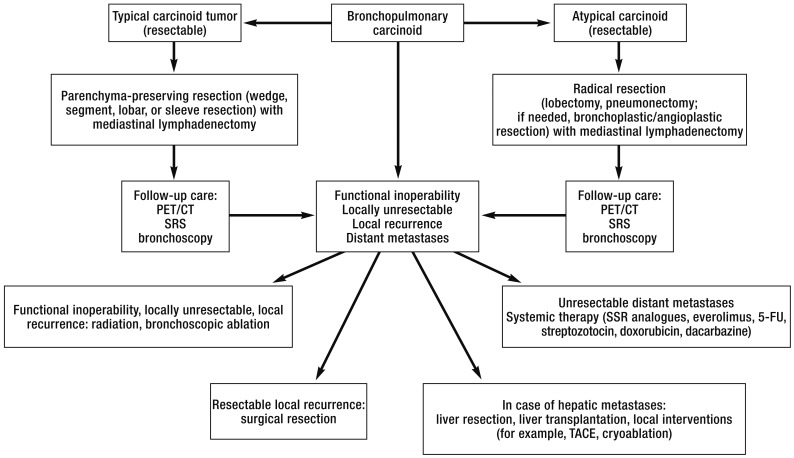
Conclusion: Because of their rarity, the treatment of bronchopulmonary carcinoid tumors presents an interdisciplinary challenge. Surgical resection, the treatment of choice for local carcinoid tumors, generally leads to long-term survival. The existing registers should be made more comprehensive so that the treatment of this disease can be better in the future.
Figures

References
-
- Pelosi G, Papotti M, Rindi G, Scarpa A. Unraveling tumor grading and genomic landscape in lung neuroendocrine tumors. Endocr Pathol. 2014;25:151–164. - PubMed
-
- Oberndorfer S. Karzinoide Tumoren des Dünndarmes. Frankfurter Zeitschrift für Pathologie. 1907;1:426–429.
-
- Arrigoni MG, Woolner LB, Bernatz PE. Atypical carcinoid tumors of the lung. J Thorac Cardiovasc Surg. 1972;64:413–421. - PubMed
-
- Travis WD, Brambilla E, Burke AP, Marx A, Nicholson AG, editors. WHO Press. 4th ed. Geneva, Switzerland: World Health Organization Classification of Tumors; 2015. WHO classification of tumours of the lung, pleura, thymus and heart; pp. 9–97. - PubMed
Publication types
MeSH terms
LinkOut - more resources
Full Text Sources
Other Literature Sources
Medical