


Outcomes of primary refractory multiple myeloma and the impact of novel therapies
- PMID: 26214732
- PMCID: PMC5801545
- DOI: 10.1002/ajh.24131
Outcomes of primary refractory multiple myeloma and the impact of novel therapies
Abstract
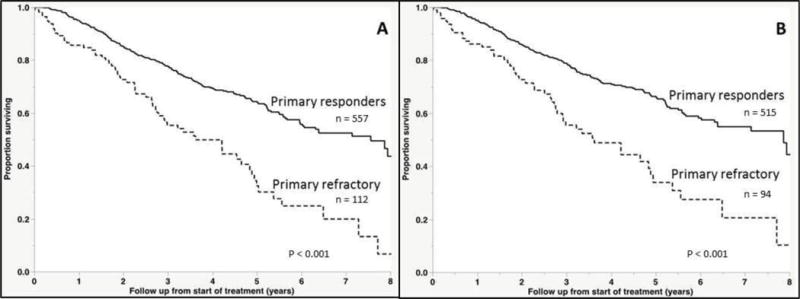
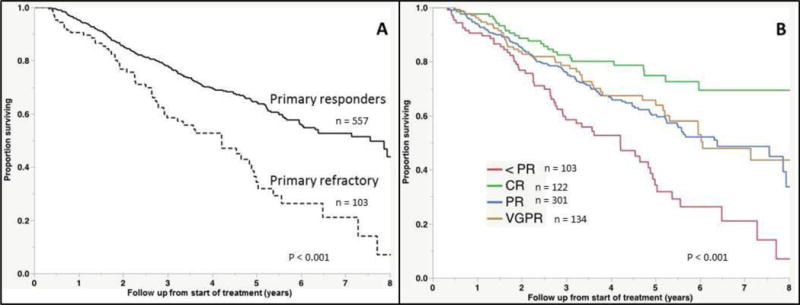
Over the past decade, use of novel agents, including immunomodulatory drugs (IMiDs) and proteasome inhibitors (PIs) has resulted in high response rates and improvement in overall survival (OS) for patients with multiple myeloma (MM); however, the prognostic significance of refractoriness to these agents when used as initial therapy has not been extensively studied. We reviewed the outcomes of 816 consecutive patients treated for MM at our institution since 2006 to evaluate the survival difference between those achieving at least a partial response (PR) to induction therapy and those who were primary refractory. The median OS from start of therapy was significantly shorter for the primary refractory group at 3.6 vs. 7.6 years for the responding patients (P < 0.001). The difference in median OS persisted when only patients receiving a novel agent as part of induction therapy were considered (3.6 vs. 7.9 years, P < 0.001) and in a 4-month landmark analysis (4.2 vs. 7.6 years, P < 0.001). The median OS for patients achieving a complete response (CR), very good partial response (VGPR), PR, or less than PR was not reached (NR), 6.1, 6.4, and 4.2 years from the 4-month landmark, respectively (P < 0.001). The comparatively poor outcomes of patients refractory to induction therapy in the current era of novel agents suggests that this high-risk subpopulation must be further studied for predictors of resistance and, when identified, should be targeted for clinical trials.
© 2015 Wiley Periodicals, Inc.
Figures
References
-
- Combination chemotherapy versus melphalan plus prednisone as treatment for multiple myeloma: an overview of 6,633 patients from 27 randomized trials. Myeloma Trialists’ Collaborative Group. J Clin Oncol. 1998;16:3832–3842. - PubMed
-
- Alexanian R, Barlogie B, Tucker S. VAD-based regimens as primary treatment for multiple myeloma. Am J Hematol. 1990;33:86–89. - PubMed
-
- Dimopoulos MA, Pouli A, Zervas K, et al. Prospective randomized comparison of vincristine, doxorubicin and dexamethasone (VAD) administered as intravenous bolus injection and VAD with liposomal doxorubicin as first-line treatment in multiple myeloma. Ann Oncol. 2003;14:1039–1044. - PubMed
-
- Wang L, Ran X, Wang B, et al. Novel agents-based regimens as induction treatment prior to autologous stem-cell transplantation in newly diagnosed multiple myeloma: a meta-analysis of randomized controlled trials. Hematol Oncol. 2012;30:57–61. - PubMed
-
- Huang H, Zhou L, Peng L, et al. Bortezomib-thalidomide-based regimens improved clinical outcomes without increasing toxicity as induction treatment for untreated multiple myeloma: a meta-analysis of phase III randomized controlled trials. Leuk Res. 2014;38:1048–1054. - PubMed
Publication types
MeSH terms
Substances
Grants and funding
LinkOut - more resources
Full Text Sources
Other Literature Sources
Medical
Molecular Biology Databases
Research Materials
Miscellaneous