


The effect of short-term high versus normal protein intake on whole-body protein synthesis and balance in children following cardiac surgery: a randomized double-blind controlled clinical trial
- PMID: 26215396
- PMCID: PMC4517637
- DOI: 10.1186/s12937-015-0061-9
The effect of short-term high versus normal protein intake on whole-body protein synthesis and balance in children following cardiac surgery: a randomized double-blind controlled clinical trial
Abstract
Background: Infants undergoing cardiac surgery are at risk of a negative protein balance, due to increased proteolysis in response to surgery and the cardiopulmonary bypass circuit, and limited intake. The aim of the study was to quantify the effect on protein kinetics of a short-term high-protein (HP) diet in infants following cardiac surgery.
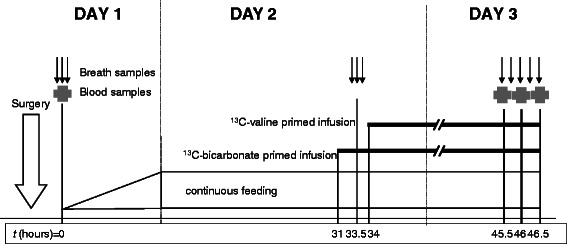
Methods: In a prospective, double-blinded, randomized trial we compared the effects of a HP (5 g · kg(-1) · d(-1)) versus normal protein (NP, 2 g · kg(-1) · d(-1)) enteral diet on protein kinetics in children <24 months, on day 2 following surgical repair of congenital heart disease. Valine kinetics and fractional albumin synthesis rate (FSRalb) were measured with mass spectrometry using [1-(13)C]valine infusion. The Mann-Whitney U test was used to investigate differences between group medians. Additionally, the Hodges-Lehmann procedure was used to create a confidence interval with a point estimate of median differences between groups.
Results: Twenty-eight children (median age 9 months, median weight 7 kg) participated in the study, of whom in only 20 subjects isotopic data could be used for final calculations. Due to underpowering of our study, we could not draw conclusions on the primary outcome parameters. We observed valine synthesis rate of 2.73 (range: 0.94 to 3.36) and 2.26 (1.85 to 2.73) μmol · kg(-1) · min(-1) in the HP and NP diet, respectively. The net valine balance was 0.54 (-0.73 to 1.75) and 0.24 (-0.20 to 0.63) μmol · kg(-1) · min(-1) in the HP and NP group. Between groups, there was no difference in FSRalb. We observed increased oxidation and BUN in the HP diet, compared to the NP diet, as a plausible explanation of the metabolic fate of surplus protein.
Conclusions: It is plausible that the surplus protein in the HP group has caused the increase of valine oxidation and ureagenesis, compared to the NP group. Because too few patients had completed the study, we were unable to draw conclusions on the effect of a HP diet on protein synthesis and balance. We present our results as new hypothesis generating data.
Trial registration: Dutch Trial Register NTR2334.
Figures

References
-
- Sermet-Gaudelus I, Poisson-Salomon AS, Colomb V, Brusset MC, Mosser F, Berrier F, Ricour C. Simple pediatric nutritional risk score to identify children at risk of malnutrition. Am J Clin Nutr. 2000;72:64–70. - PubMed
-
- Pichard C, Kyle UG, Morabia A, Perrier A, Vermeulen B, Unger P. Nutritional assessment: lean body mass depletion at hospital admission is associated with an increased length of stay. Am J Clin Nutr. 2004;79:613–618. - PubMed
Publication types
MeSH terms
Substances
Associated data
LinkOut - more resources
Full Text Sources
Other Literature Sources
Medical
Research Materials
Miscellaneous
