


Tailored e-Health services for the dementia care setting: a pilot study of 'eHealthMonitor'
- PMID: 26215731
- PMCID: PMC4517387
- DOI: 10.1186/s12911-015-0182-2
Tailored e-Health services for the dementia care setting: a pilot study of 'eHealthMonitor'
Abstract
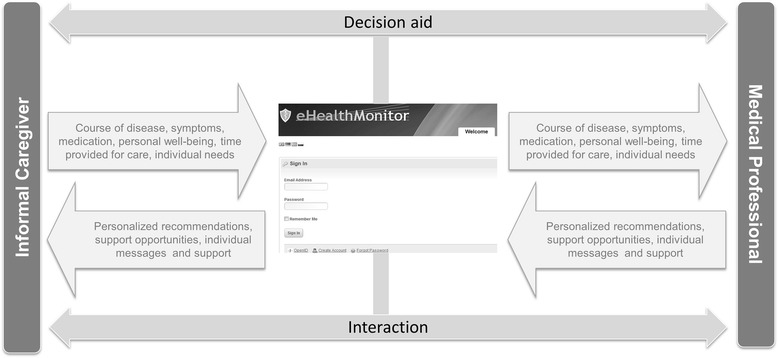
Background: The European eHealthMonitor project (eHM) developed a user-sensitive and interactive web portal for dementia care: the eHM Dementia Portal (eHM-DP). It aims to provide targeted and personalized support for informal caregivers of people with dementia in a home-based care setting. The objective of the pilot study was to obtain feedback on the eHM-DP from two user perspectives (caregivers and medical professionals), focusing on caregiver empowerment, decision aid, and the perceived benefits of the eHM-DP.
Methods: The study on the eHM-DP was conducted from March 2014 to June 2014. The methodological approach followed a user-participatory design with a total number of 42 participants. The study included caregivers of people with dementia and medical professionals (MPs) from the metropolitan region of Erlangen-Nürnberg (Bavaria, Germany). Study participants were interviewed face-to-face with semi-structured, written interviews.
Results: Caregivers indicated a high degree of perceived support by the eHM-DP and of provided decision aid. In total, 89 % of caregivers and 54 % of MPs would use the eHM-DP if access were provided. The primary benefits participants perceived were the acquisition of individualized information, computerized interaction between caregivers and MPs, empowerment in health-related decisions and comprehensive insights into the progress of the disease. Major recommendations for improving the eHM-DP encompassed: an active search functionality based on predefined terms, the implementation of a chatroom for caregivers, an upload function and alerts for MPs, as well as the overall design.
Conclusions: Our study is the first to have provided new insights and results on an interactive and needs-oriented web portal, endeavouring towards empowerment and assistance in decision making for caregivers as well as MPs within the realm of caring for patients with dementia. The acceptance and willingness to use the eHM-DP emphasizes the potential of eHealth services for community-based dementia care settings.
Figures
References
-
- World Health Organization (WHO). Dementia - a public health priority. Report. 2012.
-
- Zwaanswijk M, Peeters JM, Van Beek AP, Meerveld JH, Francke AL. Informal caregivers of people with dementia: problems, needs and support in the initial stage and in subsequent stages of dementia: a questionnaire survey. Open Nurs J. 2013;7:6–13. doi: 10.2174/1874434601307010006. - DOI - PMC - PubMed
-
- Raivio M, Eloniemi-Sulkava U, Laakkonen ML, Saarenheimo M, Pietila M, Tilvis R, et al. How do officially organized services meet the needs of elderly caregivers and their spouses with Alzheimer’s disease? Am J Alzheimers Dis Other Demen. 2007;22:360–8. doi: 10.1177/1533317507305178. - DOI - PMC - PubMed
-
- Gräßel E, Adabbo R. Perceived Burden of Informal Caregivers of a Chronically ill Older Family Member. J GeroPsych Geriatr Psychiatr. 2011;2:143–54.
Publication types
MeSH terms
LinkOut - more resources
Full Text Sources
Other Literature Sources
Medical
