


Do body mass index trajectories affect the risk of type 2 diabetes? A case-control study
- PMID: 26215867
- PMCID: PMC4517348
- DOI: 10.1186/s12889-015-2073-y
Do body mass index trajectories affect the risk of type 2 diabetes? A case-control study
Abstract
Background: Although obesity is a well-studied risk factor for diabetes, there remains an interest in whether "increasing body mass index (BMI)," "high BMI per se," or both are the actual risk factors for diabetes. The present study aimed to retrospectively compare BMI trajectories of individuals with and without diabetes in a case-control design and to assess whether increasing BMI alone would be a risk factor.
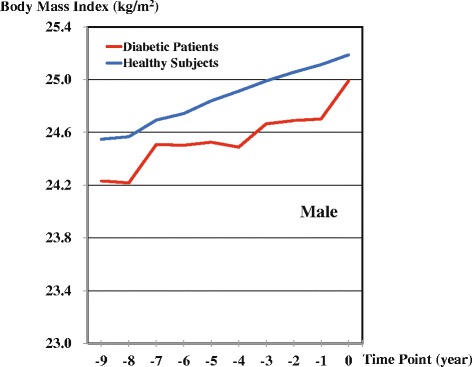
Methods: Using comprehensive health check-up data measured over ten years, we conducted a case-control study and graphically drew the trajectories of BMIs among diabetic patients and healthy subjects, based on coefficients in fitted linear mixed-effects models. Patient group was matched with healthy control group at the onset of diabetes with an optimal matching method in a 1:10 ratio. Simple fixed-effects models assessed the differences in increasing BMIs over 10 years between patient and control groups.
Results: At the time of matching, the mean ages in male patients and controls were 59.3 years [standard deviation (SD) = 9.2] and 57.7 years (SD = 11.2), whereas the mean BMIs were 25.0 kg/m(2) (SD = 3.1) and 25.2 kg/m(2) (SD = 2.9), respectively. In female patients and controls, the mean ages were 61.4 years (SD = 7.9) and 60.1 years (SD = 9.6), whereas the mean BMIs were 24.8 kg/m(2) (SD = 3.5) and 24.9 kg/m(2) (SD = 3.4), respectively. The simple fixed-effects models detected no statistical significance for the differences of increasing BMIs between patient and control groups in males (P = 0.19) and females (P = 0.67). Sudden increases in BMI were observed in both male and female patients when compared with BMIs 1 year prior to diabetes onset.
Conclusions: The present study suggested that the pace of increasing BMIs is similar between Japanese diabetic patients and healthy individuals. The increasing BMI was not detected to independently affect the onset of type 2 diabetes.
Figures


References
-
- International Diabetes Federation. Diabetes Atlas 6th Edition. 2013. Available: http://www.idf.org/diabetesatlas. Accessed 29 June 2015.
-
- Headquarters of Cancer Control, Ministry of Health, Labour and Welfare . Outline of the results of the 2012 National Health and Nutrition Survey. 2013.
MeSH terms
LinkOut - more resources
Full Text Sources
Other Literature Sources
Medical
