. 2015 Aug 18;112(33):10437-42.
doi: 10.1073/pnas.1512503112. Epub 2015 Jul 27.

Generation of knock-in primary human T cells using Cas9 ribonucleoproteins

Affiliations

Generation of knock-in primary human T cells using Cas9 ribonucleoproteins

Kathrin Schumann et al. Proc Natl Acad Sci U S A. .

Abstract

T-cell genome engineering holds great promise for cell-based therapies for cancer, HIV, primary immune deficiencies, and autoimmune diseases, but genetic manipulation of human T cells has been challenging. Improved tools are needed to efficiently "knock out" genes and "knock in" targeted genome modifications to modulate T-cell function and correct disease-associated mutations. CRISPR/Cas9 technology is facilitating genome engineering in many cell types, but in human T cells its efficiency has been limited and it has not yet proven useful for targeted nucleotide replacements. Here we report efficient genome engineering in human CD4(+) T cells using Cas9:single-guide RNA ribonucleoproteins (Cas9 RNPs). Cas9 RNPs allowed ablation of CXCR4, a coreceptor for HIV entry. Cas9 RNP electroporation caused up to ∼40% of cells to lose high-level cell-surface expression of CXCR4, and edited cells could be enriched by sorting based on low CXCR4 expression. Importantly, Cas9 RNPs paired with homology-directed repair template oligonucleotides generated a high frequency of targeted genome modifications in primary T cells. Targeted nucleotide replacement was achieved in CXCR4 and PD-1 (PDCD1), a regulator of T-cell exhaustion that is a validated target for tumor immunotherapy. Deep sequencing of a target site confirmed that Cas9 RNPs generated knock-in genome modifications with up to ∼20% efficiency, which accounted for up to approximately one-third of total editing events. These results establish Cas9 RNP technology for diverse experimental and therapeutic genome engineering applications in primary human T cells.

Keywords: CRISPR/Cas9; Cas9 ribonucleoprotein; RNP; genome engineering; primary human T cells.


Conflict of interest statement

Conflict of interest statement: J.A.D. is a co-founder of Caribou Biosciences Inc., Editas Medicine, and Intellia and is on the scientific advisory board of Caribou Biosciences Inc. The A.M. laboratory receives sponsored research support from Epinomics. A patent has been filed based on the findings described here.

Figures
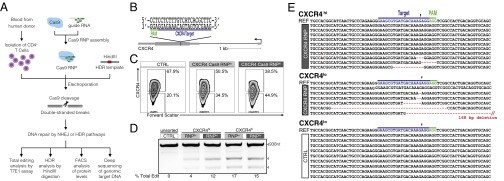
Fig. 1.
Fig. 1.
Efficient editing of CXCR4 in primary human CD4+ T cells. (A) Experimental scheme of Cas9:single-guide RNA ribonucleoprotein (Cas9 RNP) delivery to primary human CD4+ T cells for genome editing, followed by genetic and phenotypic characterization. (B) Schematic representation of sgRNA target (blue) and PAM (green) sequence designed to edit coding sequence in the human CXCR4 locus. (C) FACS plots show increasing percentages of cells with low CXCR4 expression (CXCR4lo) with higher concentrations of CXCR4 Cas9 RNP (Cas9 RNP lo: 0.9 µM; Cas9 RNP hi: 1.8 µM) compared with control-treated cells (Cas9 without sgRNA, CTRL; final concentration: 1.8 µM). (D) T7 endonuclease I (T7E1) assay demonstrates genome editing in the CXCR4 locus with more editing observed in FACS-sorted CXCR4lo cells than in CXCR4hi cells. Expected PCR product size (938 nt) and approximate expected sizes of T7E1-digested fragments are indicated. The total editing frequencies are indicated as percentage of Total Edit below the agarose gel image. (E) Mutation patterns detected by cloning and Sanger sequencing of the CXCR4 locus in sorted Cas9 RNP (1.8 µM)-treated CXCR4hi and CXCR4lo cells are compared with the sequence from CXCR4lo control-treated cells (CTRL). Reference (REF) sequence is shown on top of clonal sequences from each population with sgRNA target (blue) and PAM (green) sequences indicated. Red dashes denote deleted bases, and red sequences indicate mutated nucleotides. Arrowhead indicates the predicted Cas9 cut site. Poor quality sequences obtained from three additional CXCR4lo clones were removed from the sequence alignment.
Fig. 2.
Fig. 2.
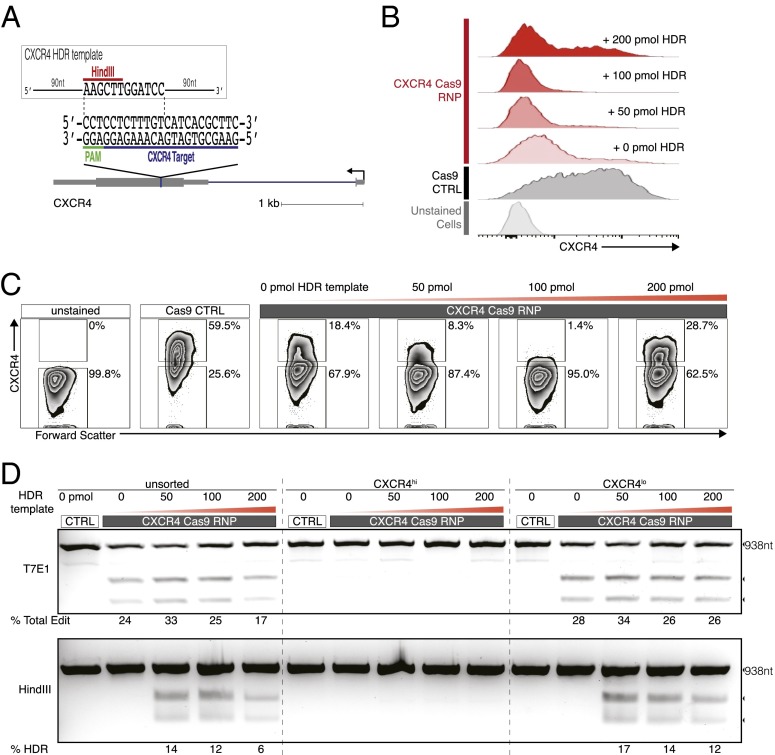
Efficient homology-directed repair allows targeted DNA replacement in primary human T cells. (A) Schematic representation of single-stranded oligonucleotide HDR template with 90-nt homology arms designed to replace 12 nt, including the PAM sequence, and introduce a novel HindIII restriction enzyme cleavage site (red) at the CXCR4 locus, where the Cas9 RNP cleaves. sgRNA target (blue) and PAM (green) sequence are indicated. (B) Histograms of CXCR4 cell-surface staining assessed by flow cytometry in CXCR4 Cas9 RNP-treated cells in the presence of varying concentrations of single-stranded HDR template (compared with control Cas9 protein-treated cells and unstained cells). (C) FACS plots (corresponding to histograms in B) show maximal ablation of CXCR4 with Cas9 RNP treatment and 100 pmol of HDR template. (D) T7E1 assay was used to estimate the “% Total Edit” (defined as the sum of all NHEJ and HDR events that gives rise to indels at the Cas9 cleavage site), whereas HDR frequency was determined by HindIII digestion, which specifically cleaved the newly integrated HindIII site, and was calculated as the ratio of DNA product to DNA substrate. Expected PCR product size (938 nt) and approximate expected T7E1 and HindIII digestion fragments are indicated.
Fig. 3.
Fig. 3.
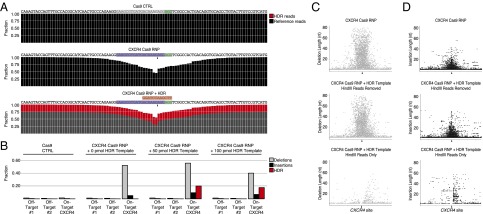
Quantitative analysis of Cas9 RNP-mediated editing and HDR by deep sequencing. (A) CXCR4 Cas9 RNP-mediated indels and HDR from experiments in Fig. 2 were analyzed by targeted deep sequencing of the CXCR4 locus. A total of 100 nt centered on the predicted cut site are shown with sgRNA target (blue), PAM (green), and predicted sequence after HDR genome targeting (red). At each position, the fraction of reads that correctly aligned to the reference genome (black) or HDR template-derived sequence (red) are shown. Although rare (∼1–2%), edits were detected with Cas9-only control treatment, including at the predicted CXCR4 cut site, potentially indicating trace amounts of experimental contamination of the Cas9 RNPs. (B) Bar graph summarizes the fractions of reads edited with deletions (gray), insertions (black), or successful HDR targeting (red) in Cas9 CTRL, CXCR4 Cas9 RNP, and CXCR4 Cas9 RNP cells with 50 or 100 pmol CXCR4 HDR template at the CXCR4 site and two predicted off-target sites. Reads with HDR template-derived sequence incorporated were removed to calculate fractions with deletions and insertions (Dataset S1). Scatter plots show the genomic localization (±100 nt around the expected Cas9 cut side; chromosome 2: 136873140–136873340) and the length of (C) deletions and (D) insertions. (Top) Deletions/insertions for CXCR4 RNP-treated cells. (Middle) Deletions/insertions in reads without HDR template sequence incorporated in cells treated with CXCR4 RNP and CXCR4 HDR template. (Bottom) Deletions/insertions in reads with HDR template-derived sequence incorporated. Arrowheads indicate approximate location of expected Cas9 cut site.
Fig. 4.
Fig. 4.
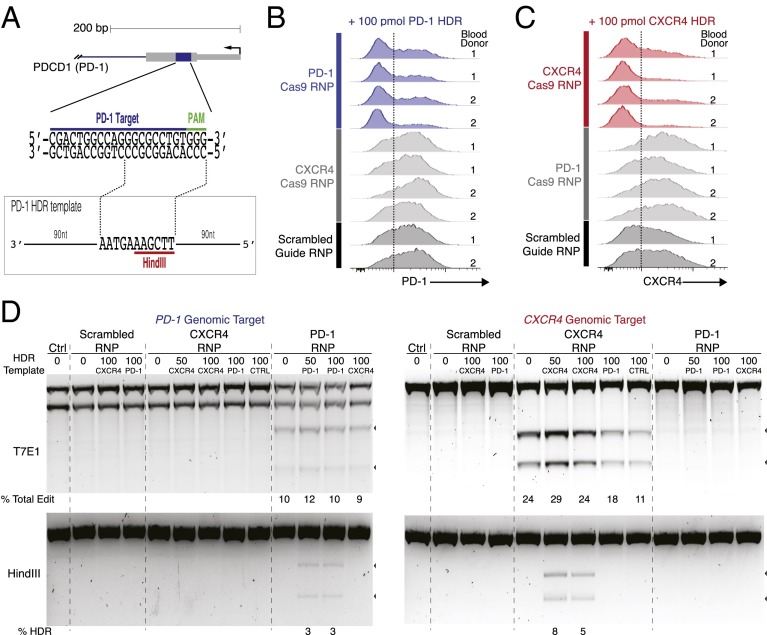
Cas9 RNPs can be programmed for knock-in editing of PD-1 or CXCR4. (A) Schematic representation of the single-stranded PD-1 HDR template with 90-nt homology arms designed to replace 12 nt with 11 nt, introducing a novel HindIII restriction enzyme cleavage site to replace the PAM sequence (red). sgRNA target (blue) and PAM (green) sequences are indicated. (B) Histograms of PD-1 cell-surface expression levels assessed by flow cytometry. All cells were treated with 100 pmol of PD-1 HDR template. PD-1 Cas9 RNP-treated cells are shown in blue, CXCR4 Cas9 RNP-treated cells in light gray, and scrambled guide (no predicted cut within the human genome) Cas9 RNP-treated cells in dark gray. (C) Histograms of CXCR4 cell-surface expression levels assessed by flow cytometry. All cells were treated with 100 pmol of CXCR4 HDR template. CXCR4 Cas9 RNP-treated cells are shown in red, PD-1 Cas9 RNP-treated cells in light gray, and scrambled guide Cas9 RNP-treated in dark gray. (B and C) Results of four experiments with two differently in vitro-transcribed and purified CXCR4 and PD-1 sgRNAs (SI Materials and Methods) tested in two different blood donors. For each blood donor, experiments done with phenol/chloroform-extracted sgRNAs are shown on Top and experiments with PAGE-purified sgRNAs are shown at the Bottom; scrambled guides were prepared for both experiments with phenol/chloroform extraction. Dotted line indicates gating on PD-1 high-expressing or CXCR4 high-expressing cells, respectively. The percentage of PD-1 high-expressing cells was significantly lower with PD-1 Cas9 RNP treatment compared either CXCR4 Cas9 RNP treatment (P < 0.001) or scrambled guide Cas9 RNP treatment (P < 0.001). The percentage of CXCR4 high-expressing cells was significantly lower with CXCR4 Cas9 RNP treatment compared with either PD-1 Cas9 RNP treatment (P < 0.001) or scrambled guide Cas9 RNP treatment (P < 0.001) (Pearson’s χ2). (D) Genome editing was analyzed by T7E1 assay, whereas HDR was detected by HindIII digestion, which specifically cleaved the newly integrated HindIII site; cleavage products for both assays are indicated with arrowheads. Concentrations of various HDR templates are indicated above the agarose gels. CTRL HDR template refers to a scrambled version of the original CXCR4 HDR template, including a HindIII restriction site. A nonspecific second gel band of unclear significance was noted in the T7E1 of the PD-1 amplicon under all conditions. Total editing and HDR frequencies were calculated and are displayed below agarose gel images.

References

    1. Doudna JA, Charpentier E. Genome editing. The new frontier of genome engineering with CRISPR-Cas9. Science. 2014;346(6213):1258096. - PubMed
    1. Hsu PD, Lander ES, Zhang F. Development and applications of CRISPR-Cas9 for genome engineering. Cell. 2014;157(6):1262–1278. - PMC - PubMed
    1. Mandal PK, et al. Efficient ablation of genes in human hematopoietic stem and effector cells using CRISPR/Cas9. Cell Stem Cell. 2014;15(5):643–652. - PMC - PubMed
    1. Maus MV, et al. Adoptive immunotherapy for cancer or viruses. Annu Rev Immunol. 2014;32:189–225. - PMC - PubMed
    1. Passerini L, et al. CD4⁺ T cells from IPEX patients convert into functional and stable regulatory T cells by FOXP3 gene transfer. Sci Transl Med. 2013;5(215):215ra174. - PubMed

Publication types

MeSH terms