


Intraluminal pressure profiles during flexible ureterorenoscopy
- PMID: 26217550
- PMCID: PMC4513000
- DOI: 10.1186/s40064-015-1114-4
Intraluminal pressure profiles during flexible ureterorenoscopy
Abstract
Background: Irrigation and instrumentation during ureterorenoscopic procedures may cause increased pressure in the renal pelvis (PP) with potential harmful adverse effects. In order to assess the pressure increases during ureterorenoscopy, we measured the intraluminal renal pelvic pressure during retrograde intrarenal stone surgery (RIRS).
Methods: Twelve patients admitted for RIRS were included. Irrigation rate was standardized to 8 ml/min. A ureteral catheter was retrogradely placed in the renal pelvis for PP measurements. PP was measured one time per second during insertion of the Storz Flex-X2 ureteroscope and during stone treatment.
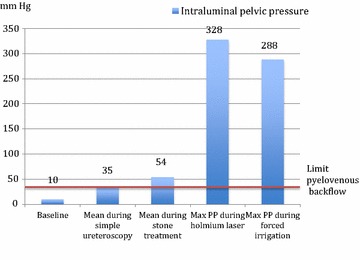
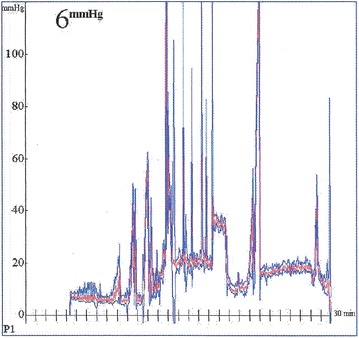
Results: Baseline PP was mean 10(±4.0) mmHg. During simple ureterorenoscopy, PP was mean 35(±10) mmHg. During stone management the average PP was 54(±18) mmHg and pelvic pressure peaks up to 328 mmHg occurred. In a 5-min standardized period of simple ureterorenoscopy, 83 pressure peaks >50 mmHg were measured in average per patient (range 2-238). Forced irrigation with a 20 ml syringe resulted in pressure peaks up to 288 mmHg.
Conclusion: Very high pelvic pressures are obtained during flexible ureterorenoscopy. Taking into consideration that the threshold for pyelovenous backflow is around 30 mmHg, it is concerning that PPs >300 mmHg are not uncommon during these procedures. Methods to monitor and lower the PP during ureterorenoscopy, therefore, are considered of importance.
Figures
References
LinkOut - more resources
Full Text Sources
Other Literature Sources
Miscellaneous
