Review
. 2015 Sep;99(18):7465-79.
doi: 10.1007/s00253-015-6821-9. Epub 2015 Jul 29.

Heparin and related polysaccharides: synthesis using recombinant enzymes and metabolic engineering

Affiliations
Review

Heparin and related polysaccharides: synthesis using recombinant enzymes and metabolic engineering

Matthew Suflita et al. Appl Microbiol Biotechnol. 2015 Sep.

Abstract

Glycosaminoglycans are linear anionic polysaccharides that exhibit a number of important biological and pharmacological activities. The two most prominent members of this class of polysaccharides are heparin/heparan sulfate and the chondroitin sulfates (including dermatan sulfate). These polysaccharides, having complex structures and polydispersity, are biosynthesized in the Golgi of most animal cells. The chemical synthesis of these glycosaminoglycans is precluded by their structural complexity. Today, we depend on food animal tissues for their isolation and commercial production. Ton quantities of these glycosaminoglycans are used annually as pharmaceuticals and nutraceuticals. The variability of animal-sourced glycosaminoglycans, their inherent impurities, the limited availability of source tissues, the poor control of these source materials, and their manufacturing processes suggest a need for new approaches for their production. Over the past decade, there have been major efforts in the biotechnological production of these glycosaminoglycans. This mini-review focuses on the use of recombinant enzymes and metabolic engineering for the production of heparin and chondroitin sulfates.


Figures
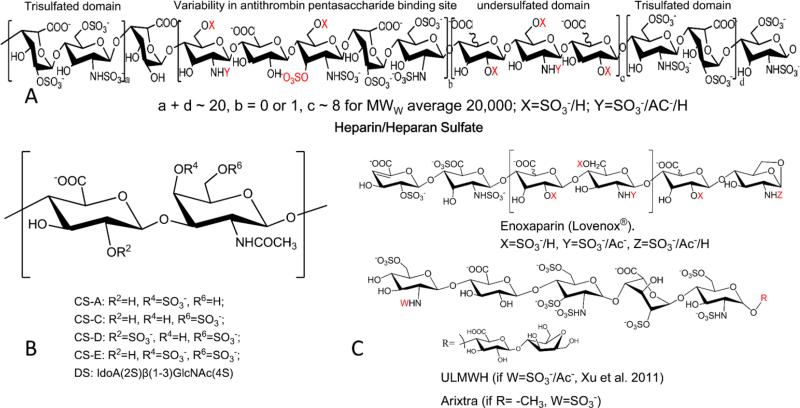
Figure 1
Figure 1
Structures of glycosaminoglycans and their oligosaccharides. A. Structure and common domains of heparin (b ~ 0.4, and a + d > c) or heparan sulfate (b < 0.4, and c > a + d). B. common chondroitin sulfates. C. Low molecular weight heparin (Enoxaparin) and ultra-low molecular weight heparins (ULMWH and Arixtra).
Figure 2
Figure 2
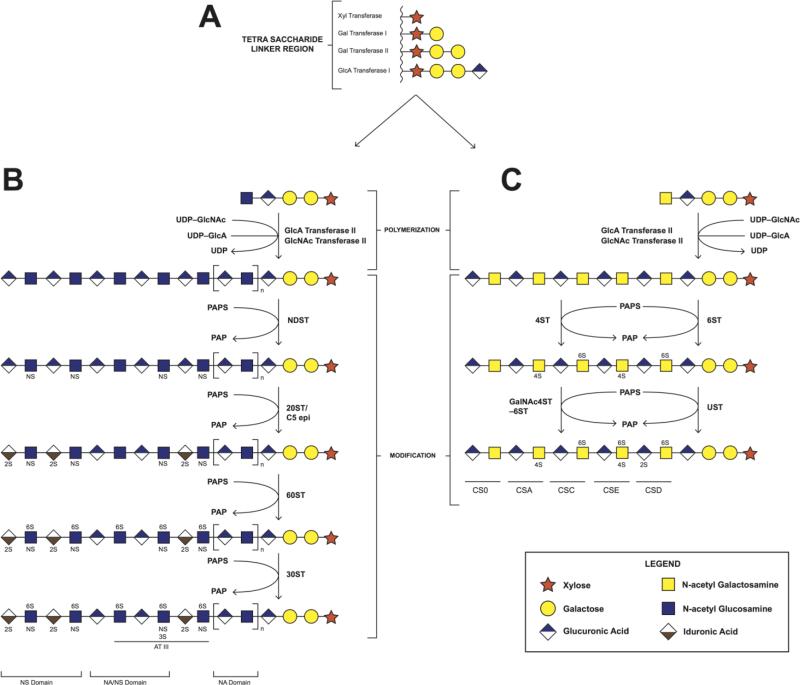
Biosynthesis of heparin/heparan sulfate and chondroitin sulfates. A. Synthesis of the tetrasaccharide linker region. B. Polymerization and modification pathway of heparin/heparan sulfates. C. Polymerization and modification pathway of chondroitin sulfates.
Figure 3
Figure 3
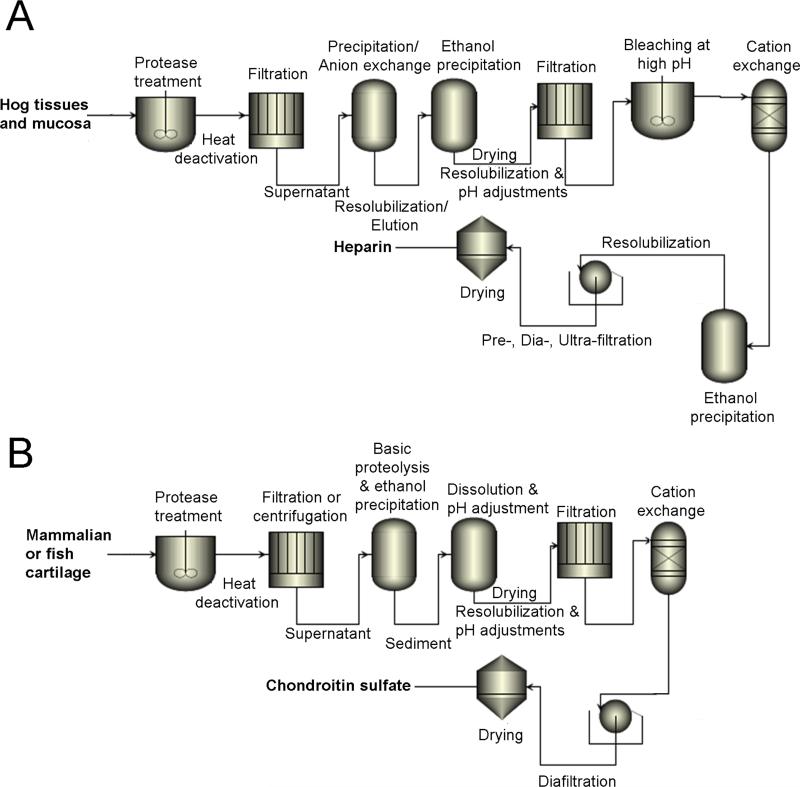
Extractive preparation of glycosaminoglycans. A. heparin and B. chondroitin sulfate.
Figure 4
Figure 4
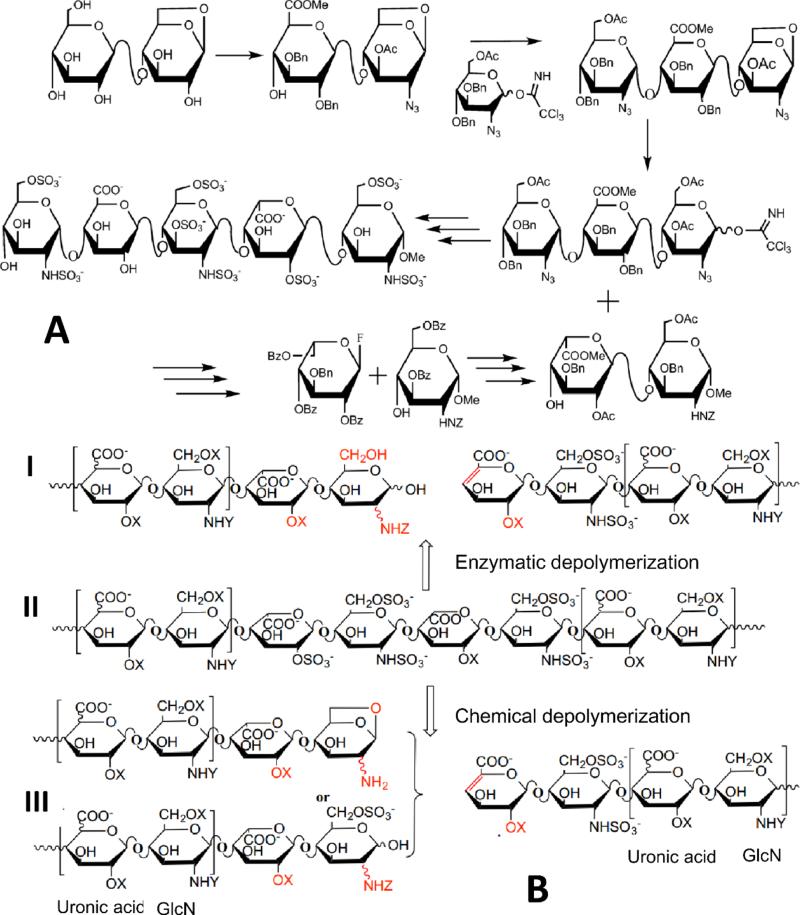
Chemical synthesis, depolymerization and enzymatic depolymerization of ultra-low molecular weight heparin and low molecular weight heparin. A. Summary of a convergent multi-step chemical synthesis of Arixtra from cellobiose derivative (reagents not shown). B. Enzymatic (I) and chemical (III) depolymerization to prepare low molecular heparins from unfractionated heparin (II).
Figure 5
Figure 5
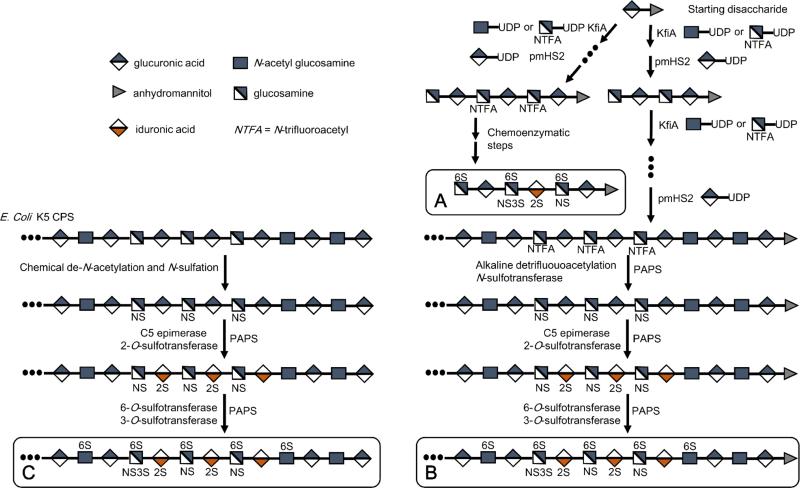
Chemoenzymatic synthesis of A. ultra-low molecular weight heparins; B. low molecular weight heparins; and C. bioengineered heparin.
Figure 6
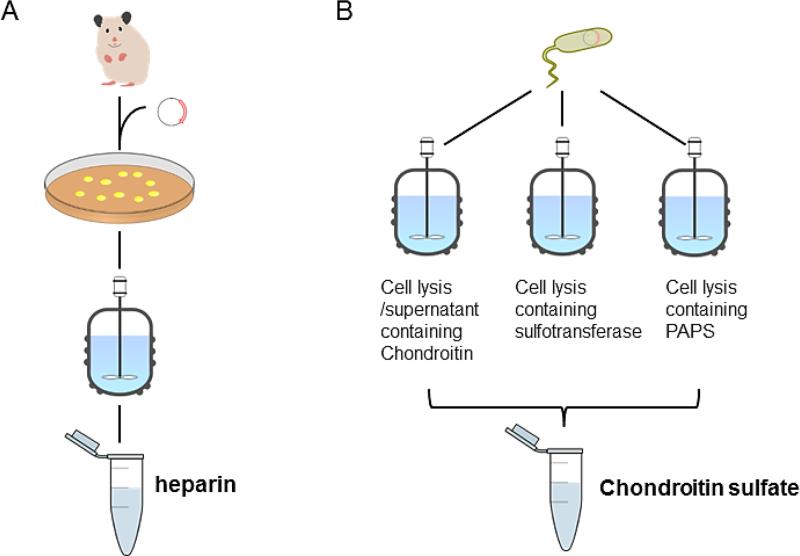
Figure 6
Alternate strategies for metabolic engineering of glycosaminoglycans. A. CHO cell engineering to produce heparin, based on manipulation of existing pathway for HS biosynthesis. B. An approach for the E. coli based production of chondroitin sulfate using microbial biotransformation. Three E. coli strains produce components for CS synthesis, including chondroitin, sulfotransferases, and the sulfate donor PAPS, which are then combined to produce CS.

References

    1. Adebowale AO, Cox DS, Liang Z, Eddington ND. Analysis of Glucosamine and Chondroitin Sulfate Content in Marketed Products and the Caco-2 Permeability of Chondroitin Sulfate Raw Materials. 2000;3:37–44.
    1. Baik JY, Gasimli L, Yang B, Datta P, Zhang F, Glass C a., Esko JD, Linhardt RJ, Sharfstein ST. Metabolic engineering of Chinese hamster ovary cells: Towards a bioengineered heparin. Metab Eng. 2012;14:81–90. doi: 10.1016/j.ymben.2012.01.008. - PMC - PubMed
    1. Bhan N, Xu P, Koffas M a G. Pathway and protein engineering approaches to produce novel and commodity small molecules. Curr Opin Biotechnol. 2013;24:1137–1143. doi: 10.1016/j.copbio.2013.02.019. - PubMed
    1. Bhaskar U, Li G, Fu L, Onishi A, Suflita M, Dordick J, Linhardt RJ. Combinatorial one-pot chemoenzymatic synthesis of heparin. 2015;122:399–407. - PMC - PubMed
    1. Bhaskar U, Sterner E, Hickey AM, Onishi A, Zhang F, Dordick JS, Linhardt RJ. Engineering of routes to heparin and related polysaccharides. Appl Microbiol Biotechnol. 2012;93:1–16. doi: 10.1007/s00253-011-3641-4. - PMC - PubMed

Publication types

MeSH terms