. 2016 Jan;37(1):369-79.
doi: 10.1007/s13277-015-3806-3. Epub 2015 Jul 29.

C14ORF166 overexpression is associated with pelvic lymph node metastasis and poor prognosis in uterine cervical cancer

Affiliations

C14ORF166 overexpression is associated with pelvic lymph node metastasis and poor prognosis in uterine cervical cancer

Weijing Zhang et al. Tumour Biol. 2016 Jan.

Abstract

C14ORF166 (chromosome 14 open reading frame 166) is a transcriptional repressor related to the regulation of centrosome architecture. However, the role of C14ORF166 in the development and progression of cancer remains largely unknown. The aim of this study was to investigate the expression and clinicopathological significance of C14ORF166 in cervical cancer. C14ORF166 expression was analyzed using quantitative real-time PCR (RT-PCR) and Western blotting in cervical cancer cell lines and eight paired cervical cancer samples and the adjacent normal tissues. Immunohistochemistry was used to analyze C14ORF166 protein expression in 148 clinicopathologically characterized cervical cancer specimens. Statistical analyses were performed to evaluate the relationship between the expression of C14ORF166 and clinicopathologic features and prognosis. C14ORF166 mRNA and protein expression were significantly upregulated in cervical cancer cell lines and tissue samples (P < 0.05). Immunohistochemical analysis revealed a high expression of C14ORF166 was observed in 39.9 % (59/148) of the cervical cancer specimens; the remaining samples expressed low levels or did not express any detectable C14ORF166. The chi-square test indicated that high-level expression of C14ORF166 was significantly associated with International Federation of Gynecology and Obstetrics (FIGO) stage (P < 0.001), vital status (P = 0.026), tumor size (P = 0.034), serum squamous cell carcinoma antigen level (SCC-Ag; P = 0.035), and pelvic lymph node metastasis (P < 0.001). Patients with highly expressed C14ORF166 showed a tendency to receive postoperative chemotherapy (P = 0.005) and postoperative radiation (P = 0.008). Furthermore, high C14ORF166 expression was associated with poorer overall survival compared to low C14ORF166 expression, and C14ORF166 was a significant prognostic factor in univariate and multivariate analysis (P < 0.05). High C14ORF166 expression had prognostic value for poor outcome in cervical cancer. C14ORF166 may represent a biomarker of pelvic lymph node metastasis and enable the identification of high-risk patients along with selection of appropriate treatment strategies.

Keywords: Biomarker; C14ORF166; Cervical cancer; Lymph node metastasis; Prognosis.


Figures

Fig. 1
Fig. 1
Overexpression of C14ORF166 mRNA and protein in cervical cancer cell lines. a, b Expression of C14ORF166 mRNA and protein in cervical cancer cell lines (HCC94, HeLa229, C33A, HeLa, ME-180, SiHa, MS751, CasKi) and normal cervical cell lines were examined by Western blotting (a) and qPCR (b). Expression levels were normalized against GAPDH respectively. Error bars represent the standard deviation of the mean (SD) calculated from three parallel experiments. *p < 0.05
Fig. 2
Fig. 2
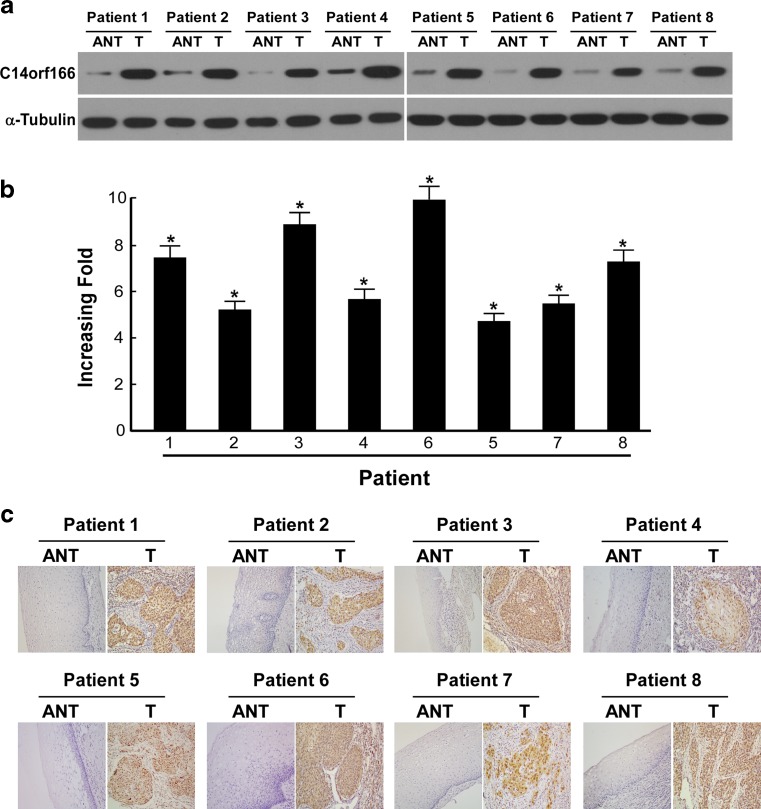
Overexpression of C14ORF166 mRNA and protein in cervical cancer tissues. a Representative images of Western blotting analyses of C14ORF166 protein expression in eight matched pairs of cervical cancer (T) and adjacent noncancerous tissues. The expression level was normalized by α-tubulin expression. b Average T/N ratios of C14ORF166 mRNA expression in paired cervical cancer (T) and adjacent noncancerous tissues (N) were quantified by qPCR and normalized against GAPDH. Error bars represent the standard deviation of the mean (SD) calculated from three parallel experiments. c Immunohistochemical assay of C14ORF166 protein expression in eight pairs of matched cervical cancer tissues. *p < 0.05
Fig. 3
Fig. 3
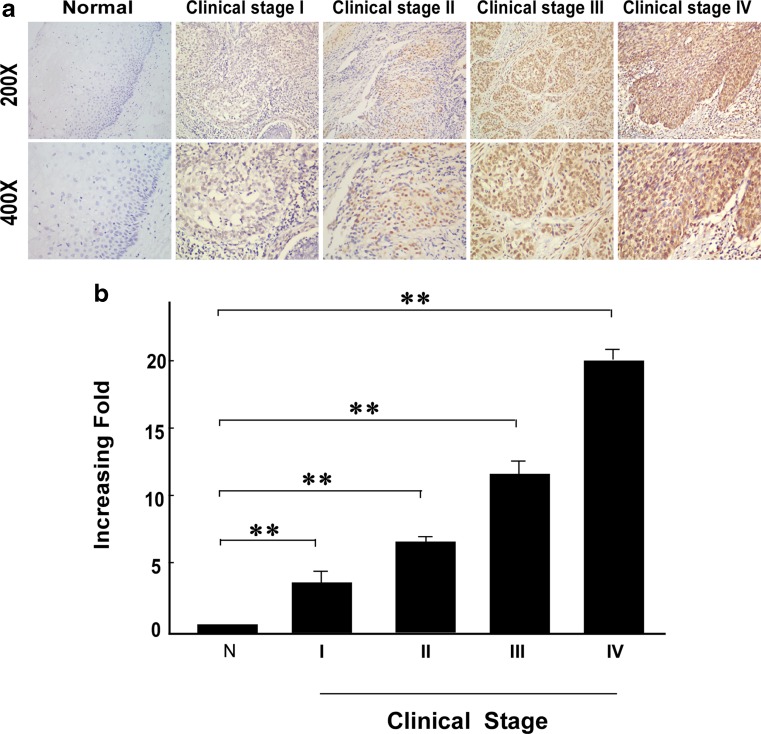
a The expression of C14ORF166 protein in cervical cancer tissues from patients at different clinical stages. b The average MOD of C14ORF166 staining between the normal cervical tissues (four cases) and different clinical stage cervical tissues (randomly picked 10 cases per stage) were statistically quantified. The average MOD of C14ORF166 staining increases as cervical cancer progresses to more advanced stages (P < 0.001). Error bars represent mean ± SD from three independent experiments.
Fig. 4
Fig. 4
Survival curves of patients with cervical carcinoma, subdivided according to C14ORF166 protein expression (log-rank test). a, b OS (a) and 5-year DFS (b) rates for cases with high C14ORF166 expression versus those for cases with low C14ORF166 expression levels in all patients. c, d OS rate for without lymph node metastasis cases (c) and clinical stage I/II cases (d) with high C14ORF166 expression versus those for cases with low C14ORF166 expression levels.

References

    1. Siegel R, Naishadham D, Jemal A. Cancer statistics. 2012. CA Cancer J Clin. 2012;62:10–29. doi: 10.3322/caac.20138. - DOI - PubMed
    1. de Guadalupe C-LM, Hernández-Gallegos E, Vázquez-Sánchez AY, Gariglio P, Camacho J. Antiproliferative and proapoptotic effects of astemizole on cervical cancer cells. Int J Gynecol Cancer. 2014;24:824–8. doi: 10.1097/IGC.0000000000000151. - DOI - PubMed
    1. Shin HJ, Joo J, Yoon JH, Yoo CW, Kim JY. Physical status of human papillomavirus integration in cervical cancer is associated with treatment outcome of the patients treated with radiotherapy. PLoS One. 2014;9 doi: 10.1371/journal.pone.0078995. - DOI - PMC - PubMed
    1. Jiménez-Wences H, Peralta-Zaragoza O, Fernández-Tilapa G. Human papilloma virus, DNA methylation and microRNA expression in cervical cancer. Oncol Rep. 2014;31:2467–76. - PMC - PubMed
    1. Gadducci A, Guerrieri ME, Greco C. Tissue biomarkers as prognostic variables of cervical cancer. Crit Rev Oncol Hematol. 2013;86:104–29. doi: 10.1016/j.critrevonc.2012.09.003. - DOI - PubMed

MeSH terms