Review
. 2015 Jul-Aug;21(4):250-3.
doi: 10.1097/PPO.0000000000000127.

The Role of Stroma in Tumor Development

Affiliations
Review

The Role of Stroma in Tumor Development

Zena Werb et al. Cancer J. 2015 Jul-Aug.

Abstract

The tumor microenvironment plays an essential role in various stages of cancer development. This environment, composed of the extracellular matrix, fibroblasts, endothelial cells, and cells of the immune system regulates the behavior of and co-evolve with tumor cells. Many of the components, including the innate and adaptive immune cells, play multifaceted roles during cancer progression and can promote or inhibit tumor development, depending on local and systemic conditions. Interestingly, a strategy by which tumor cells gain drug resistance is by modifying the tumor microenvironment. Together, understanding the mechanisms by which the tumor microenvironment functions should greatly facilitate the development of new therapeutic interventions by targeting the tumor niche.


Figures
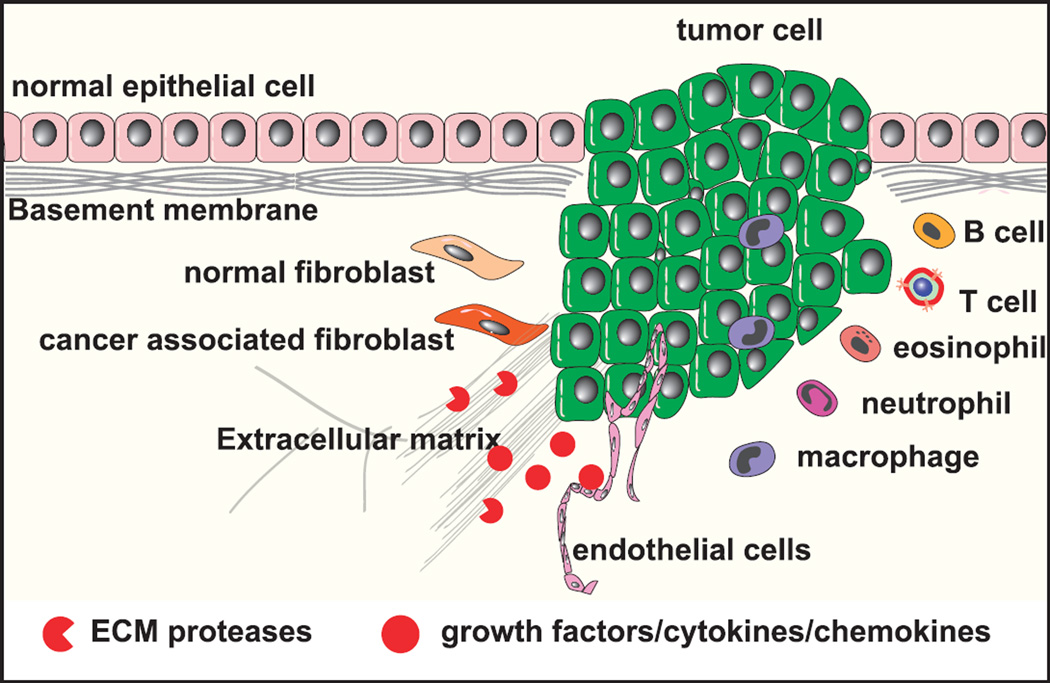
FIGURE 1
FIGURE 1
Composition of the tumor stromal microenvironment. The stroma consists of ECM, including proteoglycans, hyaluronic acid, and fibrous proteins such as collagen, fibronectin, and laminin, and stromal cells (e.g., fibroblasts and adipocytes); cells of the vascular system; and cells of the immune system.
FIGURE 2
FIGURE 2
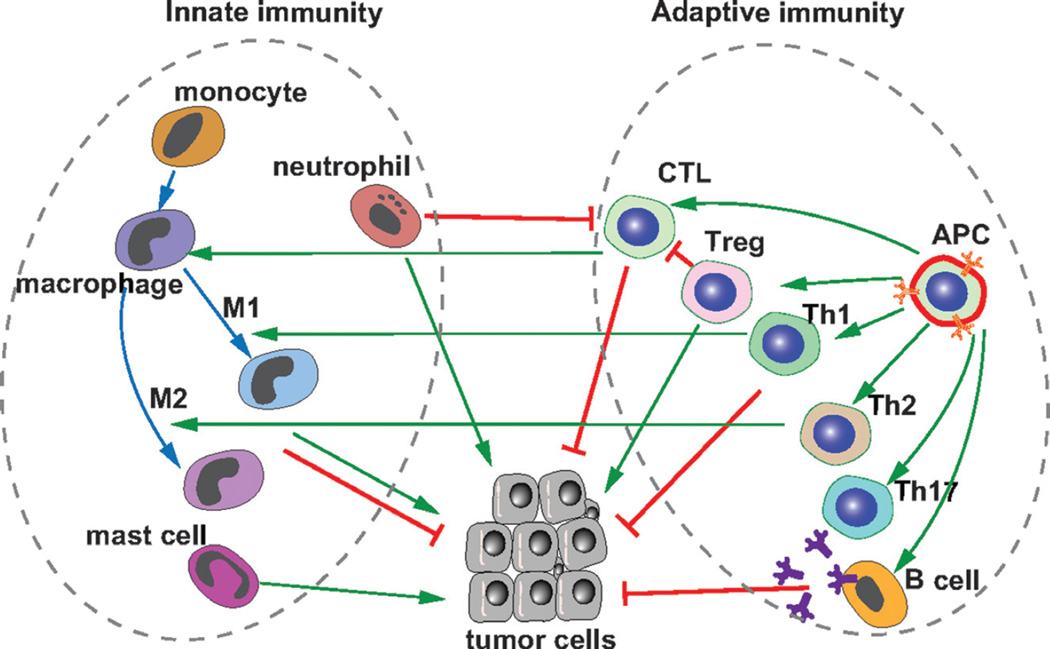
Multifaceted roles of innate and adaptive immunity in cancer development. Whereas adaptive immunity, including T and B cells, is essential for inhibiting cancer development, innate immunity, including neutrophils, macrophages, and mast cells, may promote or inhibit cancer development depending on the local and systemic contexts. For example, macrophages can be polarized and activated by cytokines secreted by TH1 cells and produce reactive oxygen and nitrogen intermediates and inflammatory cytokines. These proinflammatory M1 macrophages can inhibit tumorigenesis; by contrast, TAMs (or M2 anti-inflammatory) polarized by cytokines secreted from TH2 cells are associated with poor prognosis. Regulatory T cells can inhibit cytotoxic T-cell function and thus promote tumorigenesis.
FIGURE 3
FIGURE 3
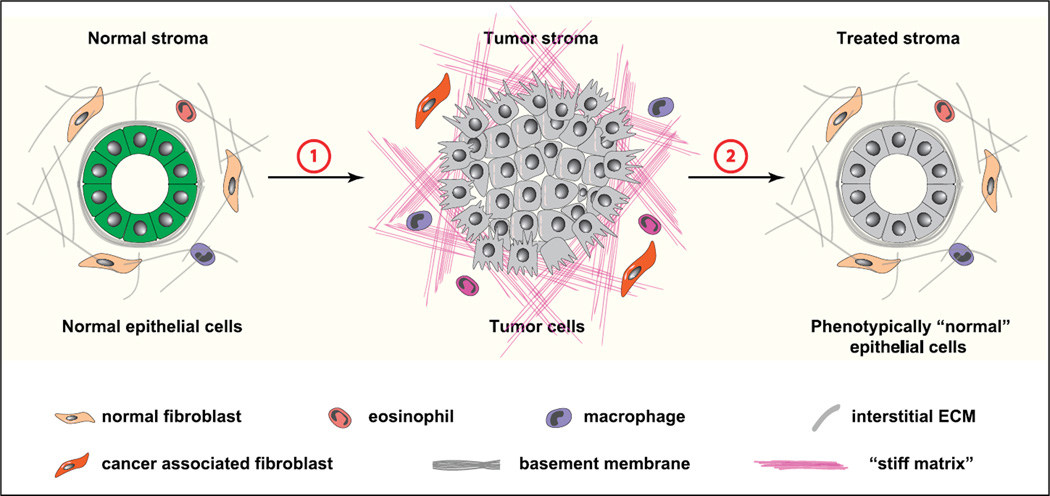
Targeting stroma in cancer therapeutics. Changes in the stromal microenvironment are an important aspect of cancer evolution. Tumor stroma undergoes concurrent changes with cancer cells and plays a causative role during initiation, progression, and metastasis of cancer development (1). In addition to promoting cancer development, tumor stroma is a major barrier to cancer drugs and plays a role in drug resistance. Importantly, forceful reversion of cancer stroma to the normal state restores normal behavior to cancer cells (2). As such, tumor stroma is a promising therapeutic target for cancer treatment.

References

    1. Egeblad M, Ewald AJ, Askautrud HA, et al. Visualizing stromal cell dynamics in different tumor microenvironments by spinning disk confocal microscopy. Dis Model Mech. 2008;1:155–167. - PMC - PubMed
    1. Egeblad M, Nakasone ES, Werb Z. Tumors as organs: complex tissues that interface with the entire organism. Dev Cell. 2010;18:884–901. - PMC - PubMed
    1. Lin EY, Gouon-Evans V, Nguyen AV, et al. The macrophage growth factor CSF-1 in mammary gland development and tumor progression. J Mammary Gland Biol Neoplasia. 2002;7:147–162. - PubMed
    1. Levental KR, Yu H, Kass L, et al. Matrix crosslinking forces tumor progression by enhancing integrin signaling. Cell. 2009;139:891–906. - PMC - PubMed
    1. Provenzano PP, Eliceiri KW, Campbell JM, et al. Collagen reorganization at the tumor-stromal interface facilitates local invasion. BMC Med. 2006;4:38. - PMC - PubMed

MeSH terms