


A Randomized, Double-Blind, Placebo-Controlled Multicenter Study of Adalimumab in Pediatric Patients With Enthesitis-Related Arthritis
- PMID: 26223543
- PMCID: PMC5057351
- DOI: 10.1002/acr.22657
A Randomized, Double-Blind, Placebo-Controlled Multicenter Study of Adalimumab in Pediatric Patients With Enthesitis-Related Arthritis
Abstract
Objective: Enthesitis-related arthritis (ERA) is a juvenile idiopathic arthritis (JIA) category, primarily affecting entheses and peripheral joints. This study evaluated efficacy, safety, and pharmacokinetics of adalimumab versus placebo in patients with ERA.
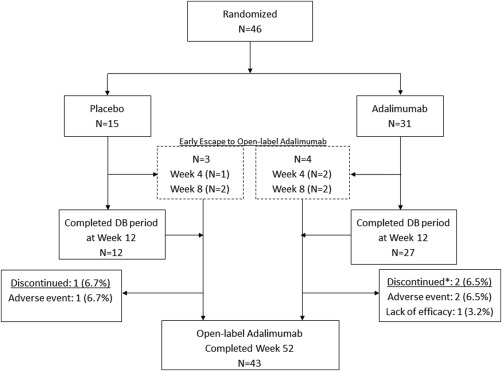
Methods: This is a phase III, multicenter, randomized double-blind study in patients ages ≥6 to <18 years with ERA treated with adalimumab (24 mg/m(2) , maximum dose 40 mg every other week) or placebo for 12 weeks, followed by up to 192 weeks of open-label adalimumab. The primary end point was percent change from baseline in number of active joints with arthritis (AJC) at week 12. Samples were collected to determine adalimumab serum concentrations. Adverse events (AEs) were assessed throughout the study.
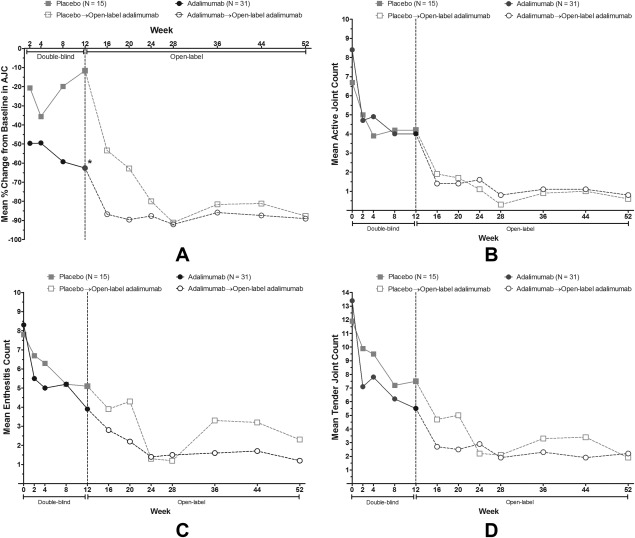
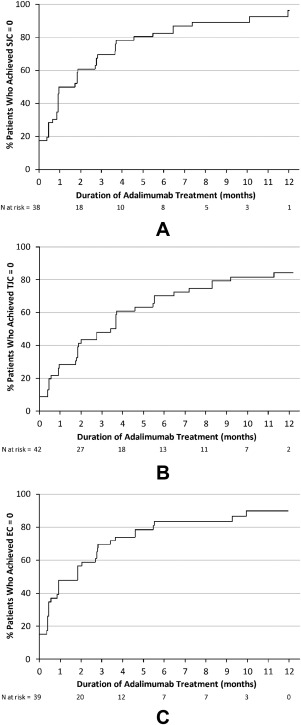
Results: Forty-six patients were randomized (31 adalimumab/15 placebo). At baseline, mean age was 12.9 years, mean duration of ERA symptoms was 2.6 years, mean AJC was 7.8, and mean enthesitis count was 8.1. Mean percent change from baseline in AJC at week 12 was greater in the adalimumab group versus placebo (-62.6% versus -11.6%; P = 0.039). Most secondary variables favored adalimumab versus placebo at week 12. Treatment response further increased with continued adalimumab therapy through week 52. Mean steady-state adalimumab serum concentrations were 7.5-11.8 μg/ml, similar to patients age ≥2 years with polyarticular JIA. AE rates were similar between placebo and adalimumab: any AE (53.3% versus 67.7%), serious AEs (0% versus 3.2%), and infectious AEs (20.0% versus 29.0%).
Conclusion: Adalimumab reduced signs and symptoms of ERA at week 12, with improvement sustained through week 52. The safety profile was consistent with previous adalimumab studies.
Trial registration: ClinicalTrials.gov NCT01166282.
© 2015 The Authors. Arthritis Care & Research is published by Wiley Periodicals, Inc. on behalf of the American College of Rheumatology.
Figures
References
-
- Petty RE, Southwood TR, Manners P, Baum J, Glass DN, Goldenberg J, et al. International League of Associations for Rheumatology classification of juvenile idiopathic arthritis: second revision, Edmonton, 2001. J Rheumatol 2004;31:390–2. - PubMed
-
- Flato B, Hoffmann‐Vold AM, Reiff A, Forre O, Lien G, Vinje O. Long‐term outcome and prognostic factors in enthesitis‐related arthritis: a case‐control study. Arthritis Rheum 2006;54:3573–82. - PubMed
-
- Stone M, Warren RW, Bruckel J, Cooper D, Cortinovis D, Inman RD. Juvenile‐onset ankylosing spondylitis is associated with worse functional outcomes than adult‐onset ankylosing spondylitis. Arthritis Rheum 2005;53:445–51. - PubMed
-
- Tupper SM, Rosenberg AM, Pahwa P, Stinson JN. Pain intensity variability and its relationship with quality of life in youths with juvenile idiopathic arthritis. Arthritis Care Res 2013;65:563–70. - PubMed
Publication types
MeSH terms
Substances
Associated data
LinkOut - more resources
Full Text Sources
Other Literature Sources
Medical
