


Lesion-Induced Mutation in the Hyperthermophilic Archaeon Sulfolobus acidocaldarius and Its Avoidance by the Y-Family DNA Polymerase Dbh
- PMID: 26224736
- PMCID: PMC4596666
- DOI: 10.1534/genetics.115.178566
Lesion-Induced Mutation in the Hyperthermophilic Archaeon Sulfolobus acidocaldarius and Its Avoidance by the Y-Family DNA Polymerase Dbh
Abstract
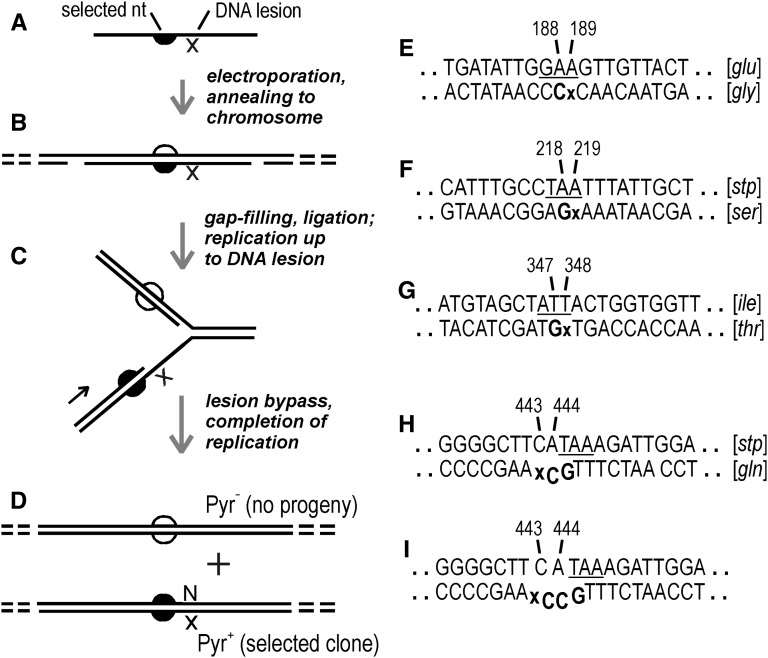
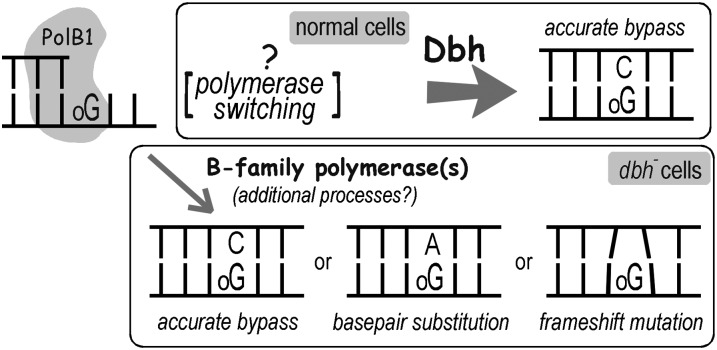
Hyperthermophilic archaea offer certain advantages as models of genome replication, and Sulfolobus Y-family polymerases Dpo4 (S. solfataricus) and Dbh (S. acidocaldarius) have been studied intensively in vitro as biochemical and structural models of trans-lesion DNA synthesis (TLS). However, the genetic functions of these enzymes have not been determined in the native context of living cells. We developed the first quantitative genetic assays of replication past defined DNA lesions and error-prone motifs in Sulfolobus chromosomes and used them to measure the efficiency and accuracy of bypass in normal and dbh(-) strains of Sulfolobus acidocaldarius. Oligonucleotide-mediated transformation allowed low levels of abasic-site bypass to be observed in S. acidocaldarius and demonstrated that the local sequence context affected bypass specificity; in addition, most erroneous TLS did not require Dbh function. Applying the technique to another common lesion, 7,8-dihydro-8-oxo-deoxyguanosine (8-oxo-dG), revealed an antimutagenic role of Dbh. The efficiency and accuracy of replication past 8-oxo-dG was higher in the presence of Dbh, and up to 90% of the Dbh-dependent events inserted dC. A third set of assays, based on phenotypic reversion, showed no effect of Dbh function on spontaneous -1 frameshifts in mononucleotide tracts in vivo, despite the extremely frequent slippage at these motifs documented in vitro. Taken together, the results indicate that a primary genetic role of Dbh is to avoid mutations at 8-oxo-dG that occur when other Sulfolobus enzymes replicate past this lesion. The genetic evidence that Dbh is recruited to 8-oxo-dG raises questions regarding the mechanism of recruitment, since Sulfolobus spp. have eukaryotic-like replisomes but no ubiquitin.
Keywords: 7,8-dihydro-8-oxo-deoxyguanosine; abasic site; oligonucleotide-mediated transformation; trans-lesion DNA synthesis (TLS).
Copyright © 2015 by the Genetics Society of America.
Figures
References
-
- Bauer R. J., Wolff I. D., Zuo X., Lin H. K., Trakselis M. A., 2013. Assembly and distributive action of an archaeal DNA polymerase holoenzyme. J. Mol. Biol. 425: 4820–4836. - PubMed
-
- Berkner S., Lipps G., 2008. Mutation and reversion frequencies of different Sulfolobus species and strains. Extremophiles 12: 263–270. - PubMed
-
- Boeke J. D., LaCroute F., Fink G. R., 1984. A positive selection for mutants lacking orotidine-5′-phosphate decarboxylase activity in yeast: 5-fluoro-orotic acid resistance. Mol. Gen. Genet. 197: 345–346. - PubMed
Publication types
MeSH terms
Substances
LinkOut - more resources
Full Text Sources
Other Literature Sources
Miscellaneous
