


Editorial
doi: 10.1161/CIRCULATIONAHA.115.018139.
Epub 2015 Jul 29.
A Not-So-Little Role for Lipoprotein(a) in the Development of Calcific Aortic Valve Disease
Affiliations
- PMID: 26224809
- PMCID: PMC4550561
- DOI: 10.1161/CIRCULATIONAHA.115.018139
Item in Clipboard
Editorial
A Not-So-Little Role for Lipoprotein(a) in the Development of Calcific Aortic Valve Disease
Circulation.
.
No abstract available
Keywords: Editorials; PCSK9 protein, human; heart valves; vascular calcification.
Figures
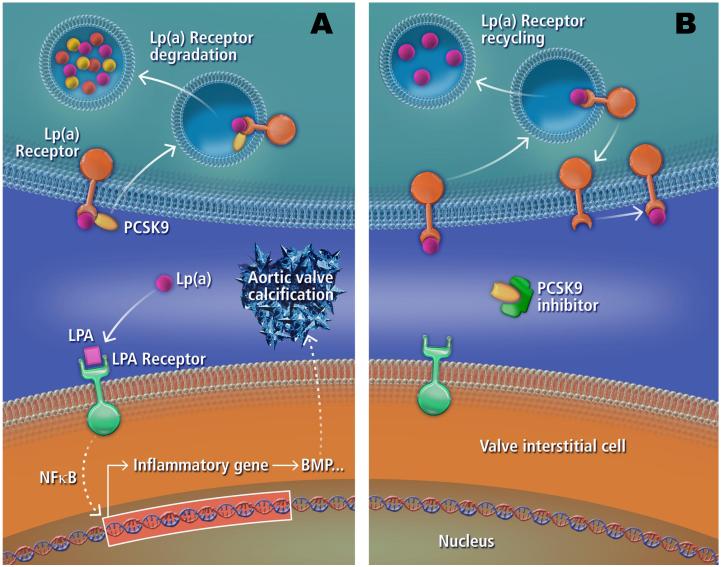
Potential role of Lp(a) and PCSK9 in CAVD. Lp(a) may get taken up and metabolized by cells via Lp(a) receptors (receptors for which Lp(a) is a ligand). However, in the presence of PCSK9 some of these receptors may be internalized and degraded instead of recycled back to the cell surface (A). As such more Lp(a) derived oxidized lipids may be converted to LPA and be taken up by VICs via LPA receptors. This may lead to the production of inflammation related cytokines (e.g., IL6) through NF-κB nuclear localization that in turn increase BMP and/or other calcification inducing processes leading to valve calcification. PCSK9 inhibitors may act to block PCSK9 interaction with Lp(a) receptors, resulting in Lp(a) receptors being recycled back to the cell surface where they can take up more Lp(a) (B). Dashed arrows indicate multiple steps in the pathway.
Comment on
-
Autotaxin Derived From Lipoprotein(a) and Valve Interstitial Cells Promotes Inflammation and Mineralization of the Aortic Valve.Circulation. 2015 Aug 25;132(8):677-90. doi: 10.1161/CIRCULATIONAHA.115.016757. Epub 2015 Jul 29. Circulation. 2015. PMID: 26224810
References
-
- Steinberg D. Atherogenesis in perspective: hypercholesterolemia and inflammation as partners in crime. Nat Med. 2002;8:1211–1217. - PubMed
-
- Thanassoulis G, Campbell CY, Owens DS, Smith JG, Smith AV, Peloso GM, Kerr KF, Pechlivanis S, Budoff MJ, Harris TB, Malhotra R, O’Brien KD, Kamstrup PR, Nordestgaard BG, Tybjaerg-Hansen A, Allison MA, Aspelund T, Criqui MH, Heckbert SR, Hwang SJ, Liu Y, Sjogren M, van der Pals J, Kalsch H, MuhleisenTW, Nothen MM, Cupples LA, Caslake M, Di Angelantonio E, Danesh J, Rotter JI, Sigurdsson S, Wong Q, Erbel R, Kathiresan S, Melander O, Gudnason V, O’Donnell CJ, Post WS. CHARGE Extracoronary Calcium Working Group. Genetic associations with valvular calcification and aortic stenosis. N Engl J Med. 2013;368:503–512. - PMC - PubMed
-
- Kamstrup PR, Tybjaerg-Hansen A, Nordestgaard BG. Elevated lipoprotein(a) and risk of aortic valve stenosis in the general population. J Am Coll Cardiol. 2014;63:470–477. - PubMed
-
- Schreiner PJ, Morrisett JD, Sharrett AR, Patsch W, Tyroler HA, Wu K, Heiss G. Lipoprotein[a] as a risk factor for preclinical atherosclerosis. Arter Throm Vas Bio. 1993;13:826–833. - PubMed
-
- Freeman RV, Otto CM. Spectrum of calcific aortic valve disease. Pathogesis, disease progression, and treatment strategies. Circulation. 2005;111:3316–3326. - PubMed
Publication types
MeSH terms
Substances
Grants and funding
LinkOut - more resources
Full Text Sources
Miscellaneous
