


Nonspecific Inhibition of the Motor System during Response Preparation
- PMID: 26224853
- PMCID: PMC4518047
- DOI: 10.1523/JNEUROSCI.1436-15.2015
Nonspecific Inhibition of the Motor System during Response Preparation
Abstract
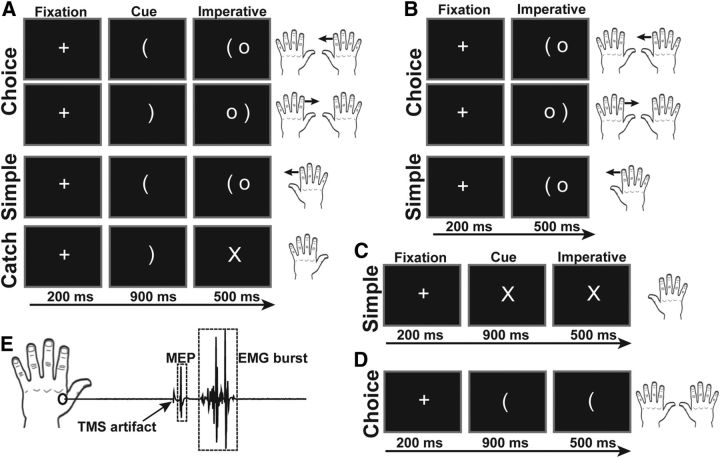
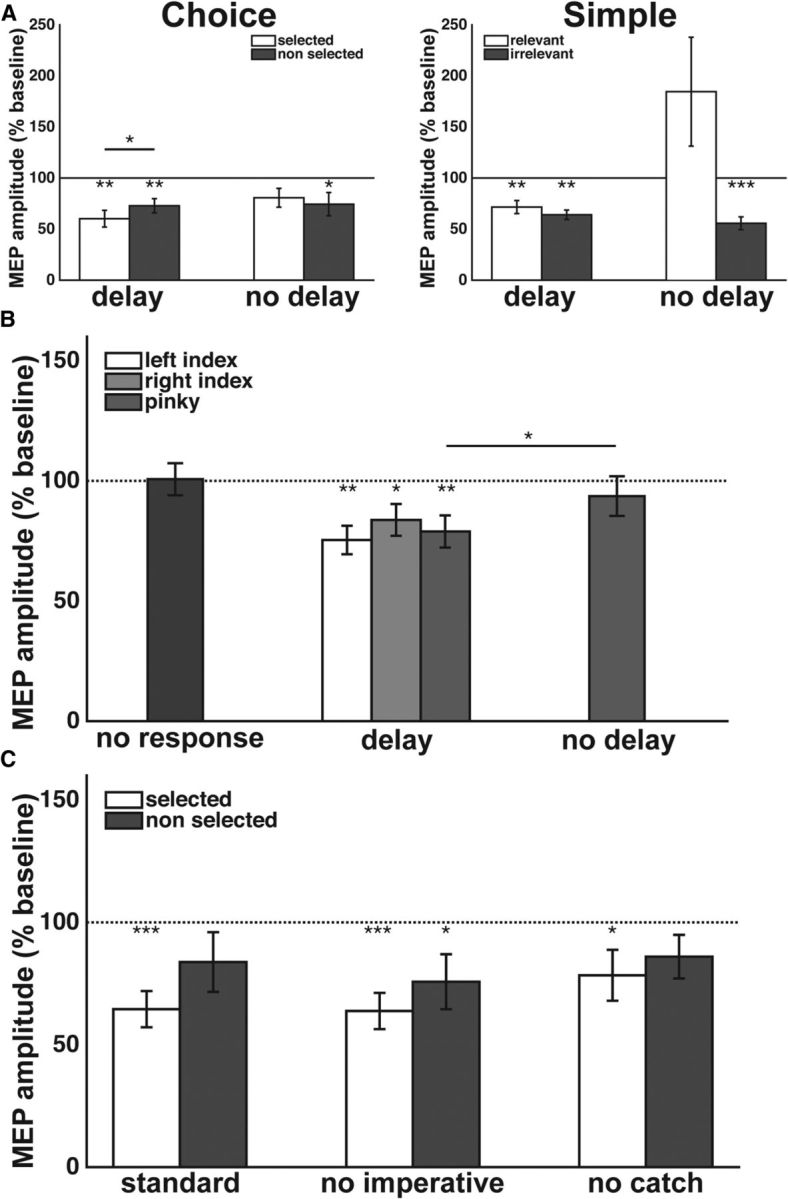
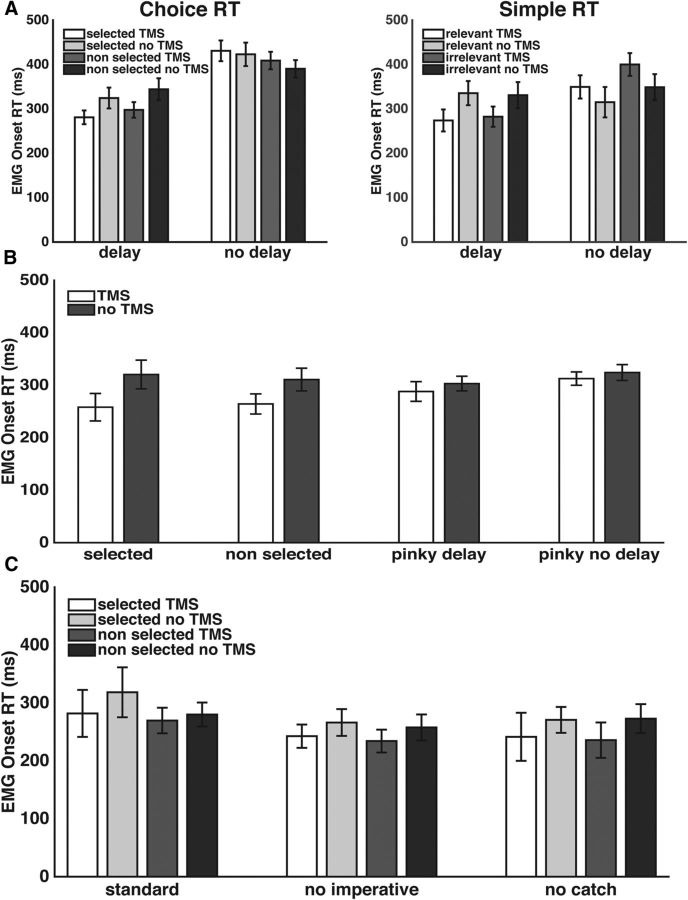
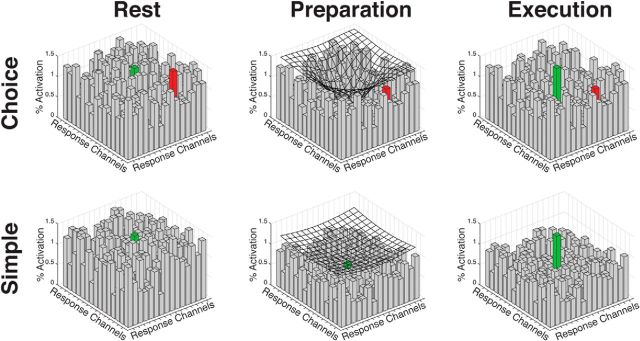
Motor system excitability is transiently inhibited during the preparation of responses. Previous studies have attributed this inhibition to the operation of two mechanisms, one hypothesized to help resolve competition between alternative response options, and the other to prevent premature response initiation. By this view, inhibition should be restricted to task-relevant muscles. Although this prediction is supported in one previous study (Duque et al., 2010), studies of stopping ongoing actions suggest that some forms of motor inhibition may be widespread (Badry et al., 2009). This motivated us to conduct a series of transcranial magnetic stimulation (TMS) experiments to examine in detail the specificity of preparatory inhibition in humans. Motor-evoked potentials were inhibited in task-irrelevant muscles during response preparation, even when the muscles were contralateral and not homologous to the responding effector. Inhibition was also observed in both choice and simple response task conditions, with and without a preparatory interval. Control experiments ruled out that this inhibition is due to expectancy of TMS or a possible need to cancel the prepared response. These findings suggest that motor inhibition during response preparation broadly influences the motor system and likely reflects a process that occurs whenever a response is selected. We propose a reinterpretation of the functional significance of preparatory inhibition, one by which inhibition reduces noise to enhance signal processing and modulates the gain of a selected response.
Significance statement: Motor preparation entails the recruitment of excitatory and inhibitory neural mechanisms. The current experiments address the specificity of inhibitory mechanisms, asking whether preparatory inhibition affects task-irrelevant muscles. Participants prepared a finger movement to be executed at the end of a short delay period. Transcranial magnetic stimulation over primary motor cortex provided an assay of corticospinal excitability. Consistent with earlier work, the agonist muscle for the forthcoming response was inhibited during the preparatory period. Moreover, this inhibition was evident in task-irrelevant muscles, although the magnitude of inhibition depended on whether the response was fixed or involved a choice. These results implicate a broadly tuned inhibitory mechanism that facilitates response preparation, perhaps by lowering background activity before response initiation.
Keywords: action selection; decision-making; gain modulation; inhibition; response preparation; transcranial magnetic stimulation.
Copyright © 2015 the authors 0270-6474/15/3510675-10$15.00/0.
Figures
Comment in
-
Global and Specific Motor Inhibitory Mechanisms during Action Preparation.J Neurosci. 2015 Dec 16;35(50):16297-9. doi: 10.1523/JNEUROSCI.3664-15.2015. J Neurosci. 2015. PMID: 26674856 Free PMC article. No abstract available.
References
-
- Berns GS, Sejnowski TJ. How the basal ganglia make decisions. In: Damasio AR, Damasio H, Christen Y, editors. Neurobiology of decision-making. Berlin, Heidelberg: Springer; 1996. pp. 101–113.
Publication types
MeSH terms
Grants and funding
LinkOut - more resources
Full Text Sources
