


An Umpolung Approach for the Chemoselective Arylation of Selenocysteine in Unprotected Peptides
- PMID: 26225900
- PMCID: PMC4613869
- DOI: 10.1021/jacs.5b05447
An Umpolung Approach for the Chemoselective Arylation of Selenocysteine in Unprotected Peptides
Abstract
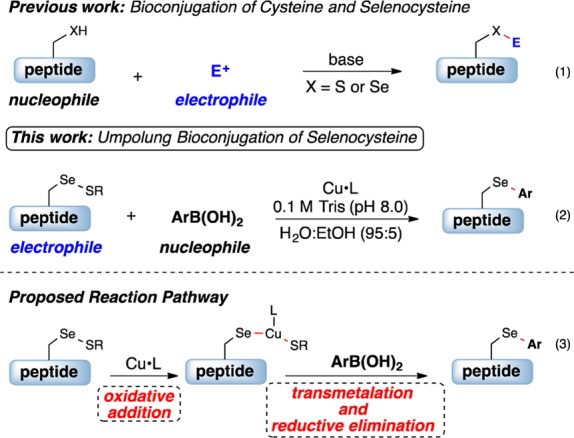
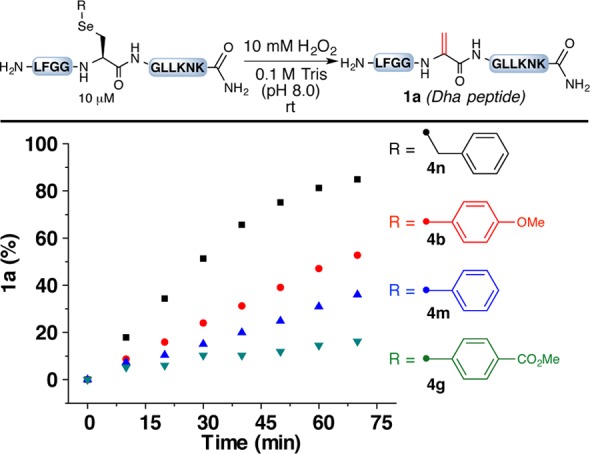
Herein we report an umpolung strategy for the bioconjugation of selenocysteine in unprotected peptides. This mild and operationally simple approach takes advantage of the electrophilic character of an oxidized selenocysteine (Se-S bond) to react with a nucleophilic arylboronic acid to provide the arylated selenocysteine within hours. This reaction is amenable to a wide range of boronic acids with different biorelevant functional groups and is unique to selenocysteine. Experimental evidence indicates that under oxidative conditions the arylated derivatives are more stable than the corresponding alkylated selenocysteine.
Conflict of interest statement
The authors declare the following competing financial interest(s): MIT has filed a provisional patent based on this technology of which S.L.B, B.L.P, D.T.C., and C.Z. will receive possible royalties.
Figures
References
-
-
For reports showing that selenocysteine is encoded by the DNA using a UGA codon, see:
- Chambers I.; Frampton J.; Goldfarb P.; Affara N.; McBain W.; Harrison P. R. EMBO J. 1986, 5, 1221. - PMC - PubMed
- Zinoni F.; Birkmann A.; Stadtman T. C.; Böck A. Proc. Natl. Acad. Sci. U. S. A. 1986, 83, 4650.10.1073/pnas.83.13.4650. - DOI - PMC - PubMed
-
-
- Metanis N.; Beld J.; Hilvert D. In PATAI’S Chemistry of Functional Groups; Wiley: Chichester, U.K., 2009.
Publication types
MeSH terms
Substances
Grants and funding
LinkOut - more resources
Full Text Sources
Other Literature Sources
