Review
. 2015 Jul 28;4(3):277-96.
doi: 10.3390/cells4030277.

Misdelivery at the Nuclear Pore Complex-Stopping a Virus Dead in Its Tracks

Affiliations
Review

Misdelivery at the Nuclear Pore Complex-Stopping a Virus Dead in Its Tracks

Justin W Flatt et al. Cells. .

Abstract

Many viruses deliver their genomes into the host cell's nucleus before they replicate. While onco-retroviruses and papillomaviruses tether their genomes to host chromatin upon mitotic breakdown of the nuclear envelope, lentiviruses, such as human immunodeficiency virus, adenoviruses, herpesviruses, parvoviruses, influenza viruses, hepatitis B virus, polyomaviruses, and baculoviruses deliver their genomes into the nucleus of post-mitotic cells. This poses the significant challenge of slipping a DNA or RNA genome past the nuclear pore complex (NPC) embedded in the nuclear envelope. Quantitative fluorescence imaging is shedding new light on this process, with recent data implicating misdelivery of viral genomes at nuclear pores as a bottleneck to virus replication. Here, we infer NPC functions for nuclear import of viral genomes from cell biology experiments and explore potential causes of misdelivery, including improper virus docking at NPCs, incomplete translocation, virus-induced stress and innate immunity reactions. We conclude by discussing consequences of viral genome misdelivery for viruses and host cells, and lay out future questions to enhance our understanding of this phenomenon. Further studies into viral genome misdelivery may reveal unexpected aspects about NPC structure and function, as well as aid in developing strategies for controlling viral infections to improve human health.

Keywords: MxB; Nup; click chemistry; gene therapy; importin/karyopherin; innate immunity; interferon; nuclear import/transport; uncoating/disassembly; virus entry.


Figures
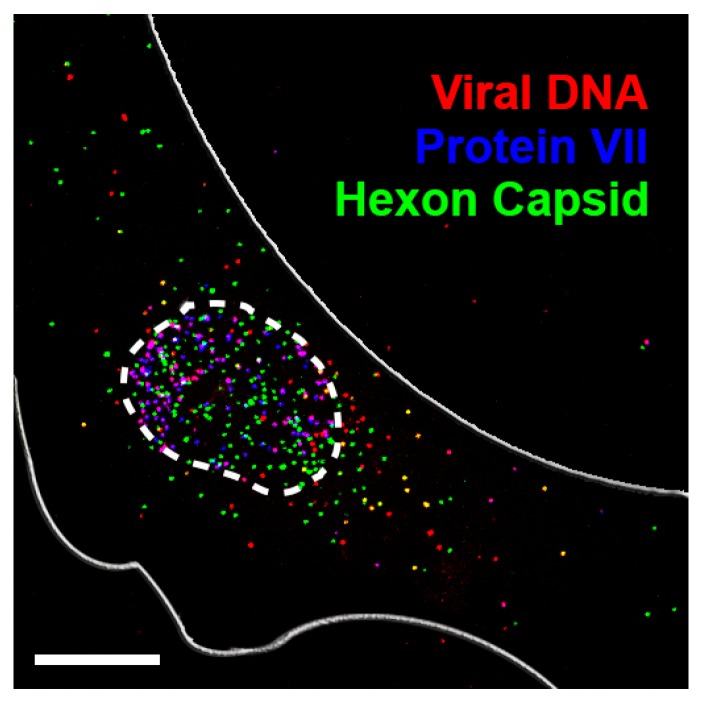
Figure 1
Figure 1
Misdelivery of capsid-free adenovirus DNA after uncoating at the nuclear pore complex. Wang et al. [53] infected HeLa cells for 150 minutes followed by fixation and viral genome click-labeling using Alexa Fluor 594 (red). Shown is a total projection of confocal optical slices depicting immune-stained protein VII (blue) and hexon capsid (green). Viral genomes associated with protein VII appear as purple dots in the nucleus, whereas partially uncoated cytosolic virus particles containing viral DNA (vDNA) appear as yellow dots. It is thought that protein VII remains attached to incoming vDNA during translocation into the nucleus, but copy number per genome is uncertain, as well as if any other viral proteins, such as terminal protein or protein X remain associated during import [58,59,60]. Analyses revealed that a large pool of viral DNA does not reach the nucleus during infection, but rather accumulates capsid-free in the cytosol of the host cell. The borders (white) were identified using DAPI for the nucleus and contrast-enhanced protein VII for the cell membrane. Scale bar, 10 µm.
Figure 2
Figure 2
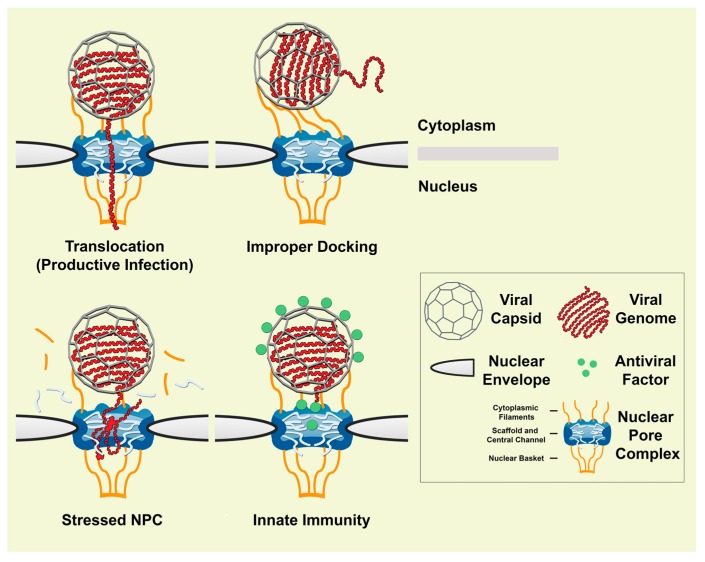
Possible ways that nuclear pore complexes inhibit viruses during cell entry. Viruses that replicate in the nuclear compartment of post-mitotic cells must somehow overcome the selective barrier of the nuclear pore complex (NPC). Large virus capsids, such as those of herpesviruses and adenoviruses are too big to pass directly through NPCs. These viruses have evolved mechanisms to negotiate translocation of their genomes and accessory proteins across NPCs (upper left). However, improper docking (upper right) and mechano-chemical stress (lower left) may cause incoming viral nucleic acids to be misdelivered to the cytosol rather than entering into the nucleus for replication. Likewise, antiviral factors, such as the recently reported interferon induced myxovirus resistance protein 2 (MxB) protein, may restrict uncoating and/or nuclear import of genomes from certain viruses, such as human immunodeficiency virus-1 (HIV) (lower right).

References

    1. Ludtke J.J., Zhang G.F., Sebestyen M.G., Wolff J.A. A nuclear localization signal can enhance both the nuclear transport and expression of 1 kb DNA. J. Cell. Sci. 1999;112:2033–2041. - PubMed
    1. Lechardeur D., Lukacs G.L. Nucleocytoplasmic transport of plasmid DNA: A perilous journey from the cytoplasm to the nucleus. Hum. Gene Ther. 2006;17:882–889. doi: 10.1089/hum.2006.17.882. - DOI - PubMed
    1. Graham F.L., van der Eb A.J. A new technique for the assay of infectivity of human adenovirus 5 DNA. Virology. 1973;52:456–467. doi: 10.1016/0042-6822(73)90341-3. - DOI - PubMed
    1. Prasad V., Suomalainen M., Pennauer M., Yakimovich A., Andriasyan V., Hemmi S., Greber U.F. Chemical induction of unfolded protein response enhances cancer cell killing through lytic virus infection. J. Virol. 2014;88:13086–13098. doi: 10.1128/JVI.02156-14. - DOI - PMC - PubMed
    1. Miest T.S., Cattaneo R. New viruses for cancer therapy: Meeting clinical needs. Nat. Rev. Microbiol. 2014;12:23–34. doi: 10.1038/nrmicro3140. - DOI - PMC - PubMed

LinkOut - more resources