Randomized Controlled Trial
. 2015 Dec;148(6):1489-1496.
doi: 10.1378/chest.14-2457.

Biomarker Profiles in Asthma With High vs Low Airway Reversibility and Poor Disease Control

Affiliations
Randomized Controlled Trial

Biomarker Profiles in Asthma With High vs Low Airway Reversibility and Poor Disease Control

William W Busse et al. Chest. 2015 Dec.

Abstract

Background: High bronchodilator reversibility in adult asthma is associated with distinct clinical characteristics. This analysis compares lung function, biomarker profiles, and disease control in patients with high reversibility (HR) and low reversibility (LR) asthma.

Methods: A retrospective analysis was performed with data from two completed clinical trials of similar design. Patients were divided into HR and LR subgroups based on their response to bronchodilators (HR = ΔFEV1 postbronchodilator ≥ 20%). Blood eosinophil count, serum IgE level, and fraction of exhaled nitric oxide concentration, biomarkers commonly used to stratify patients into T-helper (Th)-2-high vs Th2-low phenotypes, were measured in patients with not well controlled (1.5 ≤ Asthma Control Questionnaire [ACQ] ≤ 2.143) and very poorly controlled (ACQ > 2.143) disease.

Results: The majority of patients in the HR and LR subgroups displayed Th2-low biomarker profiles and very poor disease control. HR was more frequently associated with Th2-high biomarker profiles (40.1% vs 29.4%, P = .006), lower lung function (FEV1, 63.5 ± 7.7% predicted vs 67.9 ± 8.4% predicted; P < .001), and atopy (93.7% vs 86.5%, P = .005).

Conclusions: HR is a physiologic indicator of reduced lung function and is more often associated with elevations in Th2 biomarkers than LR in moderate to severe asthma. However, the majority of patients with HR and LR asthma in this analysis had a Th2-low biomarker profile. Moreover, a Th2-high biomarker profile was not associated with worse disease control.


Figures

Figure 1 –
Figure 1 –
A-E, Correlations between baseline and wk 12 blood eosinophil counts (cells/μL3) (A), serum IgE levels (IU/mL) (B), FeNO concentrations (parts per billion) (C), disease control assessed in terms of ACQ6 (U) (D), and bronchodilator reversibility (E) are summarized for patients who did not receive active therapy in the clinical trials studied., The results confirm the stability of these measures out to 12 wk. ACQ = Asthma Control Questionnaire; EOS = eosinophil count; FeNO = fraction of expired nitric oxide.
Figure 2 –
Figure 2 –
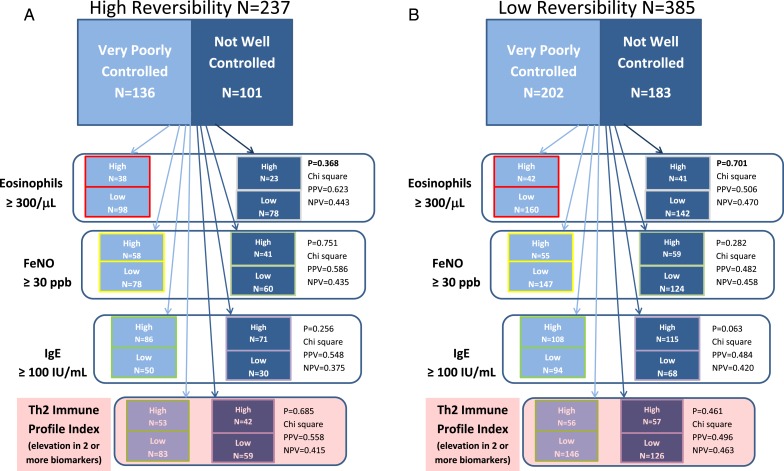
A, Patients with very poorly controlled and not well controlled disease with high reversibility assessed via ACQ6. B, Patients with very poorly controlled and not well controlled disease with low reversibility assessed via ACQ6. Patients with high reversibility (A) and low reversibility (B) phenotypes are partitioned into those with poor and adequate disease control and then further subdivided based on individual Th2 biomarkers and the aggregate Th2 Immune Profile Index. The results of χ2 analysis assessing the statistical significance of the association of each biomarker with disease control status and PPV and NPV of each biomarker for predicting disease control status are shown. NPV = negative predictive value; PPV = positive predictive value; Th2 = T-helper 2. See Figure 1 legend for expansion of other abbreviations.

References

    1. Moore WC, Meyers DA, Wenzel SE, et al. ; National Heart, Lung, and Blood Institute’s Severe Asthma Research Program. Identification of asthma phenotypes using cluster analysis in the Severe Asthma Research Program. Am J Respir Crit Care Med. 2010;181(4):315-323. - PMC - PubMed
    1. Wu W, Bleecker E, Moore W, et al. Unsupervised phenotyping of Severe Asthma Research Program participants using expanded lung data. J Allergy Clin Immunol. 2014;133(5):1280-1288. - PMC - PubMed
    1. Haldar P, Pavord ID, Shaw DE, et al. Cluster analysis and clinical asthma phenotypes. Am J Respir Crit Care Med. 2008;178(3):218-224. - PMC - PubMed
    1. Moore WC, Hastie AT, Li X, et al. ; National Heart, Lung, and Blood Institute’s Severe Asthma Research Program. Sputum neutrophil counts are associated with more severe asthma phenotypes using cluster analysis. J Allergy Clin Immunol. 2014;133(6):1557-1563.e5. - PMC - PubMed
    1. Braiser AR, Victor S, Ju H, et al. Predicting intermediate phenotypes in asthma using bronchoalveolar lavage-derived cytokines. Clin Transl Sci. 2010;3(4):147-157. - PMC - PubMed

Publication types

MeSH terms