Review
doi: 10.1371/journal.ppat.1004982.
eCollection 2015 Jul.
On and Under the Skin: Emerging Basidiomycetous Yeast Infections Caused by Trichosporon Species
Affiliations
- PMID: 26226483
- PMCID: PMC4520462
- DOI: 10.1371/journal.ppat.1004982
Item in Clipboard
Review
On and Under the Skin: Emerging Basidiomycetous Yeast Infections Caused by Trichosporon Species
PLoS Pathog.
.
No abstract available
Conflict of interest statement
The authors have declared that no competing interests exist.
Figures
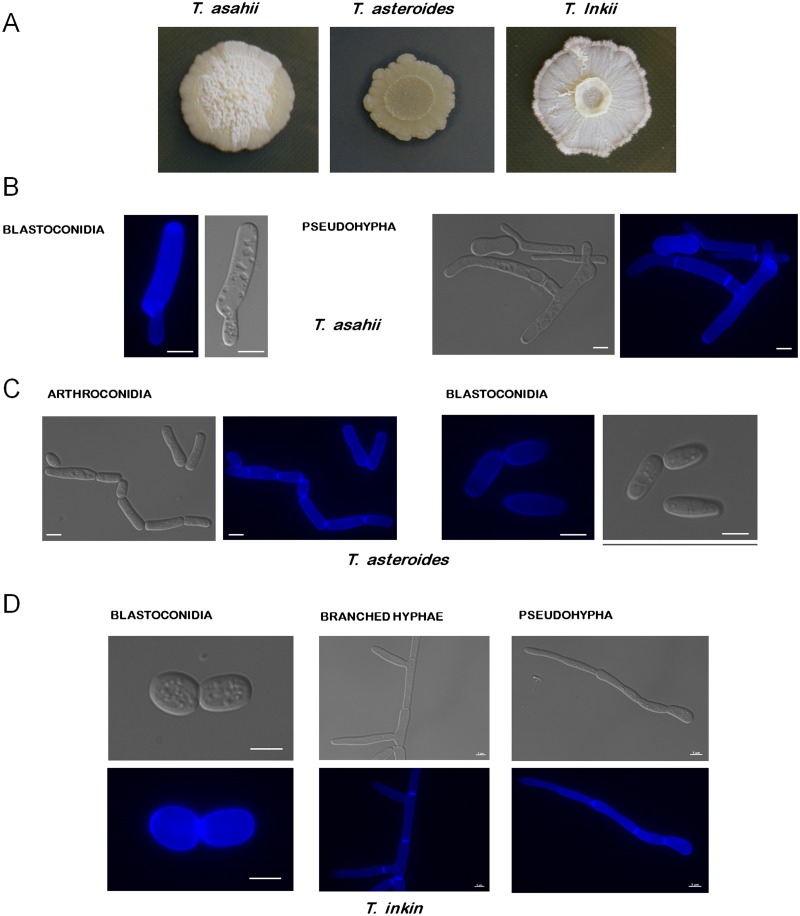
(A) T. asahii, T. asteroides, and T. inkii were grown at 30°C for 15 days on Sabouraud, YNB+tributyrin 1%, and YPD media, respectively. T. asteroides is releasing lipases, producing a halo where tributyrin is degraded. (B) T. asahii blastoconidia and pseudohypha. (C) T. asteroides arthroconidia and blastoconidia. (D) T. inkin pseudohypha, branched hypha, and blastoconidia. The blue fluorescence on the structures is due to their incubation with calcofluor white. Bars, 5 μm.
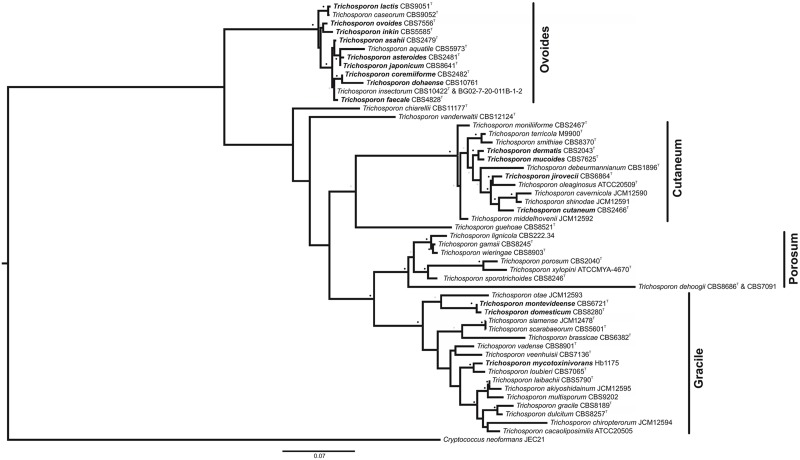
Strain names appear after the species name. Trichosporon species of clinical significance appear in bold. See S1 Table for the GenBank accession numbers. Cryptococcus neoformans was used as an outgroup. Sequences of each individual region were structurally aligned using MXSCARNA [58] and then concatenated into a supermatrix using FASConCAT [59]. Phylogenetic inference was carried out with the software RAxML [60]. For the loop regions, the evolutionary model GTR was used. The stem regions were analyzed under the S16 evolutionary model, thus taking into account secondary structure topology, i.e., compensatory mutations [–63]. Substitution rate heterogeneity was taken into account using the gamma model of Yang [64]. Bootstrap values were computed over 1,000 replicates. Grey dots represent bootstrap values 50%–75% and black dot bootstrap values 76%–100%. Bar, 0.07 substitutions per nucleotide position. T: Type strain.
References
-
- Sugita T Trichosporon behrend (1890) in: Kurtzman C.P., Fell J.W., Boekhout T. (Eds.) The yeasts: a taxonomic study. 5th ed. Elsevier Science, Amsterdam: 2004; 2011:2015–2061.
-
- Xiong L, Huang C, Li XM, Chen XF, Wang B, Wang C,et al. Acetone-Butanol-Ethanol (ABE) Fermentation Wastewater Treatment by oleaginous yeast Trichosporon cutaneum . Appl Biochem Biotechnol 2015. In press. - PubMed
Publication types
MeSH terms
Substances
LinkOut - more resources
Full Text Sources
Other Literature Sources