Review
. 2015 Jul 31:14:145.
doi: 10.1186/s12943-015-0409-y.

Genetic instability in the tumor microenvironment: a new look at an old neighbor

Affiliations
Review

Genetic instability in the tumor microenvironment: a new look at an old neighbor

Antonio Palumbo Jr et al. Mol Cancer. .

Abstract

The recent exponential increase in our knowledge of cellular and molecular mechanisms involved in carcinogenesis has largely failed to translate into new therapies and clinical practices. This lack of success may result in part from the fact that most studies focus on tumor cells as potential therapeutic targets and neglect the complex microenvironment that undergoes profound changes during tumor development. Furthermore, an unfortunate association of factors such as tumor genetic complexity, overestimation of biomarker and drug potentials, as well as a poor understanding of tumor microenvironment in diagnosis and prognosis leads to the current levels of treatment failure regarding a vast majority of cancer types. A growing body of evidence points to the importance of the functional diversity of immune and structural cells during tumor development. In this sense, the lack of technologies that would allow for molecular screening of individual stromal cell types poses a major challenge for the development of therapies targeting the tumor microenvironment. Progress in microenvironment genetic studies represents a formidable opportunity for the development of new selective drugs because stromal cells have lower mutation rates than malignant cells, and should prove to be good targets for therapy.


Figures
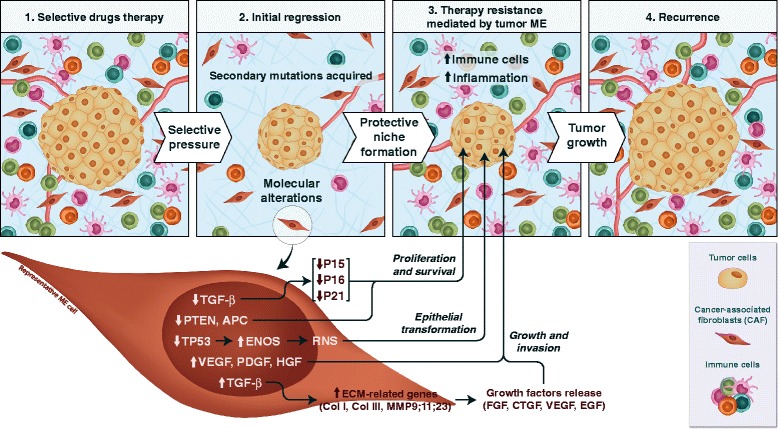
Fig. 1
Fig. 1
Molecular alterations found in the tumor microenvironment (ME) and the role of stromal cells in therapy resistance and disease recurrence. Upper panel: different steps comprised between initial therapeutic approach and tumor recurrence. 1 Tumor and ME cells at the beginning of selective drug therapy. 2 The selective pressure imposed by treatment contributes to the acquisition of secondary tumor mutations and genetic alterations in ME cells, which in turn affect tumor cells. ME alterations are represented in the CAF cell shown in the lower panel. Most of these alterations are associated with the loss of expression of tumor suppressor genes, such as PTEN and APC, which leads to increased tumor survival and proliferation. Furthermore, the loss of TP53 expression observed in CAF increases ENOS activity, which culminates in an elevation of reactive nitrogen species (RNS) and the consequent transformation of the epithelial tissue surrounding the tumor. Moreover, the higher expression of growth factors (e.g., VEGF, PDGF and HGF) contributes to tumor growth and invasion, while TGF-β down-regulation decreases the expression of CDK inhibitors (p15, p16 and p21) in tumor cells, leading to tumor proliferation and survival. On the other hand, TGF-β up-regulation increases the expression of genes related with extracellular matrix (ECM) remodeling (Col I, Col III, MMP 9, MMP 11 and MMP23) which directly contribute to tumor progression. 3 ME cellular alterations, in addition to the recruitment of immune cells, and the increase in ME inflammation create a protective niche that results in therapy resistance. 4 The final outcome: tumor re-growth and disease recurrence
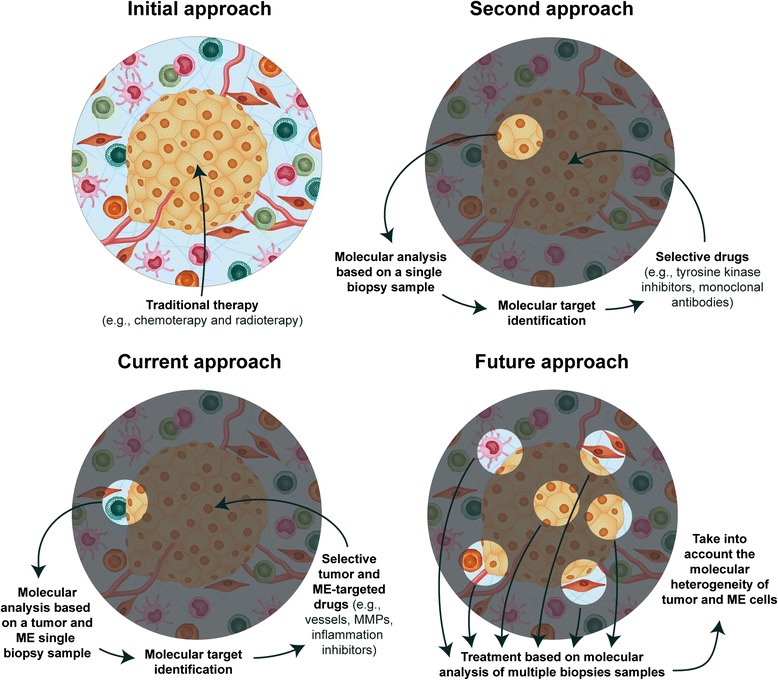
Fig. 2
Fig. 2
Evolution of cancer therapies over the years. The initial approach represents conventional therapy, which is based on the employment of unspecific chemical and physical agents (chemo and radiotherapy) that target general cellular processes occurring in both healthy and cancer cells and that do not take into account molecular alterations exhibited by the tumors. In the second approach , the molecular screening of cancer cells led to the development of selective drugs based on altered molecular features of malignant cells. This approach is particularly represented by tyrosine kinase inhibitors and monoclonal antibodies, which specifically target tumor cells. It is based on single-biopsy studies and does not take into account molecular alterations exhibited by microenvironment (ME) cells or tumor heterogeneity. The current approach shows that, lately, not only the tumor, but also its ME, have been mapped, which contributed to the development of selective drugs designed for both malignant and ME cells. The ME alterations more frequently targeted by molecular drugs are the ones observed in several types of cancers, such as angiogenesis, inflammatory processes and MMP overexpression. Again, this approach is based on single-biopsy studies and does not account for tumor heterogeneity. The future approach for cancer treatment shall account for the whole molecular heterogeneity, which is differentially exhibited by malignant and ME cells and unveiled by multiple biopsies

References

    1. Ferlay J, Soerjomataram I, Ervik M, Dikshit R, Eser S, Mathers C, et al. GLOBOCAN 2012 v1.0, Cancer Incidence and Mortality Worldwide: IARC Cancer Base No. 11 [Internet] Lyon, France: International Agency for Research on Cancer; 2013.
    1. World Health Organization, mortality database http://www.who.int/healthinfo/mortality_data/en/ (acessed on 26/02/2014).
    1. Crozier JA, Swaika A, Moreno-Aspitia A. Adjuvant chemotherapy in breast cancer: To use or not to use, the anthracyclines. World J Clin Oncol. 2014;5(3):529–38. - PMC - PubMed
    1. Damin DC, Lazzaron AR. Evolving treatment strategies for colorectal cancer: a critical review of current therapeutic options. World J Gastroenterol. 2014;20(4):877–87. - PMC - PubMed
    1. Mukohara T. Mechanisms of resistance to anti-human epidermal growth factor receptor 2 agents in breast cancer. Cancer Sci. 2011;102(1):1–8. - PubMed

Publication types

LinkOut - more resources