


Personality and smoking: individual-participant meta-analysis of nine cohort studies
- PMID: 26227786
- PMCID: PMC4609271
- DOI: 10.1111/add.13079
Personality and smoking: individual-participant meta-analysis of nine cohort studies
Abstract
Aims: To investigate cross-sectional and longitudinal associations between personality and smoking, and test whether socio-demographic factors modify these associations.
Design: Cross-sectional and longitudinal individual-participant meta-analysis.
Setting: Nine cohort studies from Australia, Germany, the United Kingdom and the United States.
Participants: A total of 79 757 men and women (mean age = 50.8 years).
Measurements: Personality traits of the five-factor model (extraversion, neuroticism, agreeableness, conscientiousness and openness to experience) were used as exposures. Outcomes were current smoking status (current smoker, ex-smoker and never smoker), smoking initiation, smoking relapse and smoking cessation. Associations between personality and smoking were modelled using logistic and multinomial logistic regression, and study-specific findings were combined using random-effect meta-analysis.
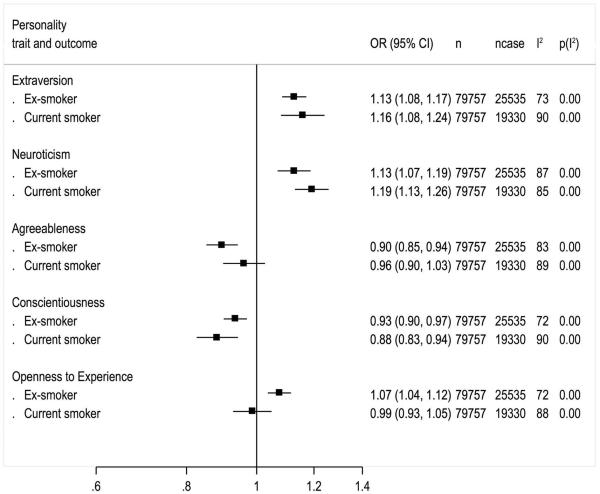
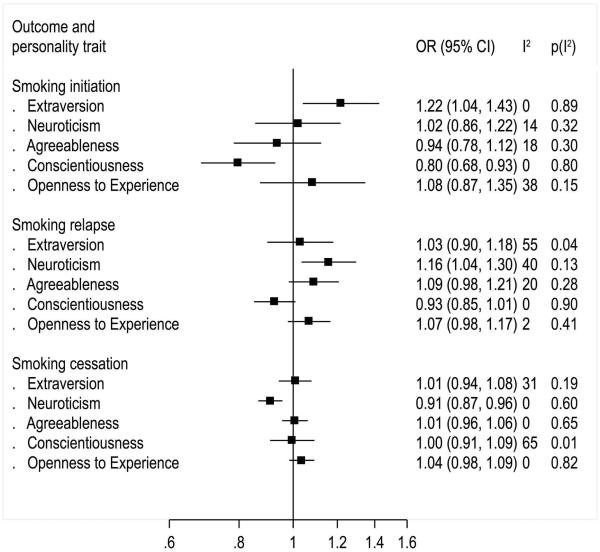
Findings: Current smoking was associated with higher extraversion [odds ratio per 1 standard deviation increase in the score: 1.16; 95% confidence interval (CI) = 1.08-1.24], higher neuroticism (1.19; 95% CI = 1.13-1.26) and lower conscientiousness (95% CI = 0.88; 0.83-0.94). Among non-smokers, smoking initiation during the follow-up period was predicted prospectively by higher extraversion (1.22; 95% CI = 1.04-1.43) and lower conscientiousness (0.80; 95% CI = 0.68-0.93), whereas higher neuroticism (1.16; 95% CI = 1.04-1.30) predicted smoking relapse among ex-smokers. Among smokers, smoking cessation was negatively associated with neuroticism (0.91; 95% CI = 0.87-0.96). Socio-demographic variables did not appear to modify the associations between personality and smoking.
Conclusions: Adult smokers have higher extraversion, higher neuroticism and lower conscientiousness personality scores than non-smokers. Initiation into smoking is associated positively with higher extraversion and lower conscientiousness, while relapse to smoking among ex-smokers is associated with higher neuroticism.
Keywords: Cohort study; five-factor model; meta-analysis; personality; smoking.
© 2015 Society for the Study of Addiction.
Figures
References
-
- Lim SS, Vos T, Flaxman AD, Danaei G, Shibuya K, Adair-Rohani H, et al. A comparative risk assessment of burden of disease and injury attributable to 67 risk factors and risk factor clusters in 21 regions, 1990–2010: a systematic analysis for the Global Burden of Disease Study 2010. The lancet. 2013;380:2224–60. - PMC - PubMed
-
- Ng M, Freeman MK, Fleming TD, Robinson M, Dwyer-Lindgren L, Thomson B, et al. Smoking prevalence and cigarette consumption in 187 countries, 1980–2012. JAMA. 2014;311:183–92. - PubMed
-
- Centers for Disease Control and Prevention Quitting smoking among adults—United States, 2001–2010. Morbidity and Mortality Weekly Report. 2011;60:1513–9. - PubMed
-
- Hartmann Boyce J, Stead LF, Cahill K, Lancaster T. Efficacy of interventions to combat tobacco addiction: Cochrane update of 2012 reviews. Addiction. 2013;108:1711–21. - PubMed
-
- Kotz D, West R. Explaining the social gradient in smoking cessation: it's not in the trying, but in the succeeding. Tob Control. 2009;18:43–6. - PubMed
Publication types
MeSH terms
Grants and funding
LinkOut - more resources
Full Text Sources
Other Literature Sources
Medical
