. 2015 Sep 18;43(16):8044-56.
doi: 10.1093/nar/gkv746. Epub 2015 Jul 30.

Towards a comprehensive picture of alloacceptor tRNA remolding in metazoan mitochondrial genomes

Affiliations

Towards a comprehensive picture of alloacceptor tRNA remolding in metazoan mitochondrial genomes

Abdullah H Sahyoun et al. Nucleic Acids Res. .

Abstract

Remolding of tRNAs is a well-documented process in mitochondrial genomes that changes the identity of a tRNA. It involves a duplication of a tRNA gene, a mutation that changes the anticodon and the loss of the ancestral tRNA gene. The net effect is a functional tRNA that is more closely related to tRNAs of a different alloacceptor family than to tRNAs with the same anticodon in related species. Beyond being of interest for understanding mitochondrial tRNA function and evolution, tRNA remolding events can lead to artifacts in the annotation of mitogenomes and thus in studies of mitogenomic evolution. Therefore, it is important to identify and catalog these events. Here we describe novel methods to detect tRNA remolding in large-scale data sets and apply them to survey tRNA remolding throughout animal evolution. We identify several novel remolding events in addition to the ones previously mentioned in the literature. A detailed analysis of these remoldings showed that many of them are derived from ancestral events.


Figures

Figure 1.
Figure 1.
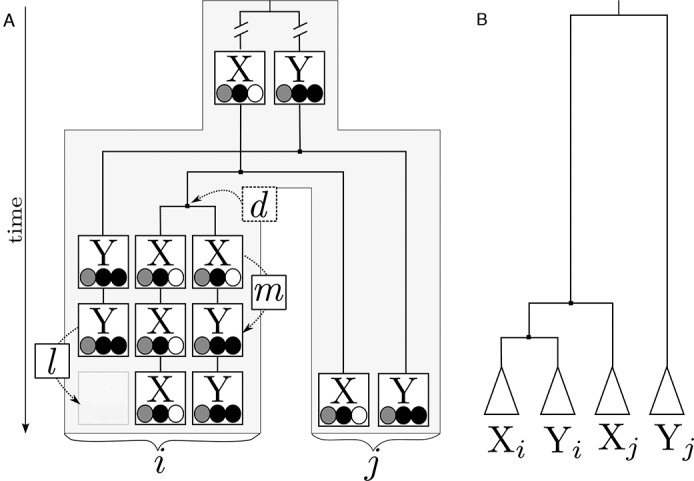
Schematic representation of an alloacceptor tRNA remolding event in a subtree i using the example of X↝Y. (A) The anticodon is represented by gray, black and white circles representing the nucleotides. Shown are the duplication (d), the point mutation in the third position of the anticodon which changes the identity of the tRNA (m), and the loss of the original trnY (l). The species tree for the affected subtree i and an unaffected sibling subtree j is shown in light gray. The gene tree for the tRNAs is represented by lines. (B) Phylogeny of the four tRNAs representing their evolutionary relationship.
Figure 2.
Figure 2.
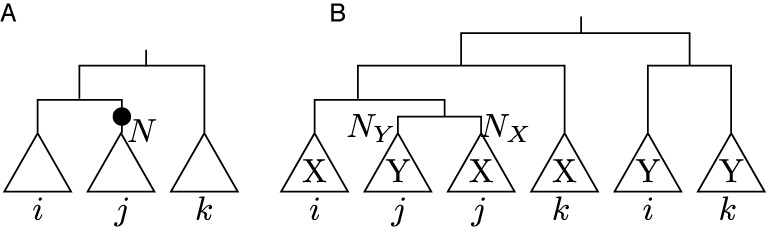
(A) Species tree including three subtrees i, j and k that is to be tested for an X↝Y on the edge leading to node N (marked with a circle); (B) The corresponding gene tree for trnX and trnY that is used for testing for the remolding event.
Figure 3.
Figure 3.
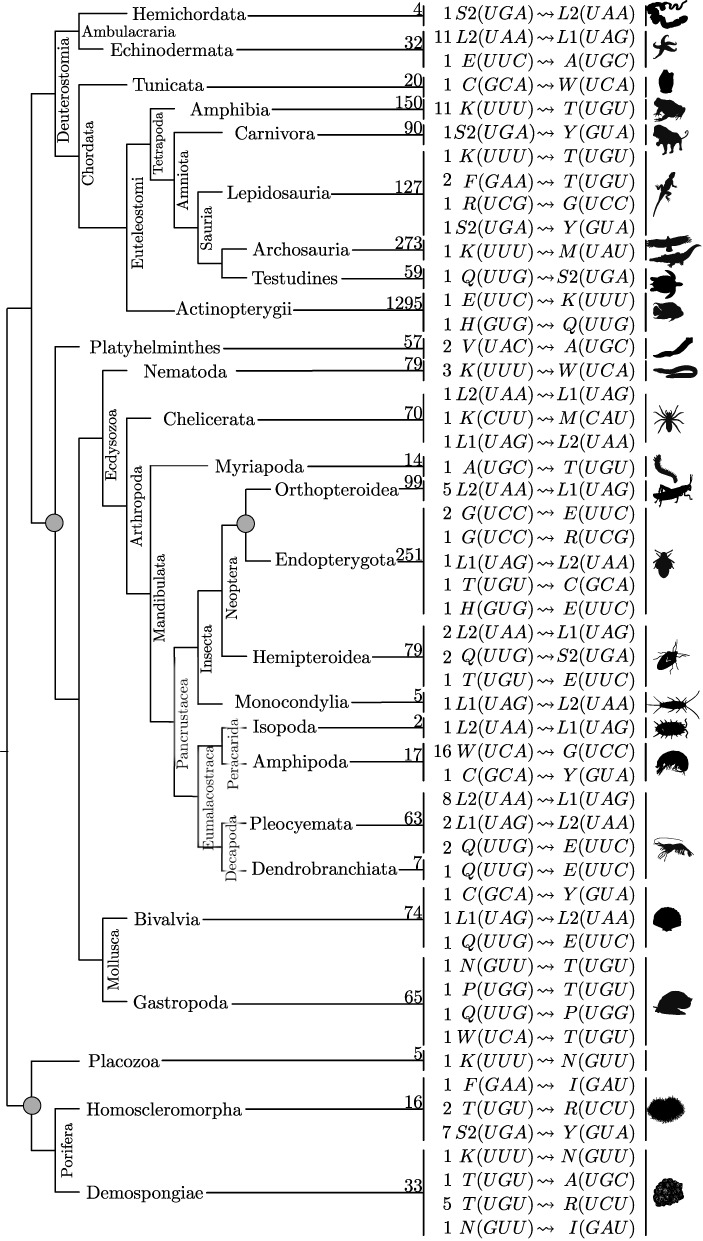
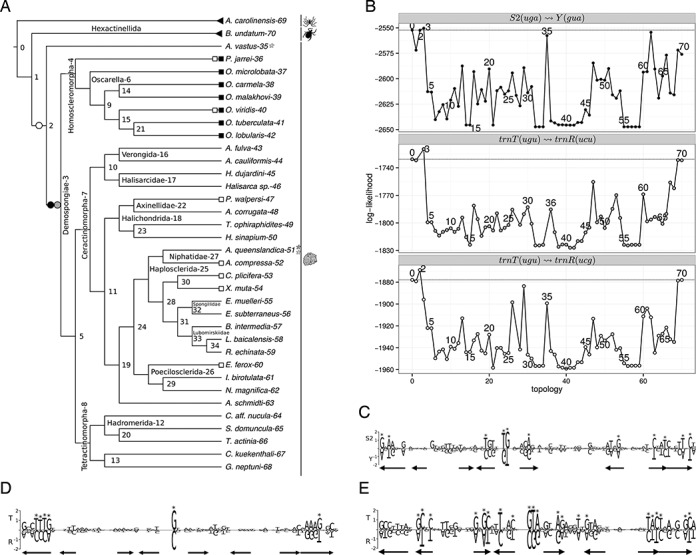
Detected tRNA remolding pairs. For each leaf the remoldings and their number is shown. Taxa without remoldings are omitted. Gray circles mark nodes that are not present in the NCBI taxonomy. Homoscleromorpha and Demospongiae have been separated for clarity.
Figure 4.
Figure 4.
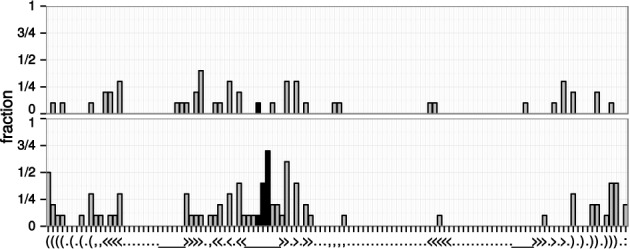
Fraction of the 10 analyzed data sets that show tRNA specific modification in an alignment column for the control (top) and remolded tRNAs (bottom). The consensus secondary structure is shown along the plot. The anticodon positions are highlighted by black bars.
Figure 5.
Figure 5.
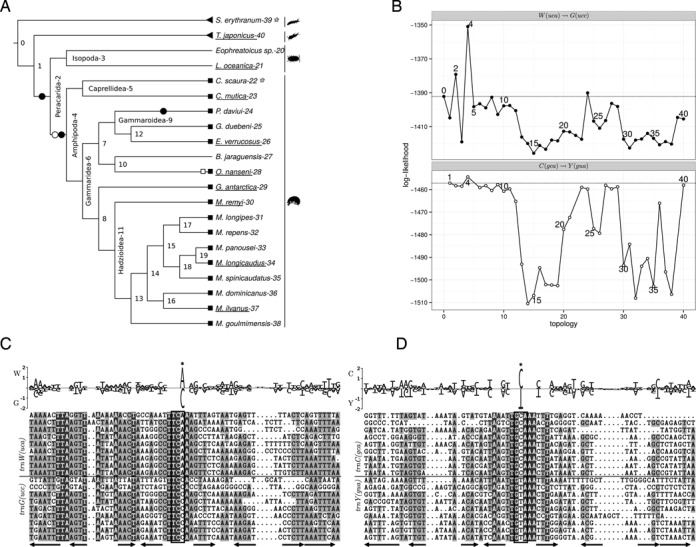
Remolding of W↝G and C↝Y in Peracarida: (A) guide tree, black and white symbols refer to the W↝G and C↝Y, respectively, sequences of underlined species are shown in the alignment, triangles mark outgroup species, squares mark candidates in ℛ, circles mark tree rearrangements which yield a higher log-likelihood score compared to the start tree, and stars mark species that are omitted due to missing annotations; (B) log-likelihood values calculated for each tree topology, numbers refer to the root node of the subtree that was moved; (C) and (D) alignment and subfamily logo for the trnW+trnG and trnC+trnY, respectively, only the species underlined in panel (A) are included in the alignment shown here. Arrows mark secondary structure elements: the stems of the acceptor arm, D arm, anticodon arm and T arm. The anticodon is indicated by a box.
Figure 6.
Figure 6.
Results for the Porifera T(UGU)↝R(UCU), T(UGU)↝R(UCG) and S2(UGA)↝Y(GUA): (A) guide tree, black, gray and white symbols refer to S2(UGA)↝Y(GUA), T(UGU)↝R(UCU) and T(UGU)↝R(UCG), respectively, triangles mark outgroup species, squares mark candidates in ℛ, circles mark tree rearrangements which yield a higher log-likelihood score compared to the start tree, and stars mark species that are omitted due to missing annotations; (B) log-likelihood score calculated for each tree topology, numbers refer to the root node of the subtree that was moved; (C), (D) and (E) subfamily logo for the trnS2(UGA)+trnY(GUA), trnT(UGU)+trnR(UCU) and trnT(UGU)+trnR(UCG), respectively, genes of the Porifera and outgroup species. Arrows mark secondary structure elements: the stems of the acceptor arm, D arm, anticodon arm and T arm.

References

    1. McBride H.M., Neuspiel M., Wasiak S. Mitochondria: more than just a powerhouse. Curr. Biol. 2006;16:551–560. - PubMed
    1. Suen D.F., Norris K.L., Youle R.J. Mitochondrial dynamics and apoptosis. Genes Dev. 2008;22:1577–1590. - PMC - PubMed
    1. Duchêne A.-M., Pujol C., Maréchal-Drouard L. Import of tRNAs and aminoacyl-tRNA synthetases into mitochondria. Curr. Genet. 2009;55:1–18. - PubMed
    1. Beagley C., Macfarlane J., Pont-Kingdon G., Okimoto R., Okada N., Wolstenholme D. Mitochondrial genomes of Anthozoa (Cnidaria) Prog. Cell Res. 1995;5:149–153.
    1. Helfenbein K.G., Fourcade H.M., Vanjani R.G., Boore J.L. The mitochondrial genome of Paraspadella gotoi is highly reduced and reveals that chaetognaths are a sister group to protostomes. Proc. Natl. Acad. Sci. U.S.A. 2004;101:10639–10643. - PMC - PubMed

Publication types

LinkOut - more resources