


Impact of the HITECH Act on physicians' adoption of electronic health records
- PMID: 26228764
- PMCID: PMC7784315
- DOI: 10.1093/jamia/ocv103
Impact of the HITECH Act on physicians' adoption of electronic health records
Abstract
Background and objective: The Health Information Technology for Economic and Clinical Health (HITECH) Act has distributed billions of dollars to physicians as incentives for adopting certified electronic health records (EHRs) through the meaningful use (MU) program ultimately aimed at improving healthcare outcomes. The authors examine the extent to which the MU program impacted the EHR adoption curve that existed prior to the Act.
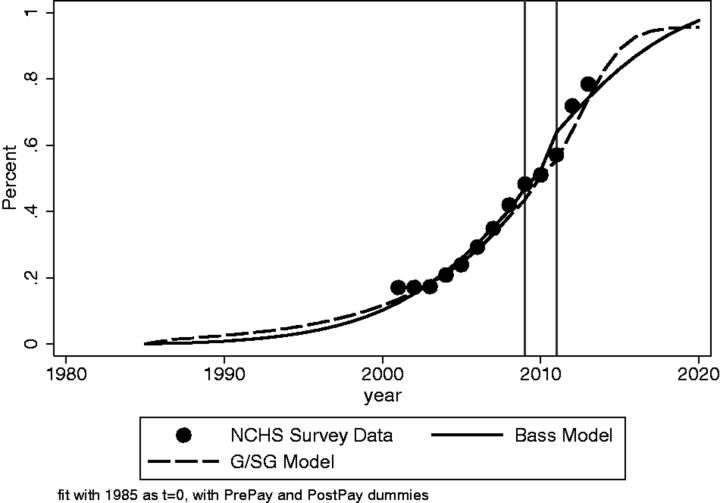
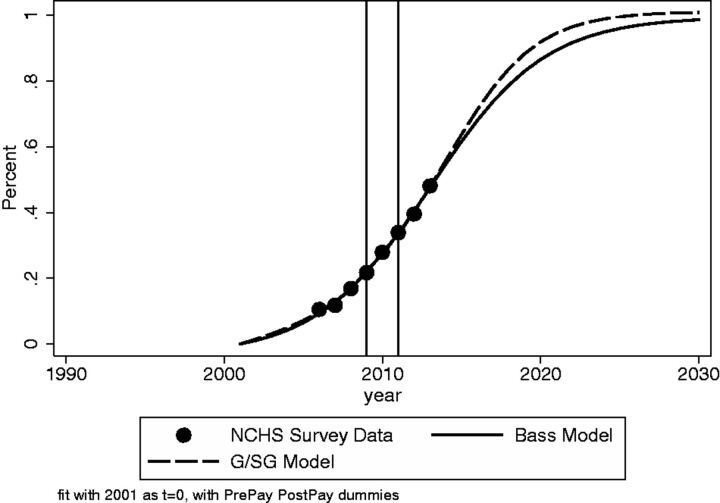
Methods: Bass and Gamma Shifted Gompertz (G/SG) diffusion models of the adoption of "Any" and "Basic" EHR systems in physicians' offices using consistent data series covering 2001-2013 and 2006-2013, respectively, are estimated to determine if adoption was stimulated during either a PrePay (2009-2010) period of subsidy anticipation or a PostPay (2011-2013) period when payments were actually made.
Results: Adoption of Any EHR system may have increased by as much as 7 percentage points above the level predicted in the absence of the MU subsidies. This estimate, however, lacks statistical significance and becomes smaller or negative under alternative model specifications. No substantial effects are found for Basic systems. The models suggest that adoption was largely driven by "imitation" effects (q-coefficient) as physicians mimic their peers' technology use or respond to mandates. Small and often insignificant "innovation" effects (p-coefficient) are found suggesting little enthusiasm by physicians who are leaders in technology adoption.
Conclusion: The authors find weak evidence of the impact of the MU program on EHR uptake. This is consistent with reports that many current EHR systems reduce physician productivity, lack data sharing capabilities, and need to incorporate other key interoperability features (e.g., application program interfaces).
Keywords: American recovery and reinvestment act; bass model; electronic health records; health information technology; technology adoption.
© The Author 2015. Published by Oxford University Press on behalf of the American Medical Informatics Association. All rights reserved. For Permissions, please email: journals.permissions@oup.com.
Figures
References
-
- Maxson E Jain S Kendall M Mostashari F Blumenthal D . The regional extension center program: helping physicians meaningfully use health information technology . Ann Intern Med. 2010. ; 153 ( 10 ): 666 – 670 . - PubMed
-
- Buntin MB Burke MF Hoaglin MC Blumenthal D . The benefits of health information technology: a review of the recent literature shows predominantly positive results . Health Aff. 2011. ; 30 ( 3 ): 464 – 471 . - PubMed
-
- Centers for Medicare and Medicaid Services . Medicare and Medicaid EHR Incentive Program Basics 2015 [cited February 17, 2015] . http://www.cms.gov/Regulations-and-Guidance/Legislation/EHRIncentiveProg... . Accessed February 29, 2015 .
MeSH terms
LinkOut - more resources
Full Text Sources
Medical
Research Materials
