


Obesity--a risk factor for postoperative complications in general surgery?
- PMID: 26228844
- PMCID: PMC4520073
- DOI: 10.1186/s12871-015-0096-7
Obesity--a risk factor for postoperative complications in general surgery?
Erratum in
-
Erratum to: Obesity--a risk factor for postoperative complications in general surgery?BMC Anesthesiol. 2015 Oct 26;15:155. doi: 10.1186/s12871-015-0136-3. BMC Anesthesiol. 2015. PMID: 26503436 Free PMC article. No abstract available.
Abstract
Background: Obesity is generally believed to be a risk factor for the development of postoperative complications. Although being obese is associated with medical hazards, recent literature shows no convincing data to support this assumption. Moreover a paradox between body mass index and survival is described. This study was designed to determine influence of body mass index on postoperative complications and long-term survival after surgery.
Methods: A single-centre prospective analysis of postoperative complications in 4293 patients undergoing general surgery was conducted, with a median follow-up time of 6.3 years. We analyzed the impact of bodyweight on postoperative morbidity and mortality, using univariate and multivariate regression models.
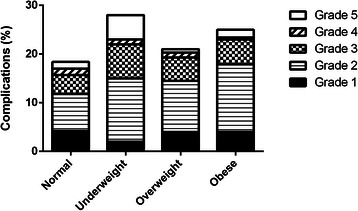
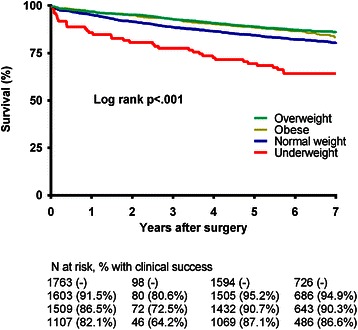
Results: The obese had more concomitant diseases, increased risk of wound infection, greater intraoperative blood loss and a longer operation time. Being underweight was associated with a higher risk of complications, although not significant in adjusted analysis. Multivariate regression analysis demonstrated that underweight patients had worse outcome (HR 2.1; 95 % CI 1.4-3.0), whereas being overweight (HR 0.6; 95 % CI 0.5-0.8) or obese (HR 0.7; 95 % CI 0.6-0.9) was associated with improved survival.
Conclusion: Obesity alone is a significant risk factor for wound infection, more surgical blood loss and a longer operation time. Being obese is associated with improved long-term survival, validating the obesity paradox. We also found that complication and mortality rates are significantly worse for underweight patients. Our findings suggest that a tendency to regard obesity as a major risk factor in general surgery is not justified. It is the underweight patient who is most at risk of major postoperative complications, including long-term mortality.
Figures
References
-
- Obesity: preventing and managing the global epidemic. Report of a WHO consultation. World Health Organ Tech Rep Ser. 2000;894:i-xii, 1–253. - PubMed
MeSH terms
LinkOut - more resources
Full Text Sources
Other Literature Sources
Medical
