A clever technique for placement of a urinary catheter over a wire
- PMID: 26229328
- PMCID: PMC4518377
- DOI: 10.4103/0974-7796.157959
A clever technique for placement of a urinary catheter over a wire
Abstract
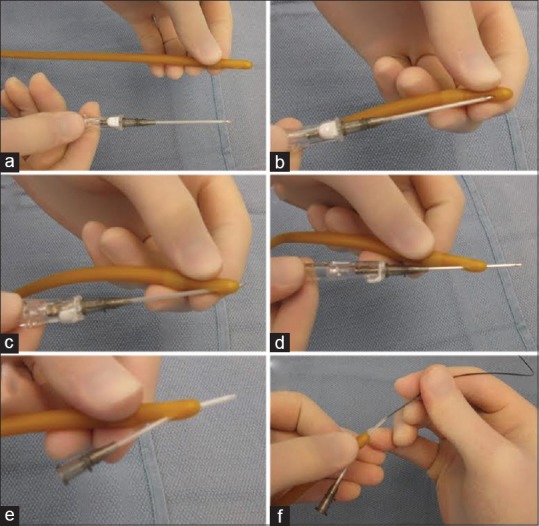
Objective: The objective was to present a straightforward, step-by-step reproducible technique for placement of a guide-wire into any type of urethral catheter, thereby offering a means of access similar to that of a council-tip in a situation that may require a different type of catheter guided over a wire.
Materials and methods: Using a shielded intravenous catheter inserted into the eyelet of a urinary catheter and through the distal tip, a "counsel-tip" can be created in any size or type of catheter. Once transurethral bladder access has been achieved with a hydrophilic guide-wire, this technique will allow unrestricted use of catheters placed over a wire facilitating guided catheterization.
Results: Urethral catheters of different types and sizes are easily advanced into the bladder with wire-guidance; catheterization is improved in the setting of difficult urethral catheterization (DUC). Cost analysis demonstrates benefit overuse of traditional council-tip catheter.
Conclusion: Placing urinary catheters over a wire is standard practice for urologists, however, use of this technique gives the freedom of performing wire-guided catheterization in more situations than a council-tip allows. This technique facilitates successful transurethral catheterization over wire in the setting of DUC for all catheter types and styles aiding in urologic management of patients at a cost benefit to the health care system.
Keywords: Prostatic hyperplasia; urethral obstruction; urethral stricture; urinary bladder neck obstruction; urinary catheter; urinary retention.
Conflict of interest statement
Figures


References
-
- Villanueva C, Hemstreet GP., 3rd Difficult male urethral catheterization: A review of different approaches. Int Braz J Urol. 2008;34:401–11. - PubMed
-
- Cancio LC, Sabanegh ES, Jr, Thompson IM. Managing the foley catheter. Am Fam Physician. 1993;48:829–36. - PubMed
-
- Walden TB. Urethral catheterization in anasarca. Urology. 1979;13:82. - PubMed
-
- Lowe MA, Defalco AJ. New endourologic technique for catheter placement after TURP, prostatectomy, and difficult urethroscopy. Urology. 1992;40:461–3. - PubMed
-
- Daneshgari F, Krugman M, Bahn A, Lee RS. Evidence-based multidisciplinary practice: Improving the safety and standards of male bladder catheterization. Medsurg Nurs. 2002;11:236–41. 246. - PubMed
LinkOut - more resources
Full Text Sources
Other Literature Sources