Review
. 2015 Jul 30;7(1):81.
doi: 10.1186/s13073-015-0199-2. eCollection 2015.

Phenotype-driven strategies for exome prioritization of human Mendelian disease genes

Affiliations
Review

Phenotype-driven strategies for exome prioritization of human Mendelian disease genes

Damian Smedley et al. Genome Med. .

Abstract

Whole exome sequencing has altered the way in which rare diseases are diagnosed and disease genes identified. Hundreds of novel disease-associated genes have been characterized by whole exome sequencing in the past five years, yet the identification of disease-causing mutations is often challenging because of the large number of rare variants that are being revealed. Gene prioritization aims to rank the most probable candidate genes towards the top of a list of potentially pathogenic variants. A promising new approach involves the computational comparison of the phenotypic abnormalities of the individual being investigated with those previously associated with human diseases or genetically modified model organisms. In this review, we compare and contrast the strengths and weaknesses of current phenotype-driven computational algorithms, including Phevor, Phen-Gen, eXtasy and two algorithms developed by our groups called PhenIX and Exomiser. Computational phenotype analysis can substantially improve the performance of exome analysis pipelines.


Figures

Fig. 1
Fig. 1
Benchmarking of all phenotype-based exome analysis tools on 1000 Genomes Project or in-house exomes. Exomes were generated by randomly inserting known disease variants from the Human Genome Mutation Database (HGMD) into either (a, c, e) 50 unaffected exomes from the 1000 Genomes Project or (b, d, f) 50 in-house generated exomes. These exomes were analyzed using each tool and the ability of each tool to rank the causative variant as the top hit, in the top 10 or top 50 was recorded. Default settings, along with filtering with a minor allele frequency cutoff of 1 %, were used for all tools. Analysis was performed using (a, b) all phenotype annotations (c, d) just three of the terms chosen randomly, or (e, f) with two of these three terms made less-specific and two random terms from the whole of the Human Phenotype Ontology (HPO) added
Fig. 2
Fig. 2
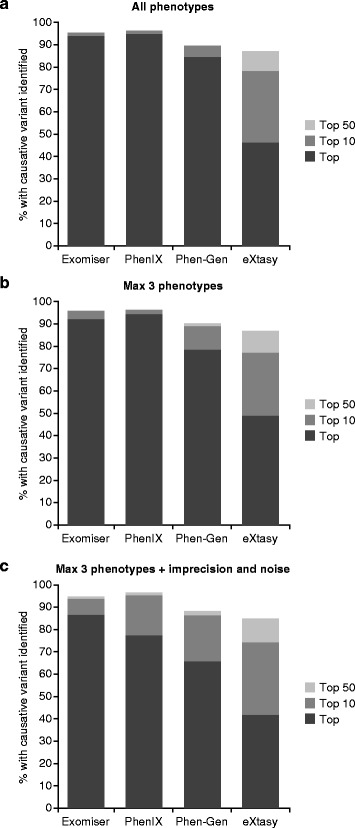
Benchmarking of command-line exome analysis software. Exomes were generated by randomly inserting known disease variants from the Human Genome Mutation Database (HGMD) into 1000 unaffected exomes from the 1000 Genomes Project. These were analyzed using each tool and the ability of each to rank the causative variant as the top hit, in the top 10 or top 50 was recorded. Default settings along with a minor allele frequency cutoff of 1 % were used for all. Analysis was performed using all phenotype annotations (a), just three of the terms chosen randomly (b), or with two of these three terms made less-specific and two random terms from the whole of the Human Phenotype Ontology (HPO) added (c)

References

    1. Dyment DA, Tetreault M, Beaulieu CL, Hartley T, Ferreira P, Chardon JW, et al. Whole-exome sequencing broadens the phenotypic spectrum of rare pediatric epilepsy: a retrospective study. Clin Genet. 2015;88:34–40. doi: 10.1111/cge.12464. - DOI - PubMed
    1. Bamshad MJ, Shendure JA, Valle D, Hamosh A, Lupski JR, Gibbs RA, et al. The Centers for Mendelian Genomics: a new large-scale initiative to identify the genes underlying rare Mendelian conditions. Am J Med Genet A. 2012;158A:1523–5. doi: 10.1002/ajmg.a.35470. - DOI - PMC - PubMed
    1. St Hilaire C, Ziegler SG, Markello TC, Brusco A, Groden C, Gill F, et al. NT5E mutations and arterial calcifications. New Engl J Med. 2011;364:432–42. doi: 10.1056/NEJMoa0912923. - DOI - PMC - PubMed
    1. Soden SE, Saunders CJ, Willig LK, Farrow EG, Smith LD, Petrikin JE, et al. Effectiveness of exome and genome sequencing guided by acuity of illness for diagnosis of neurodevelopmental disorders. Sci Transl Med. 2014;6:265ra168. doi: 10.1126/scitranslmed.3010076. - DOI - PMC - PubMed
    1. Zemojtel T, Kohler S, Mackenroth L, Jager M, Hecht J, Krawitz P, et al. Effective diagnosis of genetic disease by computational phenotype analysis of the disease-associated genome. Sci Transl Med. 2014;6:252ra123. doi: 10.1126/scitranslmed.3009262. - DOI - PMC - PubMed