


The Accuracy of p16/Ki-67 and HPV Test in the Detection of CIN2/3 in Women Diagnosed with ASC-US or LSIL
- PMID: 26230097
- PMCID: PMC4521700
- DOI: 10.1371/journal.pone.0134445
The Accuracy of p16/Ki-67 and HPV Test in the Detection of CIN2/3 in Women Diagnosed with ASC-US or LSIL
Abstract
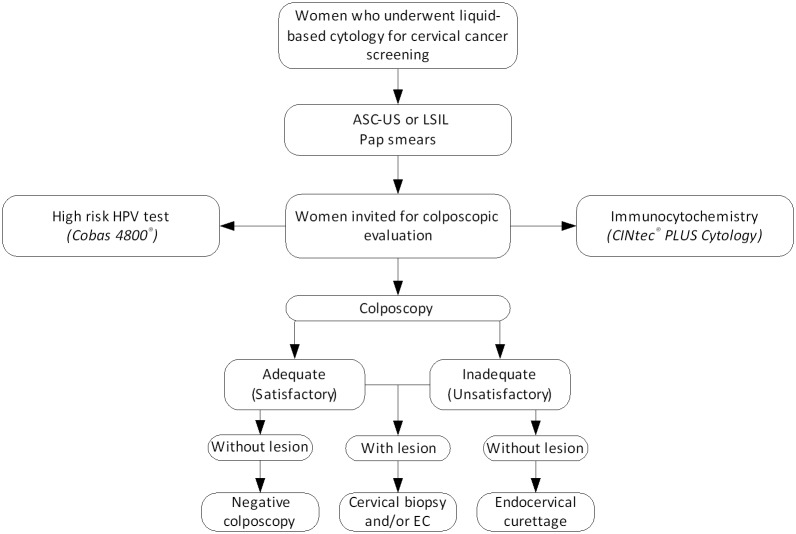
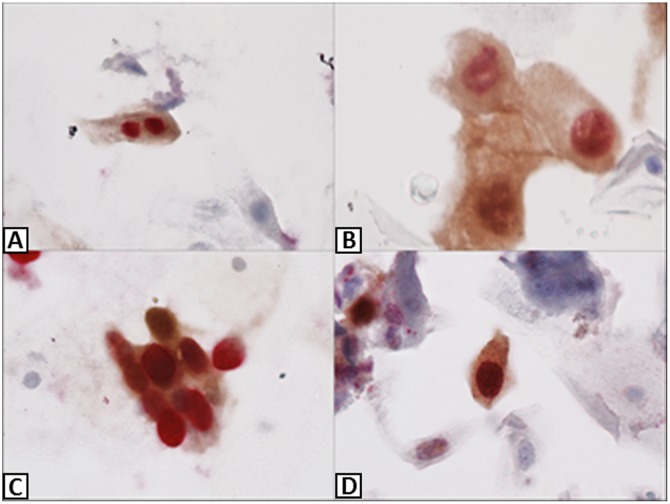
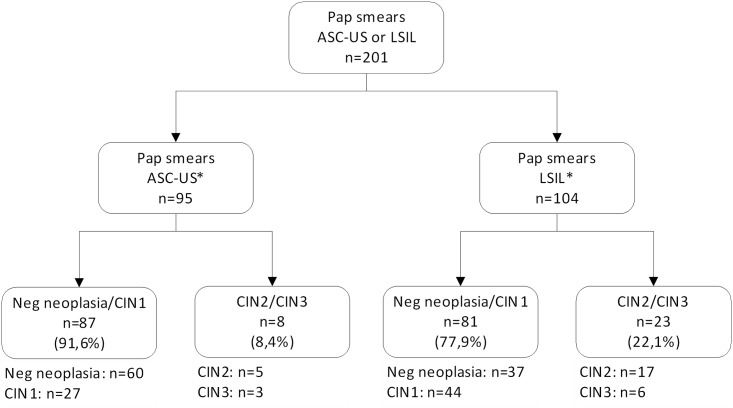
The objective of this study was to compare the accuracies of double staining for p16/Ki-67 and the molecular test for high-risk HPV (hr-HPV) to identify high-grade cervical intraepithelial neoplasia (CIN2/CIN3) in women with cervical cytology of atypical squamous cells of undetermined significance (ASC-US) and low-grade squamous intraepithelial lesion (LSIL). Data were collected from 201 women who underwent cervical cytology screening in the Barretos Cancer Hospital and their results were categorized as ASC-US (n=96) or LSIL (n=105). All patients underwent colposcopy with or without cervical biopsy for diagnosis of CIN2/CIN3. The hr-HPV test (Cobas 4800 test) and immunocytochemistry were performed to detect biomarkers p16/Ki-67 (CINtec PLUS test). Two samples (1 ASC-US/1 LSIL) were excluded from the analysis due to inconclusive results of the histologic examination. There were 8 cases of CIN2/CIN3 among 95 women with ASC-US (8.4%), and 23 cases of CIN2/CIN3 among 104 women with LSIL (22.1%). In the group of women with ASC-US, the sensitivity and specificity in diagnosing CIN2/CIN3 were 87.5% and 79.5% for the HPV test and 62.5% and 93.1% for p16/Ki-67. Among women with LSIL, the sensitivity and specificity in the diagnosis of CIN2/CIN3 were 87% and 34.7% for the HPV test and 69.6% and 75.3% for immunocytochemistry. Superior performance was observed for p16/Ki-67 double staining, especially among women under 30 for whom the test had an area under the ROC curve of 0.762 (p<0.001). Both p16/Ki-67 double staining and the hr-HPV DNA test had similar performance in predicting high-grade cervical intraepithelial neoplasia among women with ASC-US. The best performance was observed in women aged >30 years. In younger women (≤30 years) with LSIL, p16/Ki-67 had greater accuracy in identifying precursor lesions. Among women >30 years diagnosed with LSIL, the two methods showed similar performance.
Conflict of interest statement
Figures
References
-
- Sankaranarayanan R, Black RJ, Parkin DM. Cancer survival in developing countries IARC Scientific Publications N°. 15. Lyon: IARC Press; 1988. - PubMed
-
- Nanda K, McCrory DC, Myers ER, Bastian LA, Hasselblad V, Hickey JD, et al. Accuracy of the Papanicolaou test in screening for and follow-up of cervical cytologic abnormalities: a systematic review. Ann Intern Med. 2000;132(10):810–9. - PubMed
-
- Mitchell MF, Schottenfeld D, Tortolero-Luna G, Cantor SB, Richards-Kortum R. Colposcopy for the diagnosis of squamous intraepithelial lesions: a meta-analysis. Obstet Gynecol. 1998;91(4):626–31. - PubMed
-
- Allen K, Holladay EB. Risk Management for the Cytology Laboratory. Raleigh, NC: American Society for Cytotechnology; 2002.
-
- Sawaya GF, Grimes DA. New technologies in cervical cytology screening: a word of caution. Obstet Gynecol. 1999;94(2):307–10. - PubMed
MeSH terms
Substances
LinkOut - more resources
Full Text Sources
Other Literature Sources
Medical
Miscellaneous
